Fabio Sandri has a peculiar name for finding things that ought to work better: opening the gaps. In July 2023, asked about costs while chicken prices were under pressure, the Pilgrim’s chief executive described a process that starts with each supervisor and each plant imagining a perfect operation. The distance between that ideal and the actual business becomes a list of jobs, with a timetable and somebody responsible. Perfection, in this telling, comes with an action plan.
It is an unusually practical introduction to an executive. Sandri runs a food company whose decisions stretch from American processing lines to Mexican farms and European supermarket shelves. Yet his explanation of management comes down to a question that fits on a workshop wall: where is the gap, and who is going to close it?
That question provides a useful way into his career. Before chicken came electrical engineering, business school, petrochemicals and finance. Before the chief executive’s chair came nine years as the company’s chief financial officer. His public language remains full of customer demand, product mix and the workings of individual facilities. A chicken sandwich, viewed from his end of the counter, has quite a long backstory.
A circuitous route to the chicken business
Sandri earned his electrical engineering degree at the University of São Paulo’s Escola Politécnica in 1993. In 2001, he completed an MBA at Wharton, at the University of Pennsylvania. Those two qualifications sit eight years apart: a technical education followed by a financial and managerial one. His later work would require both an understanding of systems and a willingness to account for their cost.
From 2005 to 2007, he was strategy director at Braskem, the Brazilian petrochemical company. He then became its corporate controller, remaining until October 2008. Finance leadership positions followed at Imbra and, from April 2010, Estácio Participações, the Brazilian education business. These were different enterprises with different customers. Sandri’s responsibilities connected strategy, financial control and the allocation of resources.
He joined Pilgrim’s as CFO in June 2011. The appointment put a Brazilian executive with experience beyond food inside an American poultry company headquartered in Colorado. Bill Lovette, then chief executive, highlighted his experience in strategic planning and financial management. It was a finance appointment, but its stated appeal reached beyond keeping the accounts in order.
São Paulo
Wharton
Pilgrim’s
Pilgrim’s
Nine years of preparation. Three months of transition.
The move into the top job came in June 2020, when the board appointed him interim president and CEO after Jayson Penn went on leave. The company described Sandri’s nine years leading financial management and investor relations as preparation for the assignment. He already knew the business from the inside, including the numbers outsiders used to judge it.
In September, the interim appointment became permanent. Pilgrim’s announced the decision on September 23, and began looking for a new CFO. Sandri’s first statement as the confirmed chief executive emphasized working alongside the company’s team around the world. The promotion changed the scope of his responsibility while leaving him with a familiar organization to run.
Matt Galvanoni joined as CFO in March 2021. Today, Sandri’s leadership colleagues include Bernie Adcock in US Fresh, Sergio Nahuz in prepared foods and marketing, Ivan Siqueira in Europe, and Jesús Muñoz in Mexico. The range of those jobs explains something about his own: he oversees businesses selling different products, to different customers, across different markets. A single good quarter in chicken cannot describe all of them.
The customer comes before the new capacity
Listen to Sandri discuss growth and a recurring character appears: the key customer. In February 2023, an analyst asked why Pilgrim’s was planning capital spending while the industry was reducing production. Sandri’s answer began with sales commitments. Production planning, he said, followed the needs of those customers. He pointed to fourth-quarter retail growth of 6% for Pilgrim’s against 1% for the industry.
The distinction matters. A producer can add capacity because it expects the market to improve. It can also add capacity because a particular buyer is growing and needs more supply. Sandri repeatedly describes the second approach. The commercial relationship helps determine the physical investment, whether that means a different product, more portioning equipment or a change in how a plant operates.
By October 2025, he was making the same argument about chicken growth in the UK and Ireland. Pilgrim’s had existing relationships there, he explained, and differentiated products that helped its customers grow. He called the expansion “not speculative growth.” It is a compact phrase for a policy with expensive consequences: find the demand before commissioning the machinery.
“This is not speculative growth.”
Fabio Sandri, October 2025 earnings call
There is a factory behind the freezer door
The prepared foods business gives that policy a consumer-facing expression. Just Bare, Pilgrim’s and Gold Kist are brands attached to products people can recognize and ask for again. Fully cooked chicken also moves the business into a different part of the meal: the customer is buying preparation and convenience along with the meat.
In July 2025, Pilgrim’s announced a $400 million, multi-phase prepared foods facility in LaFayette, in Georgia’s Walker County. At full capacity, the project was expected to support more than 630 new jobs. Its planned output was fully cooked chicken for retail and foodservice. Hiring was expected to begin in 2027, alongside the projected completion of the first construction phase.
Sandri tied the investment directly to expanding those brands. At the time of the announcement, Pilgrim’s already operated seven food production facilities in Georgia and supported an estimated 7,500 jobs across the state. A new factory therefore entered an existing network of plants, feed mills and hatcheries. The freezer aisle’s apparently simple bag of chicken has an industrial family tree.
Early 2026 brought both encouragement and a bill for changing the business. Just Bare’s first-quarter retail sales rose nearly 40% from a year earlier. Construction in Walker County remained on schedule. Meanwhile, Pilgrim’s completed the conversion of its Russellville, Alabama, plant to case-ready production for a customer’s growth. Planned downtime and the start-up of operational projects contributed to lower profitability. Building the future interrupts the present.
The arithmetic has people in it
In June 2026, another Georgia announcement showed the harder side of rearranging a manufacturing network. Pilgrim’s planned to invest approximately $75 million at Ellijay, expanding harvesting and portioning capacity to produce more boneless chicken for sandwiches, tenders and related products. Sandri described an effort to match changing consumer demand and customer growth.
The same decision involved closing the aging harvesting operation in Chattanooga, Tennessee. Pilgrim’s said it would retain Chattanooga’s deboning infrastructure to support Ellijay. It identified 348 affected team members and offered eligibility for transfers to other company locations. The announcement also said the regional grower base would be unaffected.
These details put useful weight on the phrase “product mix.” A change in what consumers order can eventually change where work happens. For Sandri, efficiency is something that has to be organized across facilities; for employees, a facility decision can become a personal one. Both belong in the account of the strategy. A corporate map is also a map of commutes.
A five-year wager on Mexico
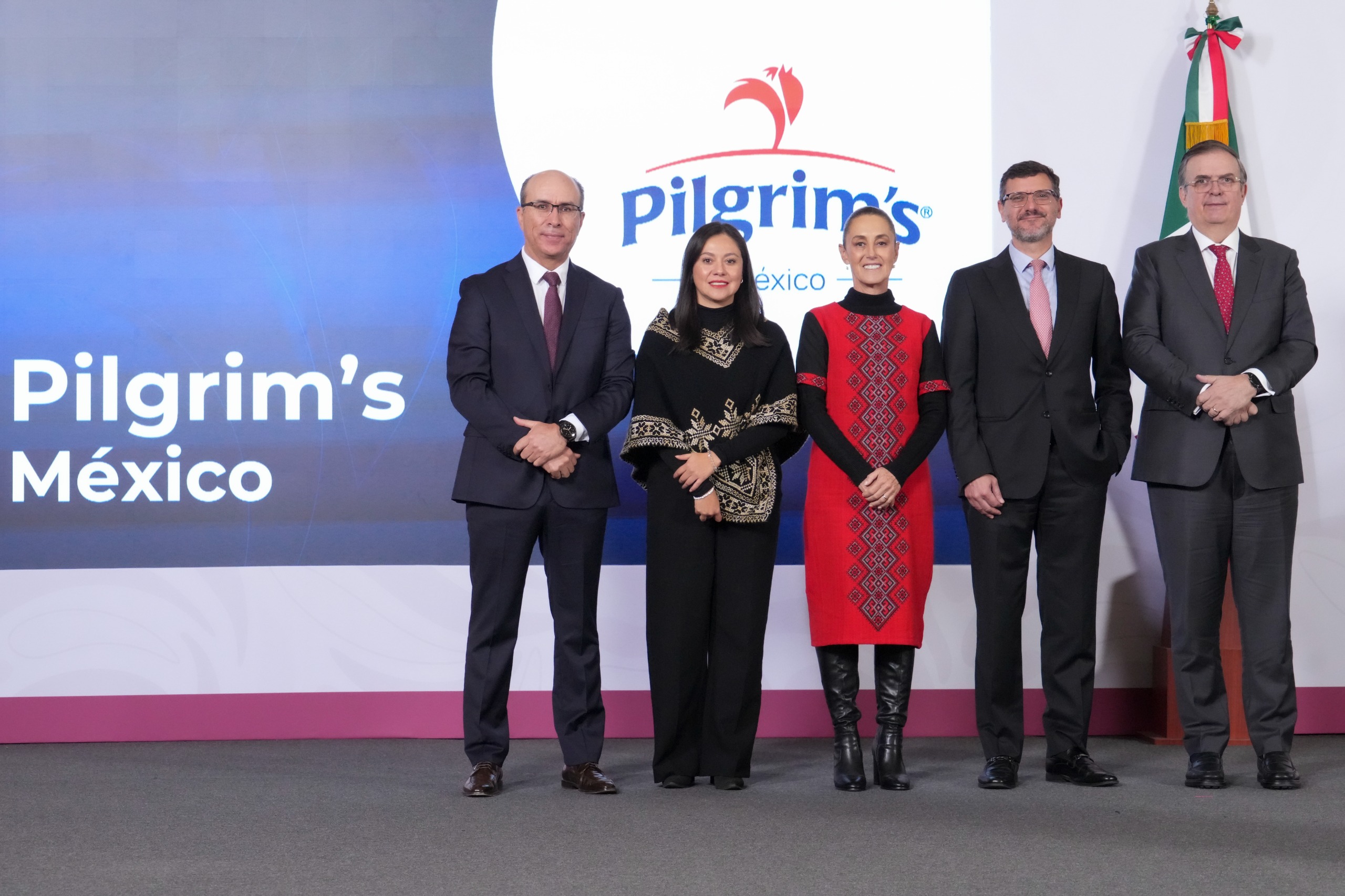
Sandri’s responsibilities also take him into rooms where factory plans become national economic news. On January 15, 2026, he appeared at Mexico’s presidential morning conference as a $1.3 billion investment program for 2026 through 2030 was announced. President Claudia Sheinbaum, Economy Secretary Marcelo Ebrard and Pilgrim’s Mexico president Jesús Muñoz participated in the presentation.
The proposed spending covered expansion, modernization and new facilities. Of the announced total, $950 million was assigned to Veracruz, Campeche and Yucatán; $200 million to the north; and $150 million to the central region. The government described an expected increase of more than 373,000 tonnes in production and more than 4,000 direct jobs. Those were planned outcomes over several years.
In February, Sandri added a qualification that matters to the headline number: the $1.3 billion included investment by growers supporting the expansion. The entire sum would not come from Pilgrim’s. He described ambitions to grow in southern Mexico and the Mérida region, and to expand prepared foods facilities. The program links the company’s production decisions to the spending and work of its agricultural partners.
- South $950m
- North $200m
- Central $150m
The market keeps setting fresh homework
There is no graduation day from volatility. In the second quarter of 2026, Pilgrim’s reported that jumbo commodity cutout values had fallen more than 25% from the previous year. Prepared foods provided some counterweight: Just Bare gained nearly three percentage points of market share in frozen fully cooked chicken over the preceding year. Sandri’s strategy was being tested in the conditions it was designed to withstand.
By October, another question sat beside the operating agenda. Pilgrim’s board had formed an independent special committee to evaluate JBS’s proposal to acquire the shares it did not already own. The board required a favorable committee recommendation before approving the proposed transaction. As of October 21, that was a review process, with no announced completed deal. The next earnings call was scheduled for October 29.
Through these changing circumstances, Sandri’s public account of leadership returns to the organization doing the work. “Culture is paramount to our success,” he said in July 2026. His ambition for a business with more dependable earnings depends on customers ordering, growers investing, supervisors spotting problems and plants delivering. Somewhere inside that enormous system is another gap, an action plan and a name beside it.
Read, watch, follow
- Pilgrim’s / company website
- Fabio Sandri / LinkedIn
- Watch / Message from CEO Fabio Sandri
- Watch / A message from Fabio Sandri
- Walker County / the prepared foods investment
- Ellijay and Chattanooga / the operational changes
- Mexico / the five-year investment announcement
- October 2026 / the JBS proposal review
Profile dated 21 October 2026. Future investments, hiring and production figures are announced plans.