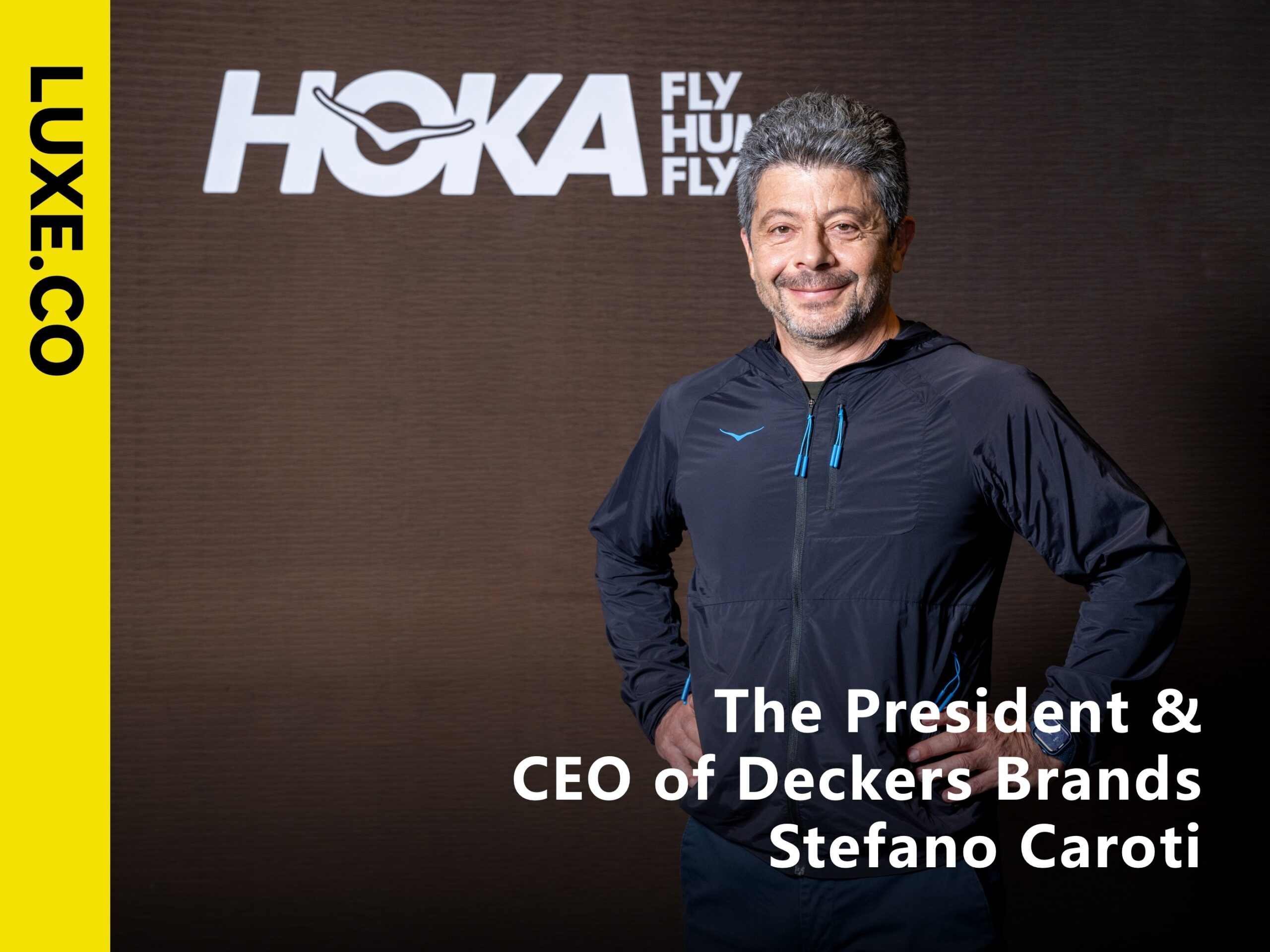
Stefano Caroti was in a running shop in Hamburg when a pair of shoes interrupted the usual business of looking at shoes. They were chunky, colorful and peculiar enough to make an experienced footwear executive curious. He went online to investigate HOKA and its founders. He would later cite the brand as one reason he joined Deckers.
It is a pleasingly unceremonious beginning for a corporate relationship. No boardroom revelation, no grand unveiling. A shoe on a wall did its job: it made someone stop. For Caroti, now President and CEO of Deckers Brands, the encounter supplies a useful opening to a career spent working out what happens between a product being made and a customer deciding to take it home.
The distinction matters because the executive’s name is less familiar than the names on the boxes. HOKA and UGG are the visible characters. Caroti’s work involves the decisions behind their visibility: the markets, channels, products and partnerships through which a brand meets people. A shoe can make a first impression by itself. Repeating that impression across a global business takes rather more organization.
The long way to the corner office
Caroti’s professional education began well before the Hamburg encounter. An Italian graduate of Middlebury College, where he earned a B.A. with honors, he started in the sporting-goods industry in Germany in 1985. Nike became his workplace for 23 years. His responsibilities moved through sales, product, marketing and general management, giving him several views of the same deceptively simple object.
By 2005, he had been general manager of Nike Italy and Nike Germany and was taking responsibility for commerce across Europe, the Middle East and Africa. Those country jobs are worth pausing over. An international brand arrives with a name people may recognize; it still has to sell through local shops, local expectations and local commercial relationships. Recognition does not complete the transaction.
A regional commerce role brings those experiences together. The product team’s choices meet the retailer’s shelf space. A campaign meets an actual order. The business has to connect what it promises with what a customer can find. Caroti’s route to senior leadership passed repeatedly through those connections, rather than through a single specialty kept at a comfortable distance from the rest.
Industry beginnings
Commercial leadership
Omni-channel president
President & CEO
Puma announced his appointment as Chief Commercial Officer in 2007, with the role beginning in August 2008. The assignment covered wholesale and retail, as well as regional operations. He had crossed from one sportswear company to another while remaining close to the machinery of selling. Different corporate badges; a recurring responsibility for making the commercial parts work together.
He stayed until the end of 2014. His departure was voluntary and for family reasons. It is a small, concrete detail in a career otherwise recorded largely through appointments. The next chapter arrived in November 2015, when Deckers hired him as President of Omni-Channel. He reported to Dave Powers, the executive he would eventually succeed.
What the customer should never have to notice
Omni-channel is an ungainly expression for something shoppers tend to regard as basic manners. A brand ought to recognize itself wherever you encounter it. The store, website and service desk should seem to belong to the same business. Customers have little reason to admire the internal complexity that makes this difficult. They would quite reasonably prefer their shoes.
In early 2016, just into his Deckers tenure, Caroti discussed selective distribution, service and the need for a consistent experience. One example was Infinite UGG, which gave shoppers access to merchandise beyond the stock physically held in a store. A smaller space could offer a broader selection. The useful innovation was the practical extension of what the customer could buy.
“Technology is just an enabler for commerce.”Stefano Caroti, 2016
His answers also offered a few glimpses of the person inside the job description. He described his style as collaborative, named the UGG Freamon as his go-to shoe, and said his first website of the morning was The New York Times. His chosen motto was about actions speaking louder than words. The footwear executive had, at least, supplied an answer about footwear.
Read together, those early remarks suggest a preference for tangible usefulness. A technology earns its place by helping someone. A retail relationship needs a reason to last. A shop needs a point of view. These were the subjects he was discussing years before the CEO appointment gave him responsibility for the whole company.
Two names on the boxes
Caroti became Chief Commercial Officer in April 2023. He also served as HOKA’s interim president during the period before becoming CEO. The appointments put company-wide commercial responsibility alongside direct experience of one of its main brands. When Powers retired from the chief executive role, Deckers chose someone who had already worked inside the organization for close to nine years.
The transition took effect on August 1, 2024. Caroti joined the board the following month. It was an internal succession with a long preparation, and it brought a particular challenge into focus: HOKA and UGG share a parent company while asking for different kinds of attention from the people buying them.
A performance-running identity and a fashion-lifestyle identity can coexist in a corporate portfolio. They do not become interchangeable because their results appear in the same earnings release. That is the interesting managerial problem. Some capabilities can be shared across a group; the reasons a customer cares about each brand need careful individual attention.
Caroti’s discussion with Pete Nordstrom on The Nordy Pod in April 2025 put UGG’s longevity and evolution at the center of the conversation. The episode also included Nordstrom footwear merchant Anna Kaplan discussing the retailer’s relationship with Deckers. It was a useful pairing of perspectives: the company building a brand and the retailer helping customers encounter it.
That relationship gives the commercial executive’s work a human scale. A partnership becomes real in the assortment someone sees, the space a retailer gives it and the experience of choosing. The vocabulary can become elaborate. The final scene is often a person trying something on and deciding whether it belongs in their life.
A shoe wall becomes a shopfront
In May 2025, Caroti was in Shanghai for the unveiling of HOKA’s brand experience center in Xintiandi. The setting brought his career’s recurring concerns into one physical place: a distinctive product, a retail environment and an international audience. Hamburg had supplied an encounter with someone else’s display. Shanghai involved a much larger expression of the brand he now helped lead.
The contrast between those two shopfronts is instructive without requiring a neat origin myth. Caroti did not invent HOKA. Its founders, Nicolas Mermoud and Jean-Luc Diard, had created the product that drew his attention. His contribution belongs to the later work of operating and expanding a business around it. Keeping those roles distinct makes the story more interesting.
Growth introduces new interpreters: regional teams, retail partners, designers, marketers and customers themselves. Each needs room to work, while the product must remain recognizable. In that sense, a retail executive spends a career managing translation. The organization has to make sense in more places without asking every place to become identical.
The arithmetic catches up
By fiscal 2026, which ended March 31, Deckers’ annual revenue had reached $5.47 billion, an increase of about 10%. Diluted earnings per share were $7.02. Those are company results produced by many people, rather than a personal scorecard. They do, however, establish the scale of the organization Caroti is responsible for leading.
The following first quarter provided another marker. For the three months ended June 30, 2026, revenue passed $1 billion for the first time in a Deckers first quarter. HOKA contributed $703.5 million and UGG $278.0 million. Wholesale remained the larger channel, while direct-to-consumer sales grew faster. His old channel questions had acquired considerably larger numbers.
Two brands carry most of the revenue.
The numbers also put some resistance into the narrative. HOKA’s quarterly growth was 7.7%; UGG’s was 4.9%. Expansion has to be earned again against an existing business of substantial size. A successful past gives a company resources and expectations at once. The next quarter arrives with very little interest in how satisfying the previous chapter looked.
Recognizable at a distance
In late 2025, Caroti was included in the Glossy 50. His accompanying remarks returned to the tension between a public company’s reporting schedule and the much longer life of a brand. “Building a strong brand takes decades, but it can be destroyed in weeks.” The sentence is blunt enough to survive a room full of presentation slides.
He has identified international expansion and innovation among his priorities. Those ambitions fit the path that brought him here: national markets at Nike, wider commercial responsibilities at Puma, channels and brands at Deckers. The through-line is practical experience with the distance between a company’s intentions and the customer’s encounter with what it makes.
As of October 21, 2026, Deckers’ next earnings call was scheduled for October 22. Another set of numbers was approaching. Behind that calendar sits the slower assignment Caroti has described: keep the brands distinctive while introducing them to more people. Somewhere, the next customer is looking at a shoe wall. It would help if something made them stop.