Adam Kinsey chose a career in the narrow, argumentative space where a scientific idea has to prove it can survive outside the laboratory. It is a place crowded with questions. Can the invention be protected? Can it be manufactured? Can it travel through the equipment that must deliver it? Can a small company finance the next experiment without losing the plot? Kinsey has spent much of his professional life translating among the people who answer those questions, first as a bioengineer, then as an intellectual-property strategist and finally as co-founder and chief executive of Ventrix.
The sequence feels unusually coherent in retrospect. He studied biomedical engineering at Johns Hopkins University, graduating in 2001. He then crossed the country for a joint Ph.D. program in bioengineering at the University of California, Berkeley and the University of California, San Francisco. While there, he added a certificate in Management of Technology from Berkeley's Haas School of Business. Science taught him to interrogate a mechanism. Business school taught him to interrogate a market. The useful trick was learning to hold both conversations at once.
His doctoral work included research on ultrasound applicators and image-guided thermal therapy, published with a UCSF team in 2008. Yet Kinsey did not take the standard route from dissertation to a bench of his own. He moved closer to the legal and commercial architecture around invention. At Wilson Sonsini Goodrich & Rosati, he worked as a patent agent and helped young companies and venture investors think through intellectual-property strategy. He also advised biotechnology startups on business development. It was a good education in consequences. A loosely drafted claim or a casual licensing assumption can become expensive precisely when the science starts to work.
A founder educated by the edges
Biotechnology likes to celebrate the eureka moment. Companies are usually built in the less photogenic minutes afterward. Someone must identify which piece of the discovery is ownable, which experiment reduces the next risk, which partner belongs in the room and which milestone makes a grant application credible. Kinsey's training placed him at those edges. He could read the technical argument, then ask what it meant for a company that had payroll, investors and a finite number of months before the next decision.
The translation loop
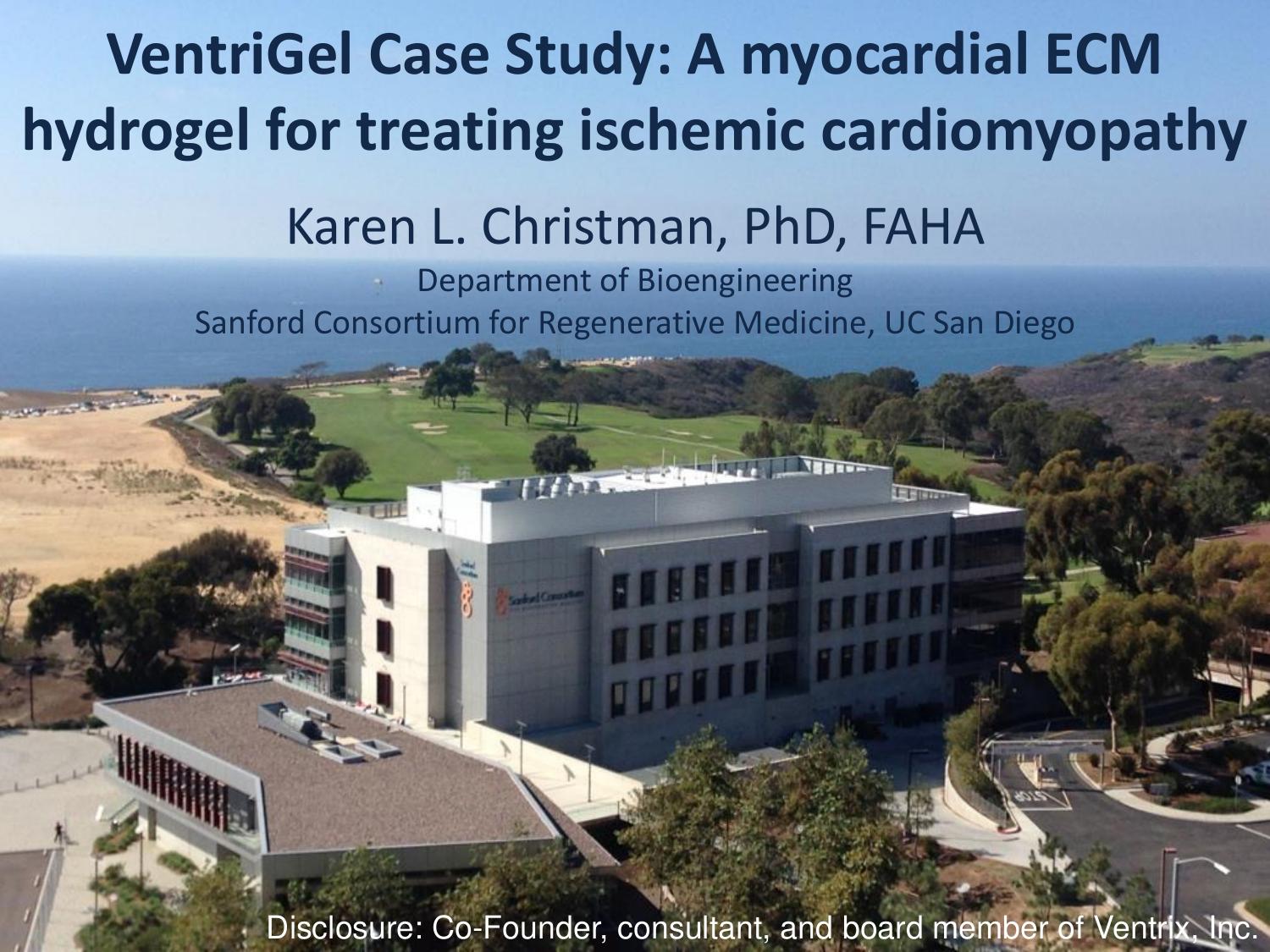
Ventrix gave that hybrid background a demanding application. The company was formed in 2009 around biomaterials developed in Karen Christman's laboratory at UC San Diego. Christman brought the academic research and became scientific co-founder. Kinsey took the chief executive role and the practical obligation to make the surrounding system cohere. The company licensed the underlying technology from the university and established itself in San Diego, close enough to the lab for knowledge to travel without ceremony.
The central concept was a material derived from extracellular matrix, the structural environment around cells. Ventrix worked on formulations designed for catheter delivery. The constraint is worth noticing because it captures the company's entire temperament: an elegant material is useful only if it can reach the intended place through a practical route. Biology and mechanics have to agree. So do manufacturing, intellectual property and study design. Kinsey's job was less a victory lap for one invention than a long campaign against misalignment.
“Always great to be back on campus! Many thanks to the Stanford Biotechnology Group for organizing this panel on starting biotech companies.”Adam Kinsey, on LinkedIn
The pitch was short. The company was not.
In 2011, Kinsey appeared as a Ventrix finalist in the fifth annual San Diego Tech Coast Angels Quick Pitch competition. More than 450 members of the region's entrepreneurial community were expected to attend. The format demanded the founder's familiar magic trick: compress a difficult company into a few lucid minutes. The event offered visibility, but it also revealed a useful irony. A pitch becomes persuasive by removing complexity. Building the company requires putting every piece of complexity back.
That same year, federal small-business research records named Kinsey as both principal investigator and business contact on a Ventrix award. The pairing is almost too neat. One title faced the experiment. The other faced the organization. Kinsey occupied both. Later awards continued the pattern, with projects in 2013, 2016, 2020 and 2023 marking the movement from early feasibility through preclinical programs, a first-in-human study and work on an infusible formulation.
The award trail does not read like founder folklore. It reads like work. Each entry defines an objective, a budget, a start date and a set of questions the next study must answer. Kinsey also appears as an author on the research itself, including a 2012 preclinical paper and the 2019 publication describing the first-in-human VentriGel study. The CEO title did not erase the scientist's name from the author list. Nor did scientific participation relieve him of the financing, staffing and partnership work around it.
A career measured in handoffs that worked
Kinsey's public biography is concise. It names the degrees, the patent work, the consulting and the CEO role. The more revealing biography is the chain of institutional handoffs around Ventrix. A university lab developed a material. A license placed it inside a company. Patent strategy described the defensible territory. Federal programs financed specific reductions of risk. Collaborators brought specialist knowledge. Investigators executed a clinical study. None of those pieces is ornamental. Remove one and the next becomes harder to reach.
This is what deep-tech operating often looks like from the inside: less like a single leap and more like ensuring the landing place exists before anyone jumps. The founder has to preserve the original scientific logic while changing nearly everything around it. A laboratory protocol becomes a manufacturing process. A research tool becomes a controlled product. A promising delivery idea becomes an engineering constraint. A paper's discussion section becomes next year's budget.
Kinsey's early patent work matters here because intellectual property is also a form of translation. The attorney, scientist and investor may use the same noun while meaning three different things. A founder fluent in each dialect can notice the disagreement early. That fluency does not remove uncertainty, but it can make uncertainty legible enough to manage. For a small biotechnology company, legibility is a quiet advantage. It helps the team decide what to test, what to protect and what to postpone.
The wider system is the product
There is a temptation to describe a technical founder as someone who eventually leaves the technical work for management. Kinsey's path suggests a different geometry. The engineering problem simply widened. Instead of optimizing one device or experiment, he had to optimize a network whose components included scientists, clinicians, grants, patents, partners and timelines. People do not behave like materials, of course. They carry calendars, incentives and opinions. The system still needs to function.
His return to a campus panel on starting biotechnology companies feels apt. Universities are where his technical story began, and where Ventrix's central research began. But the lesson he could bring back is found in everything that happens after discovery. The company is an instrument for carrying knowledge across boundaries. Its durability depends on how carefully those boundaries are crossed.
Kinsey has now spent more than a decade at Ventrix. That continuity is notable because biotechnology offers plenty of reasons for a founder to become impatient. Development proceeds by gates. Money arrives with conditions. The next formulation may force a fresh set of studies. Public attention gathers around milestones, then wanders elsewhere while the team returns to execution. Staying is an operating choice, renewed each time the work becomes less cinematic and more specific.
The aspiration visible in Ventrix's recent work is not a dramatic pivot away from its origins. It is a refinement of route and format, using an infusible extracellular-matrix formulation to pursue a more practical delivery approach. That arc suits Kinsey's biography. His career is built around a repeated question: what must change around an invention so the invention can keep its essential promise?
A founder can sell the vision and still be accountable to the footnotes. Kinsey's record contains both: the public pitch and the grant abstract, the CEO title and the author line, the business contact and the principal investigator. It is an unusually tidy description of an untidy job. Ventrix may be built around a biomaterial, but its endurance has depended on the less visible material of company building: disciplined questions, carefully managed handoffs and the willingness to keep the whole arrangement moving.