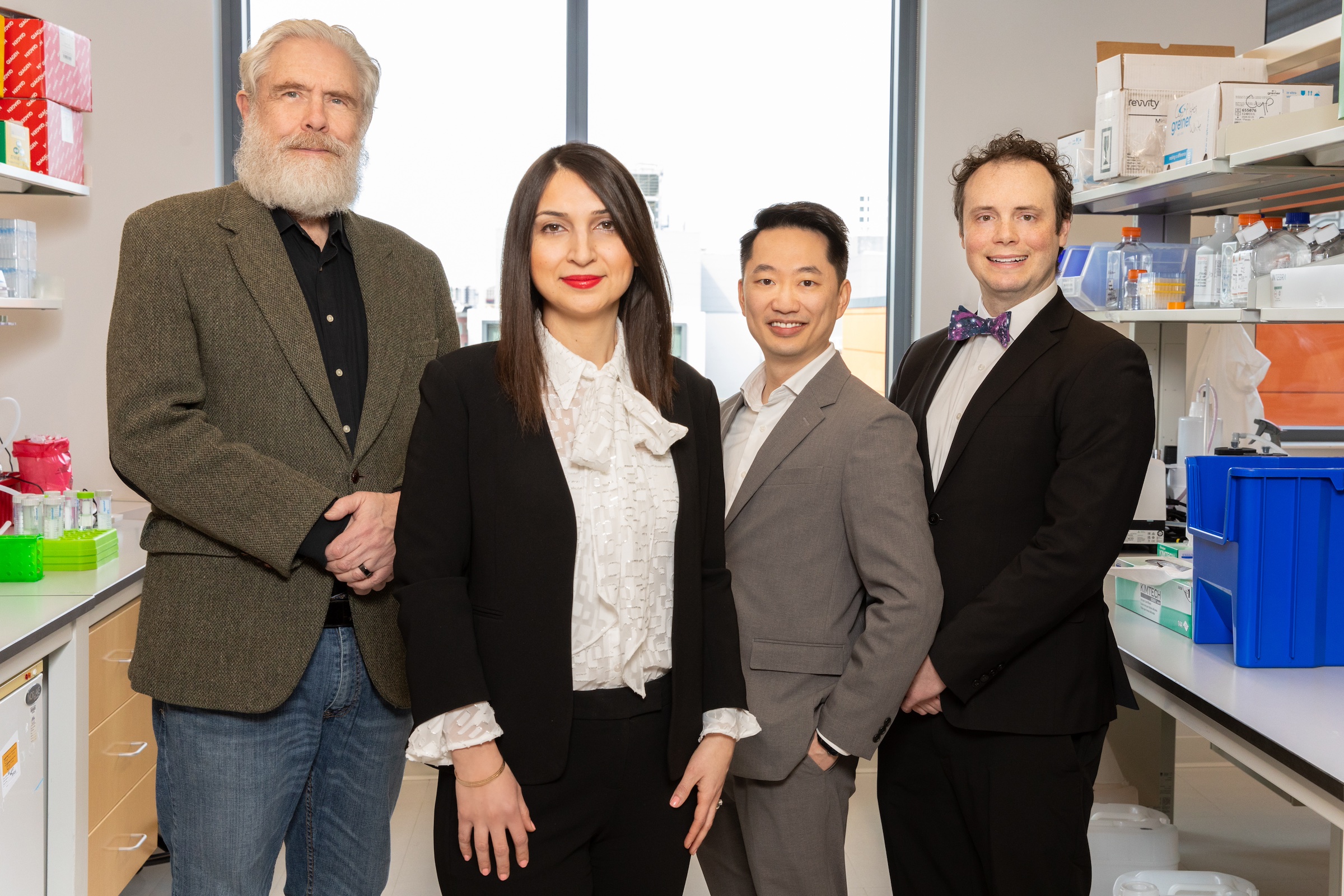
Late one evening in George Church's Harvard lab, Parastoo Khoshakhlagh arrived with a laptop and a sentence no one else could plausibly deliver: “George, look at your myelin!” The cells on the screen had begun as cells derived from Church's skin. In four days, Khoshakhlagh and her collaborators had steered them toward becoming oligodendrocytes, the cellular artisans that wrap neurons in insulating myelin. A conventional route could take weeks or months. Church, quite literally, had skin in the experiment.
The exclamation is funny because the science is so precise. It also captures Khoshakhlagh's working style: patient enough for biology, impatient with its inherited procedures. Her career has crossed materials science, neural engineering, microgravity research, synthetic biology, and company building. The subject changes. The move repeats. Find a messy process, map its components, and turn it into a tool someone can use again.
Today she is the CEO and co-founder of GC Therapeutics, a Cambridge biotechnology company built around a platform called TFome. The name is short for transcription-factor-ome, a library of proteins that help regulate which genes a cell activates and, therefore, what kind of cell it becomes. If conventional differentiation resembles coaxing a temperamental orchestra through a long score, the TFome thesis is closer to choosing the conductor and handing over a clearer arrangement.
“We do not coax cells - we code them.”Parastoo Khoshakhlagh, 2025
The useful impatience
Khoshakhlagh's route to Cambridge began with materials. She earned a bachelor's degree in materials science and engineering from Iran University of Science and Technology in 2006, followed by a master's in biomedical engineering at Amirkabir University of Technology in 2008. Her former Tulane laboratory lists her hometown as Rasht, Iran. By the time she completed a second master's and then a Ph.D. in biomedical engineering at Tulane, she was applying material design to neural models: gels, guidance cues, and three-dimensional environments in which nerve cells could be studied.
That work was already entrepreneurial. Research from Michael Moore's neural microengineering laboratory contributed to a patent application associated with AxoSim, a nerve-on-a-chip startup. Another project, developed with fellow Tulane engineer Elaine Horn-Ranney, became Tympanogen. Their concept used a gel-based patch, and in 2014 Khoshakhlagh made the winning presentation at the Tulane Business Model Competition. The two founders left with the $25,000 grand prize and a company to build.
Here the story refuses to stay earthbound. Khoshakhlagh and Horn-Ranney later worked with NASA and the organization managing research aboard the International Space Station to study how microgravity affected their hydrogel. In December 2018, the experiment launched aboard a SpaceX Dragon cargo ship. NASA followed the pair through training, launch, on-station work, and the return to gravity. Most startup origin stories contain a garage. This one acquired mission control.
An astronaut in orange
Years later, when LabCentral's Johannes Fruehauf asked her to bring an orange object to an interview, Khoshakhlagh chose Julie, a small astronaut in an orange suit. Julie stood for the orbital experiment, but Khoshakhlagh gave the prop a second job. She wanted girls considering science and engineering to feel that ambitious work belonged to them. “When we have bold female leaders,” she said, “even the sky isn't the limit.” It is a neat piece of personal stagecraft: a toy carrying a serious memory without becoming solemn about it.
The orange astronaut also reveals how Khoshakhlagh thinks about institutions. A lab is where an idea can be tested. A startup is where it can become an operating system. NASA is where a material can encounter a strange environment. A public interview is where an object can invite someone else into science. She does not collapse these places into one another. She uses each for what it is good at.
Build the library first
After Tulane, Khoshakhlagh completed postdoctoral work in Ali Khademhosseini's lab at the Harvard-MIT Division of Health Sciences and Technology. She later joined Church's orbit at Harvard Medical School and the Wyss Institute. Church connected her with doctoral researcher Alex Ng, who was wrestling with a cell-differentiation problem. Khoshakhlagh brought experience in neural stem-cell models and startup formation. Together with Cory Smith and Church, the work became the foundation of GC Therapeutics.
Their first strategic choice was gloriously un-small: construct a comprehensive library of human transcription factors, then screen it. The team's 2020 Nature Biotechnology paper described 1,732 transcription-factor isoforms and identified hundreds of unexpected routes toward cell identities. Khoshakhlagh noted that the surprise was not merely the volume of results. Many factors worked without the microenvironmental cues researchers had assumed were essential. A complicated recipe had lost some ingredients.
This is the part founders outside biotechnology can steal. A library is not glamorous in the way a product demo is glamorous. It is patient infrastructure. Yet it changes discovery from a procession of clever hunches into a search process that can learn. Each validated component becomes a starting point for another experiment. The artifact is not just an answer. It is a better way to ask the next question.
GC Therapeutics began modestly. An account of the Church lab's spinouts describes the young company starting with one bench at LabCentral, the shared Cambridge laboratory. The idea could be difficult to sell to investors, while companies quickly grasped what a repeatable cell-programming platform might mean. So the team accumulated proof: accelerator grants in 2017 and 2018, a prize at Massachusetts Life Sciences Innovation Day, recognition in Harvard's President's Innovation Challenge and MIT's $100K competition, a peer-reviewed paper, and working recipes.
From one bench to a platform
The company publicly launched in September 2024 with a $65 million Series A led by Cormorant Asset Management and participation from Mubadala Capital, Andreessen Horowitz Bio + Health, Medical Excellence Capital, Cercano Management, and Pear VC. The round brought its announced total financing to $75 million. Money of that size does not settle a scientific question, and Khoshakhlagh does not talk as if it does. It buys room to turn a laboratory system into an organization: people, manufacturing discipline, quality controls, and a pipeline.
In 2025, the research advanced from testing individual transcription factors to systematically exploring combinations. A Nature Communications paper described an iterative screen that found a six-factor recipe producing microglia-like cells in four days. The work added a computational method for mapping relationships between the factors and gene activity. In plain English, the cookbook was becoming more than a shelf of recipes. It was learning something about why the recipes worked.
Khoshakhlagh's language for the ambition is industrial without being bloodless. She has described contemporary cell therapy as a boutique treatment and wants it to become a first-line medicine. The operating levers are speed, consistency, cost, and scale. GC Therapeutics says its single-step approach is designed to make certain iPSC-derived cell products as much as 100 times faster than conventional methods. Designed is the responsible word. Biology still gets a vote.
“One thing about George that is very significant is that he sees what you can't even see in yourself.”Parastoo Khoshakhlagh on George Church, CBS 60 Minutes
The company as a research instrument
Khoshakhlagh's connection to Church is scientific, entrepreneurial, and quietly personal. On CBS's 60 Minutes, she described his unusual gift for seeing capacity in people before they could see it themselves. She has since hosted conversations with Church about mentorship and failure. The lesson she drew was not the romance of risk. It was the responsibility to attempt hard work when the potential consequence justified the effort.
That responsibility runs through her own sequence of ventures. Tympanogen began with a material that might simplify a procedure. GC Therapeutics began with a library that might simplify cell differentiation. Both companies asked whether a laboratory method could travel farther if placed inside an institution designed to repeat it. Khoshakhlagh seems less interested in entrepreneurship as personal theater than in the company as a piece of equipment - a machine for carrying an idea beyond the people who first discovered it.
Her public roles have widened with the company. She serves on MassBio's board and participates in the network of women leading biotechnology companies in the region. In June 2026, EY named her one of its Entrepreneur Of The Year New England winners. By then, GC Therapeutics had added experienced scientific and board leadership while reporting continued work toward a development candidate and expansion of its programming platform.
The clean line through all of it is not a particular molecule or market. It is the conversion of tacit craft into explicit instruction. Gels become tunable environments. Factors become a library. Experiments become reusable data. A startup becomes the place where the recipe can meet reality at scale. Khoshakhlagh's useful impatience has a disciplined counterpart: before you can skip the waiting, you must understand exactly what the waiting was doing.
Watch / The orange astronaut explains herself
Khoshakhlagh joins LabCentral's Johannes Fruehauf for a conversation about company building, cell programming, accessibility, and the small orange space traveler she brought along.
Watch on YouTube ↗