The Company Keeping Water Out of 15 Million Cars
It started in a Malden kitchen and now guards the circuit boards inside 15 million cars. actnano bet that a gel could do what a hard shell couldn't - and that dropping the fluorine would become the whole point.
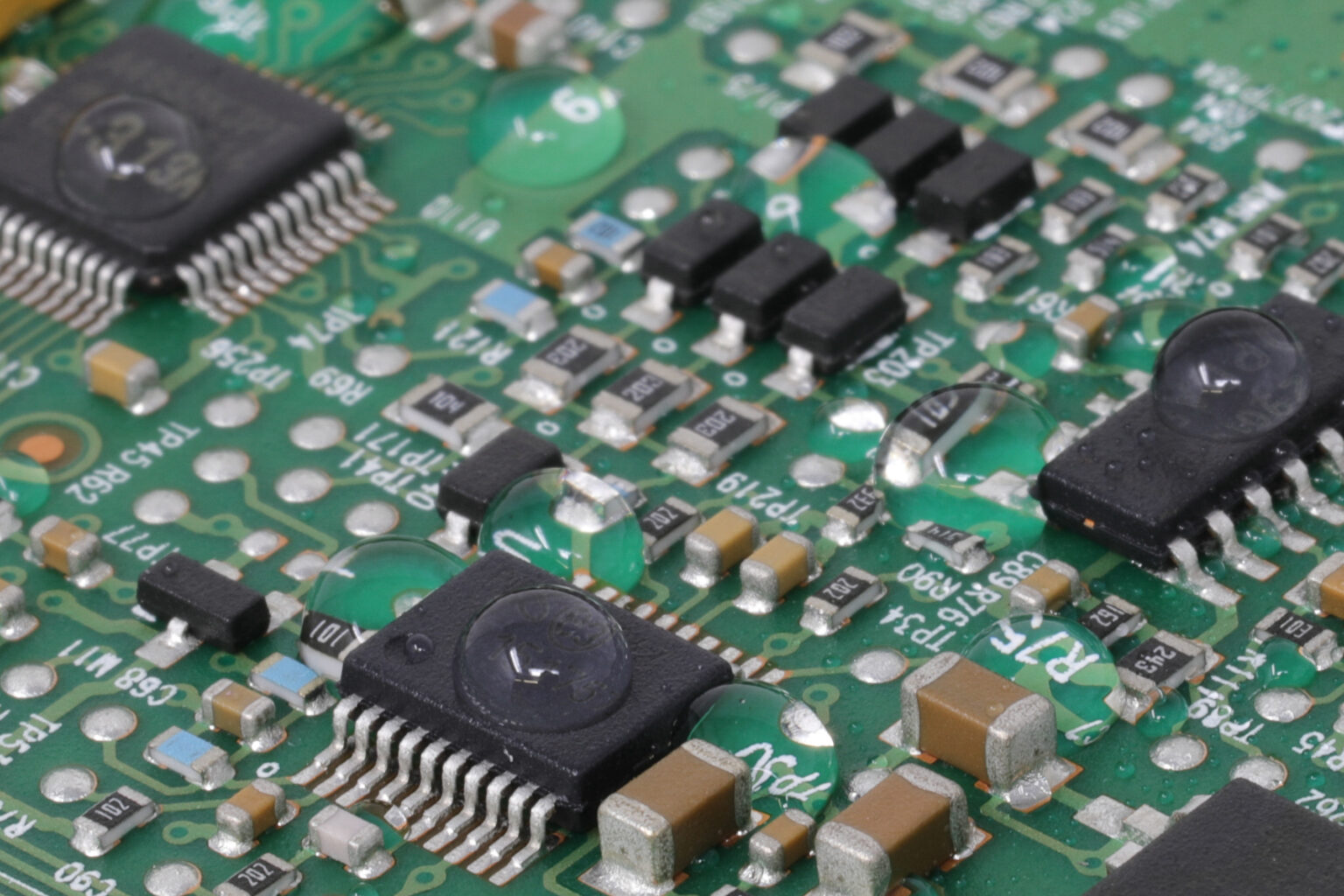
The most valuable thing actnano makes is something you will never see. It is a layer of gel a few nanometers thick, sitting invisibly on the circuit boards inside cars, phones, solar inverters and, lately, the servers doing your AI. Its entire job is to be the reason those boards keep working after they get wet. The company estimates the coating is already on more than 15 million production vehicles, quietly keeping driver-assistance sensors alive through car washes, humidity, road salt and the fog of a cold morning.
The founder, Taymur Ahmad, did not arrive at this from a lab. He spent close to two decades in manufacturing management at companies like Alcoa and Philips, long enough to watch the same failure over and over: electronics die when moisture reaches the board. The standard fix - a hard "conformal coating" painted over the assembly - kept annoying him, because it couldn't cover the parts that mattered most. So, as the origin story goes, he started mixing coatings in his own kitchen. actnano was founded on that stubbornness in 2012.
01 - The ProblemWhy hardware dies
Electronics fail in wet conditions because moisture bridges tiny gaps on a circuit board, corrodes contacts and shorts things out. For decades the industry's defense was conformal coating - acrylic, silicone, urethane or parylene lacquers brushed or sprayed over a board. They work, but they come with a list of compromises. They can't go on connectors (you still need to plug things in), they get masked off antennas (they interfere with the signal), and they are kept away from high-heat components and LEDs. They also typically need an energy-hungry curing oven, and many of the best-performing chemistries rely on fluorinated compounds - the "forever chemicals," or PFAS, that regulators are now moving to ban.
02 - The ProductAdvanced nanoGUARD
actnano's answer is Advanced nanoGUARD, and the trick is in the phrase "gel-state." Instead of drying into a rigid shell, it stays a soft, hydrophobic gel. That single property solves the list of compromises at once. Because it's a gel, a connector pin can push straight through it and still make contact, so you can coat connectors. It doesn't trap heat, so it can go over hot components. It doesn't degrade RF signal integrity, so antennas are fair game. It cures at ambient temperature, so the curing oven disappears from the production line. And it delivers up to IPx8 protection - the highest common waterproofing tier - with full 3D coverage of the whole board.
Traditional conformal coating
- Must mask connectors & antennas
- Kept off high-heat parts & LEDs
- Needs a curing oven
- Can crack over time
- Often fluorine / PFAS-based
Advanced nanoGUARD
- Coats connectors & antennas
- Covers high-heat parts & LEDs
- Cures at room temperature
- Gel-state, no hard shell to crack
- 100% fluorine-free, PFAS-free
03 - The TwistBetting against the chemistry
Here is the part that makes actnano more than a better mousetrap. The company didn't just build a fluorine-free coating and call it a feature. It built the whole business around the coming regulatory wall. In 2023, actnano publicly submitted comments supporting the European Union's proposed ban on PFAS - effectively lobbying to outlaw the class of chemistry many competitors depend on. When your product is the compliant option, regulation stops being a threat and becomes a growth strategy. The company positions Advanced nanoGUARD as the industry's only 100% fluorine-free 3D surface protection technology, and it is REACH and RoHS compliant.
04 - The CustomersCars, phones, and now AI
actnano is a B2B materials supplier. It doesn't sell to you; it sells the coating and the process to OEMs and Tier-1 suppliers who build it into their manufacturing lines. The clearest market is automotive, where Advanced nanoGUARD protects ADAS and vehicle electronics across those 15-million-plus vehicles. But the same failure mode - water hits a board - shows up everywhere, which is why the customer map keeps widening.
The newest and loudest opportunity is AI infrastructure. Data centers are shifting to liquid cooling to keep GPUs from melting, which introduces a new nightmare: coolant leaking onto very expensive silicon. actnano spun up a dedicated presence at actnano.ai to coat server PCBAs so a drip doesn't become a data-center outage. Same gel, brand-new billion-dollar problem.

05 - The MoneyAn investor list that reads like a supply chain
actnano has raised roughly $85M to $111M depending on the source, and the more telling detail is who wrote the checks. This isn't a list of generic growth funds. It's the automotive, components and telecom supply chain betting on its own future: BMW i Ventures and Porsche Ventures on the car side, HELLA, TDK and Henkel on components, Ericsson Ventures on telecom, plus Emerald Technology Ventures and Material Impact. When strategics fund you, they're not buying a quarter - they're buying a roadmap.
Series C was led by Anthelion Capital in April 2024; Ericsson Ventures added $3M in a second close that October. Total raised is reported in the ~$85M-$111M range across sources.
06 - The EdgeWhat competitors can't easily copy
The alternative to actnano is the entire established conformal-coating industry - HZO, Henkel, Dow, HumiSeal, P2i and the parylene specialists - plus manufacturers who try to seal boards mechanically. actnano's defensible ground is the intersection nobody else fully occupies: fluorine-free and gel-state and oven-free and able to cover the connectors, antennas, LEDs and hot chips that everyone else masks off. Each of those is achievable alone; together, protected by qualification cycles that take years inside automotive programs, they're a moat.
The company has also worked to remove the last excuse for not switching: the factory line. In 2025, Nordson Electronics Solutions enabled actnano's coatings to run on its ASYMTEK Select Coat systems, meaning a manufacturer can dispense Advanced nanoGUARD on equipment it may already own rather than buying a new line. Distribution through Ellsworth Adhesives widens the funnel further.
07 - The ScorecardAwards, growth, and a young bench
The signals of traction are stacking up. The Advanced nanoGUARD Titan Series won a 2024 Global Technology Award for Conformal Coating Materials at SMTA International and was recognized in the Mexico Technology Awards the same year. actnano landed on the Financial Times and Statista list of the Americas' Fastest-Growing Companies in both 2024 - ranked #1 in Electrical Manufacturing - and again in 2026. Two of its leaders, VP of Operations Justin Whitney and VP of Technology Dr. Cassandra Zentner, were named to SMTA's "40 Under 40," a hint that the technical bench is both young and decorated. The company employs around 100 people from its base in Malden, Massachusetts.
08 - The TakeawayWhat you can copy
There's a reusable lesson in here that has nothing to do with chemistry. actnano found a failure mode that appears in every hardware category - moisture on a board - and refused to accept the standard fix's compromises. Then it aligned the product with where regulation was heading instead of fighting it, so that time was on its side. If you're building anything physical: pick the unglamorous failure everyone tolerates, solve it without the usual trade-offs, and make the rulebook your tailwind rather than your enemy.
Where would it not work? A coating this specialized only matters where boards actually meet water, heat or salt, and where reliability is worth paying for - which is why actnano lives in automotive, industrial, medical and data-center hardware rather than throwaway gadgets. And it still has to win long qualification cycles device by device. But those same slow cycles are exactly what make each design win hard for a rival to take back.