A solar panel can spend its whole working life facing the sun and still turn some of the light away. The culprit is ordinary glass. Before a photon reaches the electricity-making material beneath it, the surface can send it back into the sky. Pellucere Technologies has built a business around persuading that surface to behave differently. The proposed upgrade is almost invisible. The commercial problem is anything but.
- MoreSun adds an anti-reflective, anti-soiling coating to suitable existing solar modules.
- Pellucere supplies the application system and installation, alongside the chemistry.
- The same surface expertise now serves greenhouses, mirrors, automotive sensors and architectural glass.
A better welcome for a photon
MoreSun forms a thin silica layer on module glass. Its nanoparticles assemble into a structure that gives incoming light a more gradual optical transition between air and glass. Less reflection means more light available to the cell. Its Talus Dirt Rejection Technology also reduces dust adhesion. These are two separate gains: one concerns photons bouncing away; the other concerns dirt getting in their path.
That distinction matters because a desert and a German solar farm are different customers. Dust reduction can be valuable in an arid location. Optical gains can matter even where soiling is modest. In its September 2024 brochure, Pellucere claims annual anti-reflective energy gains of 3.5–4.5% for suitable modules without factory anti-reflective coatings. The starting surface is part of the proposition, rather than an inconvenient footnote.
Silica structure changes the optical transition at the glass surface.
Surface structure reduces the adhesion that helps dust accumulate.
The invention had to leave the factory
The attractive customer is someone who already owns a great many panels. Replacing them to improve their glass would be an extravagant solution to a surface problem. MoreSun’s low-temperature curing makes field application possible. Pellucere sells coatings to solar manufacturers too, but retrofit lets it approach an installed asset with a different question: how much of its lost light can be recovered?
The research began at Oregon State University. Chemical engineer Chih-hung Chang founded predecessor CSD Nano, and Seung-Yeol Han helped develop MoreSun. Energy Innovation Capital supplied growth capital associated with Pellucere’s formation in 2018; a February 2019 announcement backed commercial deployment. Fortistar joined EIC as an investor in 2021. The university laboratory supplied the idea. Commercialization required equipment, capital and customers willing to measure the result.

Pellucere says it designs the chemistry, applicators, quality-control measuring devices and control software used in its retrofit system. It also provides turnkey installation. A drum of liquid alone leaves a buyer responsible for uniformity and execution. A delivered coating project gives those responsibilities a supplier. For a materials business, that is a consequential choice about what the product includes.

Eighteen months before “yes”
Juwi’s operations and maintenance business compared anti-reflective coatings for about 18 months before selecting MoreSun. Its German distribution and application agreement was announced in February 2020. The reported decision rested on optical performance, durability and resistance to soiling. That is a more useful account of persuasion than an enthusiastic demonstration: a maintenance provider had to judge what would survive on its customers’ assets.
Other relationships followed a similar commercial logic. Alectris and Pellucere won ENI’s 2020 Innovation Match retrofit category together. Iberdrola selected MoreSun in the coatings category of its solar-cleaning challenge. In April 2021, Pellucere became an American-Made Solar Prize Round 4 finalist, receiving $100,000 in cash and $75,000 in support vouchers. It was a finalist, rather than one of that round’s two eventual grand-prize winners.
“It’s a lot of the same technology, but we weren’t competitors.”Corey Thompson, on WattGlass joining Pellucere, 2022
Where the surface meets the spreadsheet
Pellucere’s 2024 brochure reports 2 GW of MoreSun retrofit installations in eight countries. It advertises fixed-price turnkey delivery, a 36–48 month payback and a warranty promising qualifying customers recovery of installation cost through additional earnings, or a refund of the difference. Those are company statements with eligibility conditions. They give the buyer an economic framework, rather than a universal price tag.
Across eight countries, according to Pellucere’s September 2024 brochure.
A useful evaluation begins with the actual modules, their existing coatings, their measured output and local soiling. Extra generation must become valuable energy revenue. Cleaning practices matter too: Pellucere ties its durability claim to testing in the southwestern United States and adherence to its cleaning procedures. A seasonal dust benefit should not be mistaken for the same percentage increase across every month of the year.
The mirror belongs in this story
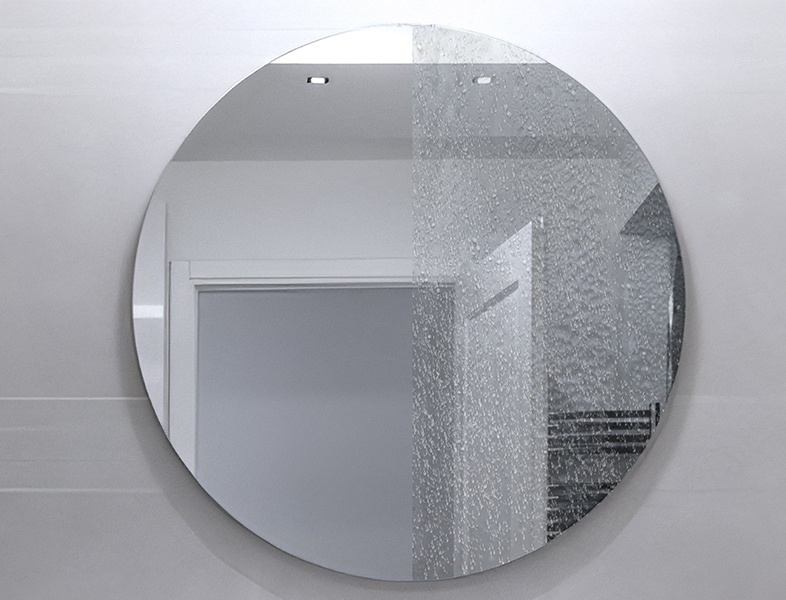
The wider portfolio makes more sense once glass is treated as an engineered surface. AquaARC targets light transmission through greenhouse glass and lighting covers, using water-based wet deposition. ClearAF addresses fog on mirrors, sensor covers and refrigerated displays. Repelle is hydrophobic and PFAS-free, encouraging water to leave the surface. Geminas combines solar-activated photocatalysis with a water-spreading, super-hydrophilic layer for architectural glass.
The company assembled some of that breadth. WattGlass brought University of Arkansas research into the business; Germany’s ETC products joined through a December 2023 acquisition. Its specialty range extends to glass-printing primers, industrial non-stick layers and LiDARC, a screen-printable coating for transmitting laser light at 900 nanometres and above. The customers are manufacturers and fabricators as well as solar owners.
Pellucere therefore sits between advanced-materials research and the people who must make glass perform every day. Washing and cleaning robots remain alternatives for managing dirt; factory-coated replacement modules offer another route to better optics. Its particular case is that an existing surface can be improved economically, in place. The lesson other businesses can borrow is practical: build the method of application alongside the material. A photon needs only a clear path. A customer needs evidence that the path is worth paying for.