A magnet is a remarkably small place to hide an industrial dependency. It can sit inside a truck's motor, a factory pump, a robot, or a hard drive, quietly doing its job until the buyer has to find another one. Then a sliver of engineered metal becomes a procurement problem. Noveon Magnetics has made that problem its business. In San Marcos, Texas, it produces sintered neodymium-iron-boron magnets - the strong permanent magnets many electric machines need - and it can make them using magnetic material recovered from old equipment.
- Noveon sells finished magnets and assemblies, not a consumer recycling service.
- Its EcoFlux process can use up to 100% recycled magnetic feedstock, though it also accepts virgin material.
- Named buyers and supply partners include General Motors, ABB, and Nidec Motor.
- A $215 million financing round announced in January 2026 is meant to expand manufacturing capacity.
The idea sounds almost too tidy: recover magnets from retired machines and give the material another working life. The untidy part is that the next buyer expects a precise magnetic grade, resistance to heat, tight dimensions, reliable coating, and deliveries on schedule. Nobody excuses a failed motor because its magnet had an admirable biography.
The first business was scrap
Noveon began as Urban Mining Company. Co-founder and chief executive Scott Dunn had been around the scrap business since childhood; he later worked with co-founder Peter Afiuny on recovering valuable metal from old solar thermal equipment. A professor and a mentor steered the pair toward battery materials and rare earths. They eventually joined forces with Miha Zakotnik and Catalina Oana Tudor to develop and scale a way to make new magnets from old magnetic material.
That shift changed the question. Selling scrap asks what a discarded product contains. Manufacturing a magnet asks whether the recovered material can pass a customer's specification. The team spent years on patents, a Texas pilot operation, and a commercial plant. Its EcoFlux magnet arrived in 2022; the San Marcos factory began selling magnets commercially in 2023. The old name described the source. The new business had to prove the output.
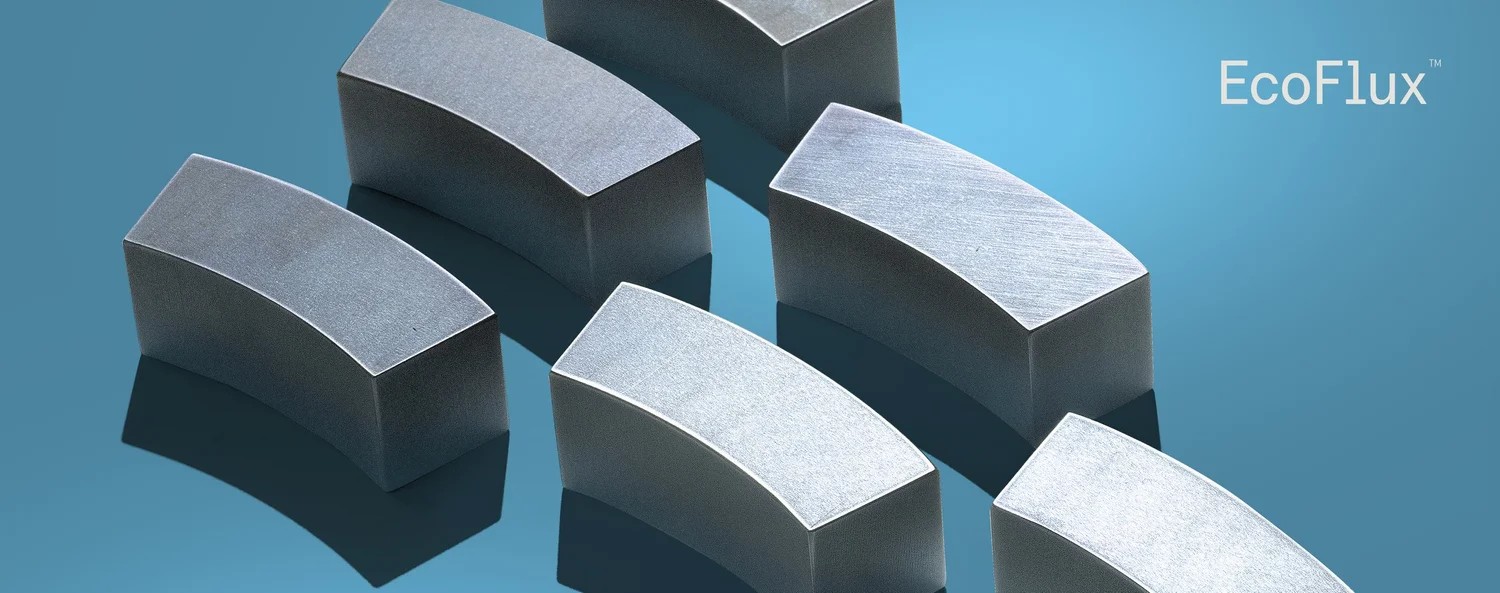
A second life with a strict entrance exam
The process starts with equipment such as motors, hard drives, medical devices, and energy systems. Noveon describes collecting end-of-life material, extracting magnets, sorting components, then returning the magnetic material to production. Its Magnet-to-Magnet process supplies recycled feedstock; its grain-boundary engineering helps tune the properties of the finished EcoFlux magnet. Alloys, milling, pressing, heat treatment, coating, magnetization, and inspection happen within its San Marcos operation.
The loop describes Noveon's manufacturing route. Recycled content varies with the feedstock and the magnet specification.
The company says EcoFlux can be made from entirely recycled end-of-life feedstock. That is a capability, not a claim that every magnet leaving the factory contains only recovered material. Virgin inputs remain part of its supply options, and a November 2025 agreement with Solvay will provide rare-earth oxides beginning in 2026. Flexibility is the useful detail: a manufacturer wants material it can source and tune, rather than a single virtuous recipe that works only when the bins are full.
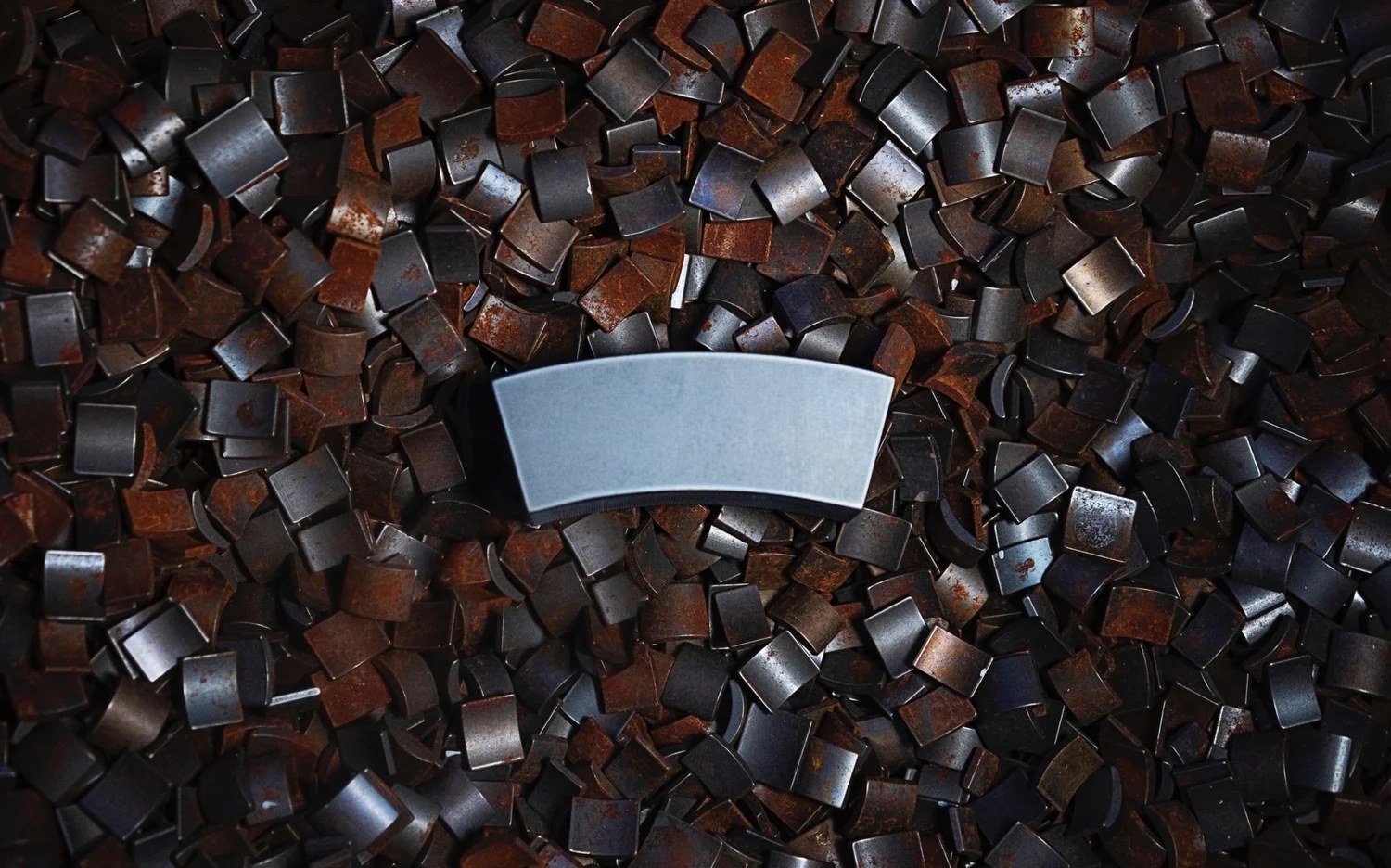
“Permanent magnets are to motors what lithium is to batteries.”Kirk Anderson, Nidec Motor
Noveon also makes custom assemblies and works with customers on application engineering, testing, and evaluation. That matters because a motor maker rarely buys a magnet as an abstract commodity. It needs a part shaped and magnetized for a particular system, with performance that survives the intended temperature and duty cycle. The company says its process can reduce heavy rare-earth use by at least 20% against conventional approaches, but buyers will ultimately judge each grade against their own test data.
The customers are the proof
For years, the company had a difficult sales pitch: an American-made rare-earth magnet from a process that could use scrap. In 2025, it attached that pitch to substantial purchasing agreements. Nidec Motor signed a five-year binding off-take agreement with potential for more than 1,000 tons of finished magnets, with deliveries scheduled to begin that year. ABB signed a long-term, multi-million-dollar agreement for magnets in industrial motors. General Motors said deliveries began in July 2025 for components used in full-size trucks and SUVs.
Those deals tell us more than a broad claim about the market. Nidec makes motors. ABB uses the magnets in industrial motor applications. GM uses them across vehicle components. Eriez, an industrial equipment maker, was among the early customers that tested Noveon's products. These buyers care about supply risk, yes, but also about whether a magnet can be qualified and supplied repeatedly. In this business, a purchase order is a sterner review than a sustainability award.
There is a second kind of customer relationship. In January 2025, Noveon, LG Electronics, and Kangwon Energy announced a program to take end-of-life magnets from LG products and make new magnets for LG applications. Noveon's LinkedIn account later reported receiving an initial scrap magnet delivery for analysis. It is a promising loop, though the public announcement and first material receipt do not establish commercial scale. That distinction is worth keeping: a recycling diagram is complete long before a recycling supply chain is.
The cost of making the claim real
The visible price of the project is substantial. The company announced a $75 million Series B in 2023, led by NGP and Aventurine Partners. In January 2026 it closed a $215 million Series C led by a $200 million investment from One Investment Management. It also received federal support during its development. The latest money is intended to expand annual capacity beyond 2,000 tons; that is a target for production capability, not a report that 2,000 tons have shipped.
What failed first was the simple version of the story. Recovering a valuable element did not, by itself, create a business with automakers and motor manufacturers. The company had to move from scrap recovery to repeatable magnet making, then spend years qualifying a product and building a plant. Even after the machinery was running, each customer's grade could require months of testing. The first operational bottleneck was credibility at industrial scale.
Noveon occupies a curious place in the market. MP Materials, USA Rare Earth, Quadrant Magnetics, and eVAC are among the companies developing or operating pieces of a North American magnet supply chain. Imported magnets remain the established alternative. Noveon's particular offer is a U.S. sintered-magnet operation that can bring recovered magnetic material directly into new product. Its competitors may have different advantages in mining, refining, scale, or customer ties. No single factory eliminates every upstream dependency, which is why Noveon's Solvay and Lynas relationships matter alongside the recycling pitch.
What another manufacturer can steal
The transferable lesson is less romantic than “turn trash into treasure.” Start with the buyer's hardest specification. Design collection and sorting around that specification. Build testing into the process. Let the recycled-content claim follow the part that actually passes. Noveon did not ask a motor maker to admire a pile of discarded scooters; it offered a magnet that could fit into a motor.
That approach has limits. A closed loop needs a steady stream of suitable old magnets and a customer willing to qualify the result. Some grades may still need virgin or specially sourced rare-earth material. Expanding a plant also demands capital, equipment, skilled workers, and time. The magnet's small size can disguise all of this. Noveon's bet is that enough buyers will pay for a dependable domestic part, with recycled feedstock as an option rather than an excuse.