Jake Guglin entered metallurgy through a sentence he could understand. In an MIT classroom, a doctoral student from professor Chris Schuh's lab rehearsed a thesis defense about a new way to create alloys. Guglin, then an MBA student with a philosophy background, has been admirably plain about the encounter: “I didn't understand any of it.” Then came the useful part. He heard “stronger metals.” The phrase was small enough to carry and large enough to rearrange a career.
By then, Guglin had already taken a winding route toward hard technology. He graduated magna cum laude from Colgate University in 2012 with a degree in economics and philosophy, worked in natural-gas derivatives and physical commodities, and moved into startups and venture work. One early biography called him a “reformed commodities trader-turned-startup enthusiast,” which is both a career summary and a minor act of self-forgiveness.
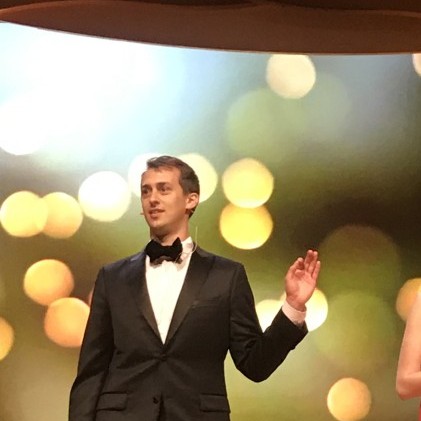
At MIT Sloan, from 2017 to 2019, he managed the MIT $100K Entrepreneurship Competition, assisted with the Nuts and Bolts of New Ventures course, worked with the Media Lab's Space Exploration Initiative, and won grants for entrepreneurial work. He had come to MIT looking for fundamental technologies capable of creating what he called “asymmetric value” - breakthroughs that might not happen anywhere else. Schuh's research was exactly that kind of thing, even if its first introduction arrived in a dialect Guglin did not yet speak.
“I heard ‘stronger metals’ and I saw the potential of this incredible platform.”Jake Guglin
The education of an operator
Guglin contacted Schuh, and the relationship continued while Guglin went to work in strategy, finance, operations, procurement, and manufacturing scale-up at SpaceX and Blue Origin. Rockets have a theatrical habit of leaving Earth on columns of fire. Their supply chains are less photogenic. A delayed metal part does not trend on social media, but it can hold up the machine that does.
The aerospace jobs turned “stronger metals” into a practical question. Materials determine whether an engine can run hotter, whether a tool wears out after too few cycles, whether a component survives both heat and force, and whether a factory can get the parts it needs at the rate it needs them. Guglin saw metal-parts constraints from the customer's side. The lab insight had acquired an invoice, a lead time, and a place on a production schedule.
In February 2022, Guglin, Schuh, Jasper Lienhard, and Tim Rupert founded Foundation Alloy. The technical lineage mattered. Schuh and his collaborators had spent years studying how processing shapes the microscopic structure and properties of metals. Lienhard completed doctoral work in Schuh's lab. Rupert, a professor at UC Irvine, developed complementary solid-state technologies. Foundation Alloy licensed intellectual property from MIT and UC Irvine, while Guglin took charge of strategy, operations, financing, and commercialization.
The division of labor is revealing. Guglin did not become a metallurgist by proclamation. He became the translator between a body of science and an industrial customer. Translation here means more than explaining the process on a podcast. It means turning a discovery into repeatable manufacturing, a specification into a shipped part, and a pilot into a reorder.
Delete the melting step
Conventional alloying begins with heat. Different metals are melted, mixed, solidified, and often subjected to more processing before they become useful stock or finished parts. It is a recipe with a magnificent record. Bronze gave its name to an age. The trouble is that melting also imposes rules. Some elements resist mixing because their melting points are too far apart. Solidification can leave microstructures that introduce tradeoffs among strength, ductility, and heat resistance. The process is energy intensive and can require long chains of secondary work.
Choose powdered elements for the target performance.
Mechanically combine particles without melting.
Press, mold, or 3D-print the engineered powder.
Use a furnace to densify the final metal part.
Foundation Alloy's MetalsFIRST process changes the middle of that recipe. A specialized mill repeatedly smashes metal-powder particles together until the mixture becomes homogeneous down to the atomic level. Guglin calls the machine an “industrial KitchenAid blender,” an image that makes a difficult process instantly visible while making every baker nervous. The powder can then be pressed, injection molded, or 3D printed before sintering in a furnace.
The distinction is precise: the alloying happens without melting. The shaped part is still heated during sintering, but Foundation Alloy says its materials densify at lower temperatures and in less time than conventional alternatives. The company also says the process produces ultra-fine grains, allows unusual compositions, uses roughly an order of magnitude less heat, and can reduce downstream processing. Its early commercial family includes molybdenum alloys for demanding uses such as tooling, rocket nozzles, heat shields, furnace components, semiconductors, and energy systems.
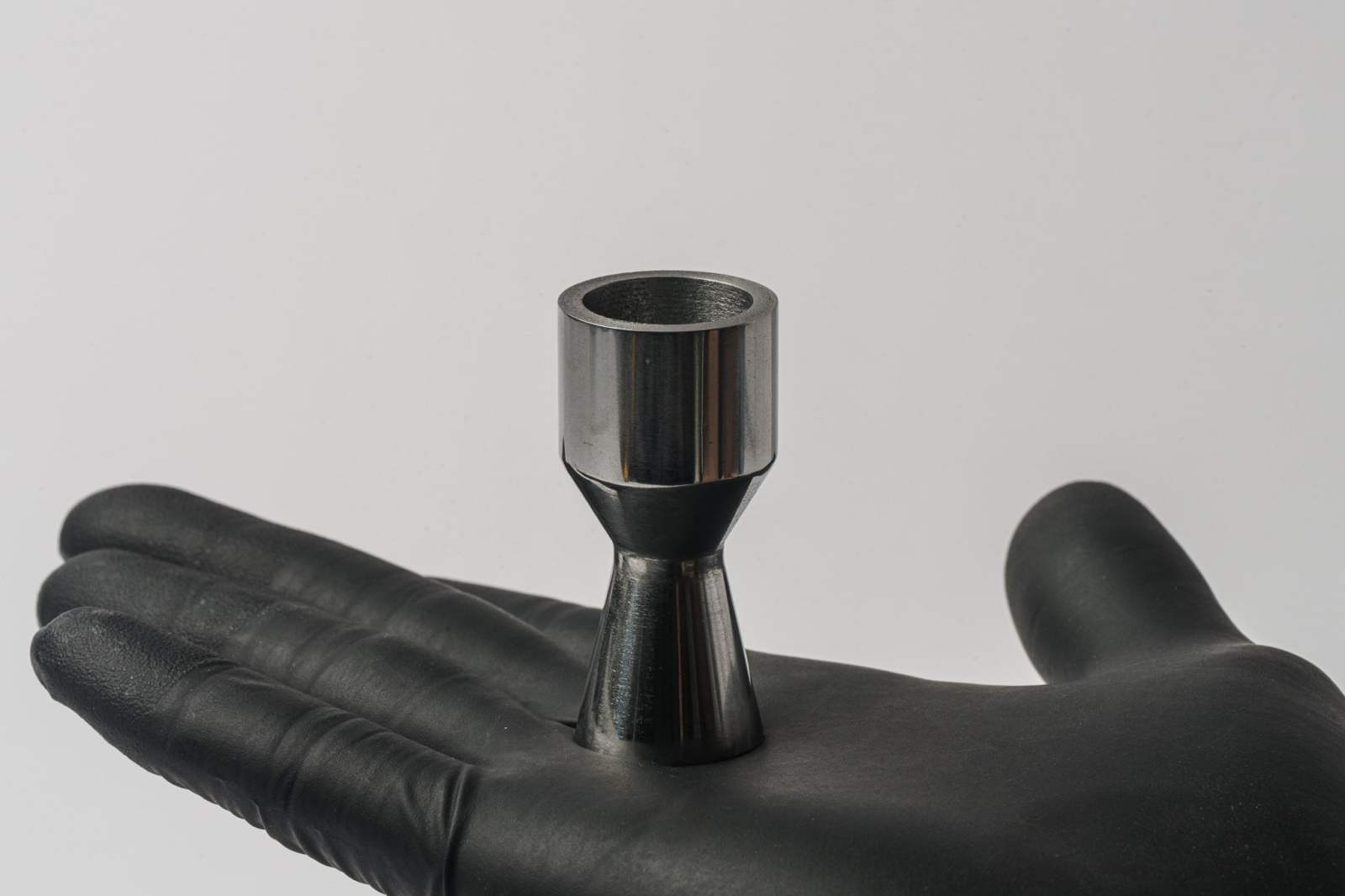
“The quality of the output of a dish is not just based on the ingredients, it's how you cook it. We have a new way to cook.”Jake Guglin
The laboratory is only the prologue
Advanced materials companies possess a particular temptation: fall in love with the chart where the new line rises above the old line. Guglin's public language keeps returning to the part after the chart. “Metals make an impact once they're actually out in the field and once they're at scale,” he said in 2026. That conviction has shaped Foundation Alloy's architecture. It develops compositions and builds manufacturing capacity rather than handing off the difficult passage between the two.
The founding challenge was repetition. A lab can do something once with five grams. A supplier must do it again and again, at kilograms per batch, while controlling contamination, consistency, density, and cost. Guglin described the leap as going from a five-gram experiment to doing it 100 times a week at 100 kilograms per batch. The arithmetic is dramatic. The real work lives in the unromantic nouns: process control, qualification, yield, throughput.
Foundation Alloy says a crucial advantage is that development and production travel along the same solid-state path. Traditional alloy development can demand new furnaces, tooling, and capital for every scale change. Here, a composition tested in grams can move toward kilograms without replacing the underlying method. In 2026 the company showed a 7.2-kilogram customer billet beside a small development pellet and described the jump as 1,000-fold. Same process, larger consequence.
Parts in people's hands
Guglin's preferred test of product-market fit is pleasantly physical: “parts in people's hands that they use and want to buy more of.” By mid-2026, Foundation Alloy said its materials were with customers across North America, Europe, and Japan. The applications included automotive tooling, aerospace, defense, semiconductors, watches, and chef's knives. The assortment sounds like a particularly ambitious hardware store. Its coherence comes from the problem underneath: a customer wants a metal to perform better, arrive faster, or exist in a composition old methods cannot make.
The defense example is especially sharp. A supply chain arranged to make roughly 100 exacting fighter-jet parts a year does not naturally accommodate a demand for 10,000 drone parts a month. Better materials alone do not solve that mismatch. A production system must be flexible enough to respond. Foundation Alloy's pitch therefore joins performance to resilience: develop alloys faster, manufacture domestically, and use a common platform across different compositions and shapes.
The 2026 Series A, led by Voyager Ventures, is meant to fund that thesis in concrete. The company announced a 36,000-square-foot Massachusetts facility, a second factory in New Hampshire, and a modular production cell with Re:Build Manufacturing. It also announced a partnership with Kanematsu to distribute its alloys in Japan and Southeast Asia. The plan called for a 100-fold increase in capacity toward tonnes per week, expansion from refractory alloys and specialty steels into stainless steels and nickel superalloys, and a doubling of headcount.
Those plans turn Guglin's career back upon itself. The commodities trader once watched markets move standardized material. The startup operator watched founders try to create demand. The aerospace employee watched programs wait on specialized components. The MIT student watched science promise a stronger substance. At Foundation Alloy, each perspective sits at the same table.
A useful kind of outsider
Guglin's story is sometimes framed as the non-scientist who spotted the science. That is true, but incomplete. Recognition was only the opening move. His more durable contribution is an insistence that technical possibility must survive contact with factories, procurement teams, customer qualification, and volume. A material with astonishing properties is a scientific result. A material made reliably, shaped into parts, delivered on time, and ordered again is an industrial result.
His philosophy training gives the story a charming first scene, yet its practical residue may be more important. Philosophy asks what a thing is, which assumptions are necessary, and whether an inherited rule is a law or merely a habit. Metallurgy's inherited habit is melting. Foundation Alloy is not arguing that civilization made a 7,000-year mistake. It is arguing that one successful method need not be the only method.
That leaves Guglin with an unromantic and consequential assignment in deep tech: make the alternative ordinary. Make the exotic alloy arrive as stock. Make the laboratory batch become a line item. Make the rocket-nozzle material, the die-casting mold, or the knife blank good enough that the customer asks for another. The future of metals, in this telling, does not announce itself with a gong. It ships in a box.