Company Profile · Advanced Materials
The Company That Makes Metal Without Melting It
A Cambridge startup spun out of MIT skips the furnace entirely - smashing metal powders together instead of melting them - and says the result is a molybdenum alloy three times stronger than what the market sells today.
For roughly a century, making a new metal alloy has meant the same thing: heat everything past its melting point, pour the molten mix, and hope the microstructure cooperates as it cools. Foundation Alloy, a company based in Cambridge, Massachusetts, decided the melting step was never really the point. It is the part where hidden voids form, where metals with different melting points refuse to blend, and where engineers are forced to trade heat resistance against strength. So the company skips it.
Instead of a furnace, Foundation Alloy uses a specialized mill that repeatedly impacts metal powders together until they fuse into a new alloy - all in the solid state, without the material ever going liquid. The company calls the approach MetalsFIRST, and it is the foundation of a business that raised a $22 million Series A in June 2026 and now wants to turn a laboratory technique into a factory that ships tons of advanced metal every week.
What it actually doesA furnace-free way to build an alloy
The MetalsFIRST platform is a single integrated pipeline. It starts with alloy composition design, moves to mechanical alloying - the milling step that blends powdered raw materials to atomic-level uniformity - then shape forming through pressing, injection molding or 3D printing, and finishes with low-temperature sintering. Because the metal is never melted, the company says development that traditionally takes years can happen in months, and parts that took weeks can be produced in days.
MetalsFIRST · powder to part
That last figure is the one that turns a science story into a business. By avoiding the molten state, the company says its process uses around an order of magnitude less energy than conventional melt-based metallurgy. Less energy is less cost, and, because parts come out close to final shape and reach their properties as-sintered, there is far less machining and scrap on the back end.
It also opens the door to combinations the furnace never allowed. When you melt an alloy, metals with very different melting points fight each other, and as the pool cools it can trap microscopic voids that quietly weaken the finished part. Blending powders in the solid state sidesteps both problems: the company says it can create more homogeneous crystalline structures without those voids, and mix metals that would be impractical to combine in a melt. That is the practical meaning of "properties other people can't" - not marketing, but the specific compositions and microstructures a molten process cannot reach.
We're actually smashing metal powder particles together instead of melting them. We can create properties that other people can't.Jake Guglin, CEO and Co-Founder
The flagshipMolyclast MC1200, a molybdenum flex
The clearest proof point is the product line Foundation Alloy calls Molyclast. Its headline grade, MC1200, is a molybdenum alloy the company describes as the strongest commercially available - with a yield strength of 950 to 1,250 MPa, up to three times the market leader, roughly 98% density, and about 97% of its strength retained at 1,000°C. Refractory metals such as molybdenum usually force an ugly compromise: they are strong or ductile, tough hot or tough cold, rarely both. MC1200 is meant to stay ductile at room temperature while holding strength as it heats.
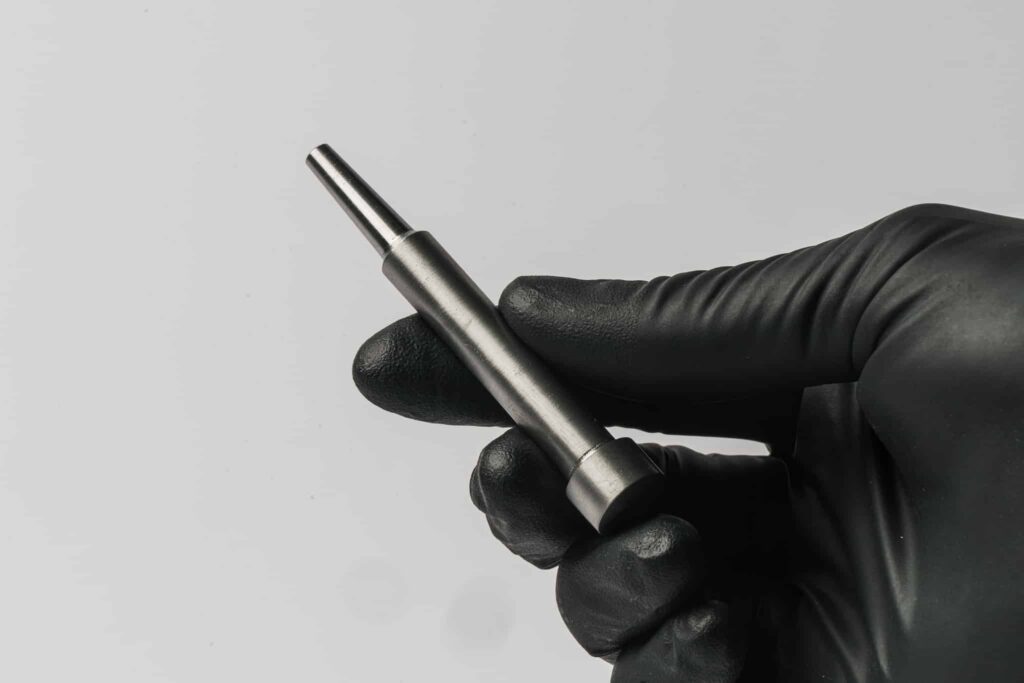
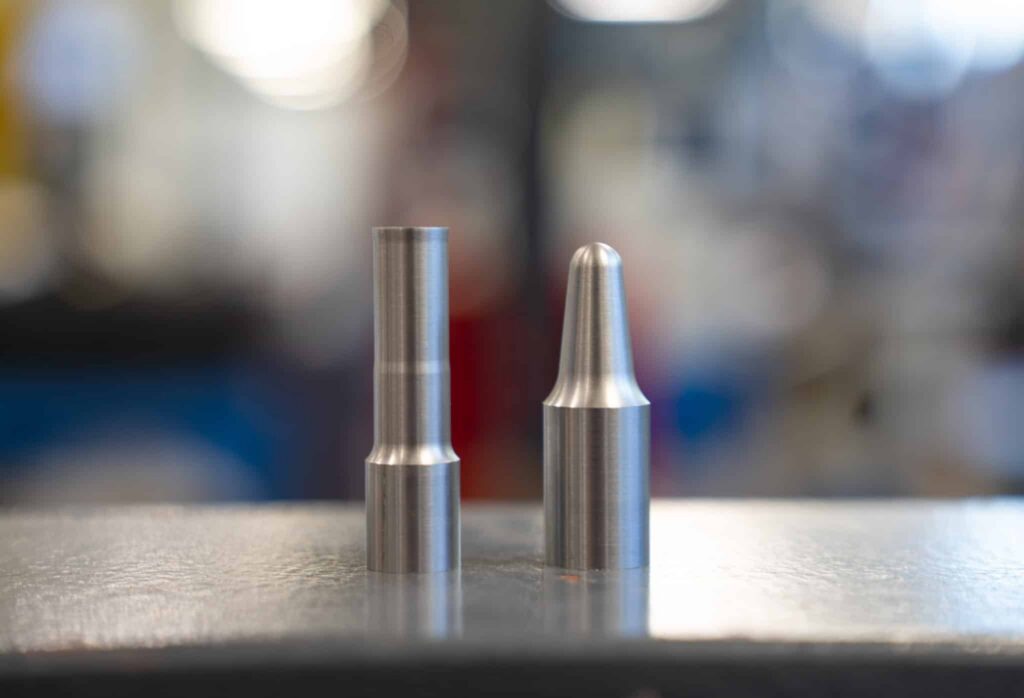
Because MC1200 reaches full strength straight out of the sinter, components can be produced as near-net shapes with what the company says is uniform performance in every direction - a first it claims for the molybdenum market - eliminating more than 60% of the processing time and scrap typical of refractory parts. Two more grades round out the family: MC700, an isotropic molybdenum tuned for high elongation, and MC-X, still in development, which aims to marry refractory heat tolerance with tool-steel strength. Specialty steels are on the roadmap too.
Who is behind itA Sloan classroom, then SpaceX and Blue Origin
CEO and co-founder Jake Guglin found the technology the unglamorous way. As a graduate student at MIT's Sloan School around 2017, he sat in on a PhD student defending research from the lab of professor Chris Schuh and recognized a platform hiding inside the science. Guglin then spent time at SpaceX and Blue Origin, where he ran into the supply-chain pain of getting advanced metal parts made. He reconnected with Schuh, and in 2022 the team launched Foundation Alloy, licensing roughly two decades of research out of MIT's Department of Materials Science and Engineering and UC Irvine's Nanoscale Mechanics and Materials Laboratory.
The co-founding bench is deep on materials: Schuh previously co-founded Desktop Metal and Xtalic; Tim Rupert carried the long arc of foundational research; Jasper Lienhard rounds out the technical team. Today the company runs lean - around 19 people - and has raised roughly $40 million in total, starting with a $10.5 million seed in 2022.
Foundation Alloy, at a glance
- Founded2022, Cambridge, Massachusetts
- Spun out ofMIT & UC Irvine research
- PlatformMetalsFIRST solid-state metallurgy
- FlagshipMolyclast MC1200 molybdenum alloy
- Total raised~$40M ($10.5M seed + $22M Series A)
- Team~19 employees
The money and the planThis round funds the factory, not the lab
The June 2026 Series A was led by Voyager Ventures, with Trust Ventures, Yamaha Motor Ventures, America's Frontier Fund, Overlap Holdings, Material Impact, Engine Ventures, El Cap and Japan's Kanematsu Corporation joining. The stated use of funds is deliberately unromantic: build capacity. Foundation Alloy is opening a 36,000-square-foot facility in Massachusetts and standing up an additional modular production cell with Re:Build Manufacturing in southern New Hampshire, aiming to grow from pilot batches to tons per week by 2027 - a more than 100-fold increase.
This Series A funds the factory, not the lab - a 100x increase, built on modular equipment.Jake Guglin, CEO and Co-Founder
The word "modular" is the tell. Rather than pouring one enormous plant, the company plans to scale by duplicating a production cell - a reproducible unit of capacity. It is a strategy any hardware operator can recognize: de-risk growth by copying a known-good building block instead of betting everything on a single site.
The marketMade in America, sold into hard industries
Foundation Alloy sells business-to-business into industries where metal performance and supply-chain reliability both matter: aerospace and defense, semiconductor manufacturing, medical imaging, energy, and industrial tooling. As of mid-2026 it reported commercial pilots with Japanese industrials, production trials across North America and Europe, and forging demonstrations with LIFT in Detroit. The Kanematsu deal hands it distribution across Japan and Southeast Asia, and Kanematsu also invested - a distributor with skin in the game.
The competitive field is made up of established refractory and molybdenum producers that rely on traditional powder metallurgy and melt-based processing, alongside metal 3D-printing and specialty-alloy firms. Foundation Alloy's differentiation is the thing it removed: it never melts the metal, and it delivers finished mechanical properties as-sintered. The domestic angle matters too - for defense and semiconductor buyers, a US-based alloy supply chain is itself a feature.
For a design engineer, the appeal is concrete. Faster development means a new alloy composition can be dialed in over months instead of a multiyear program, so a team chasing a specific strength or temperature target is not held hostage to a supplier's melt schedule. Near-net-shape parts that skip most machining shorten the path from drawing to installed component. And uniform, predictable properties in every direction remove one of the quiet headaches of refractory design, where a part can behave differently depending on how it was formed. The pitch, boiled down: harder metal, made faster, closer to home, with less waste.
Foundation Alloy delivers a leap forward with metals engineered at the atomic level, all made in America.Sarah Sclarsic, Voyager Ventures
The honest caveatsWhere the pitch has to prove itself
The strength figures are impressive, but they come from the company, and the hard part of any materials business is not the lab result - it is doing it consistently, at volume, at a price customers accept. The whole thesis hinges on the 100x scale-up landing on schedule. Solid-state and powder routes carry their own constraints on part size and geometry, and refractory metals are unforgiving. What Foundation Alloy is really selling is a bet that removing the melt step is not a clever trick but a durable manufacturing advantage. The next two years, on the factory floor rather than the bench, are where that gets settled.
The reach of the underlying idea is wide, if the execution holds. Metals from a furnace-free platform could plausibly show up in military drones, semiconductor tooling, medical imaging hardware - and, the company has noted, in more everyday objects like luxury watches and chef's knives. The common thread is simple: a stronger, more predictable metal, made with less energy, closer to home.