Somewhere on a New York sidewalk, an idea arrives at precisely the wrong moment. Your phone is in your pocket. Your hands are occupied. By the time you unlock the screen, the thought has acquired competition: a message, a notification, perhaps the irresistible business of everybody else’s life. Sandbar is building a company around that small interruption. Its proposed remedy sits on your index finger.
- Stream captures spoken thoughts with a press-to-talk ring and companion software.
- The human starts and stops the exchange. The microphone waits for a press.
- The business is hardware plus optional software. Its real test is whether that gesture earns a daily habit.
The company’s founders, Mina Fahmi and Kirak Hong, met at CTRL-labs, the neural-interface startup Meta acquired in 2019. They subsequently founded Sandbar in 2023. Their expertise concerns the awkward border between wanting to do something and persuading a machine to do it. Fahmi’s explanation to Observer was unusually plain: “I wanted it to be an extension of my own thinking.”

The camera earbuds that stayed in the workshop
The path included Fuji, experimental camera earbuds. In Sandbar’s account, early image transfer was too slow. A Bluetooth-controller bug depressed throughput; a vendor patch helped. Keeping the camera awake drained the battery and threatened brownouts. Switching it off between captures reduced power consumption, although rapid exposure adjustment remained unresolved.
By February 2025, the team had demonstrated a system combining camerabuds, a voice ring, and conversational AI. Further testing persuaded it to avoid launching several products together. Fuji was paused. Stream Ring became the public product. The lesson for another builder is wonderfully unromantic: put the prototype on a person, find the bottleneck, and reduce the number of things that must work on launch day.
A button with manners
Stream’s interaction is press, speak, release. A glass touchpad starts the microphone; silent haptics acknowledge the exchange. The ring can also control music. The charm is that the interaction has a boundary you can feel. There is no wake word to pronounce before the useful sentence can begin.
That choice places Sandbar in a particular corner of the wearable market. A health ring observes the body. A meeting recorder collects a conversation. Stream invites a person to contribute a thought deliberately. The distinction matters in a cafe: lifting a hand to your mouth conveys a different intention from wearing a device that appears to collect the room.

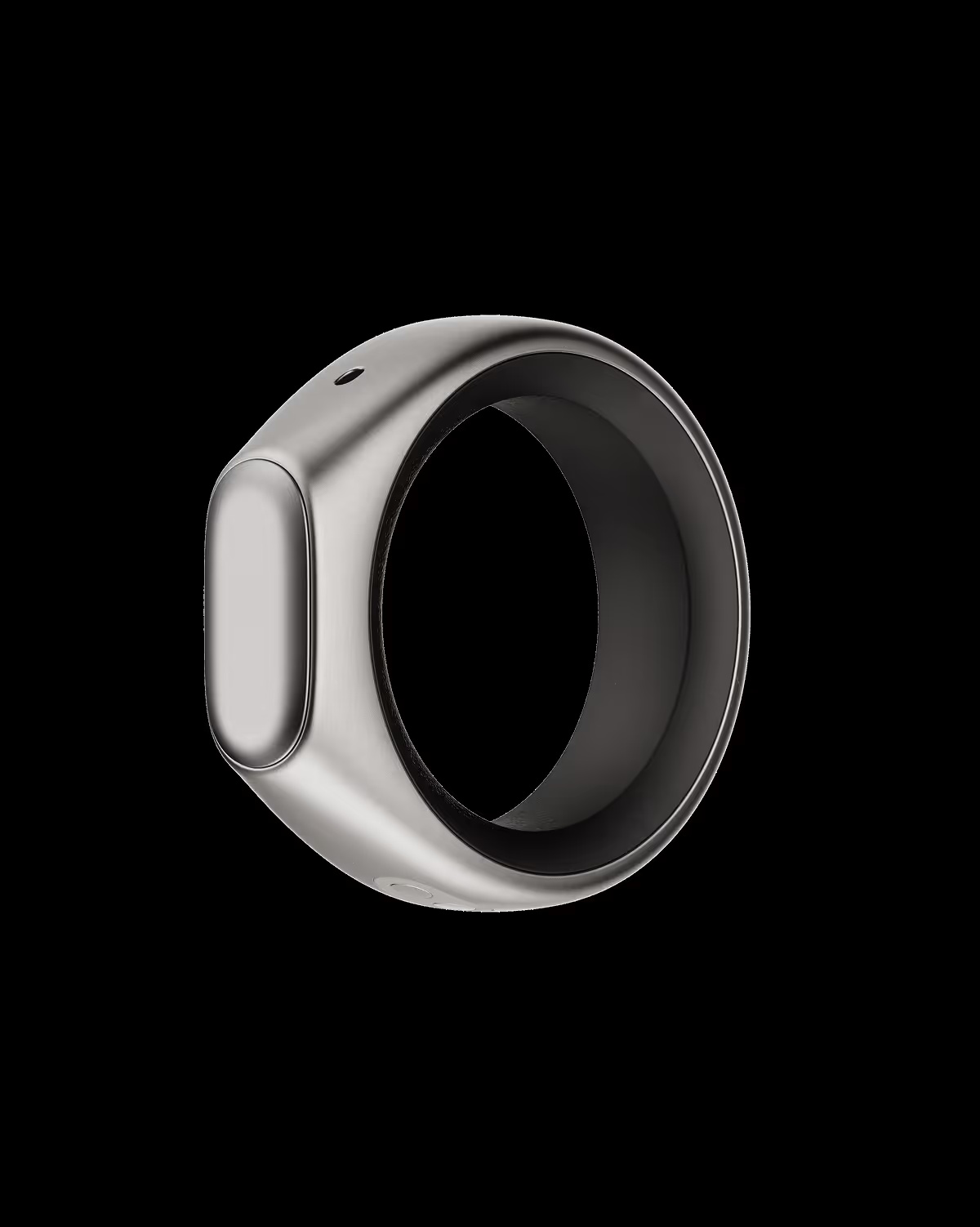
It also leaves a formidable alternative: the phone already in your pocket. Plaud, Omi, and Pebble inhabit the neighboring voice-capture market. Sandbar must make its particular gesture convenient enough to justify another object to charge, wear, and remember.
Your own voice, slightly rearranged
The software gives this hardware its stranger quality. Stream’s Inner Voice is personalized partly from the user’s voice. An answer can feel like an echo of the person who asked. In early demonstrations, the effect was familiar enough to be disconcerting. Sandbar’s wager is that familiarity lowers the threshold for thinking aloud.
“We aim to augment individuals”Sandbar’s published beliefs
The company’s philosophy favors user agency and an interface without an independent companion identity. That is a design commitment, rather than evidence that every response will be wise. A familiar voice still needs scrutiny. The useful question is whether it helps you develop your own idea, especially when a terse answer would be better than another minute of conversation.
Imagine a writer rehearsing an opening paragraph while walking home. The useful exchange would preserve the sentence, allow a revision, and leave the walk intact. An answer that keeps talking would spoil the point. For this kind of product, restraint belongs in the interface: the person needs an easy way to finish, interrupt, or simply save something without turning every observation into a discussion.
The thought has somewhere to go
Capture alone risks producing a handsome junk drawer. Sandbar’s MCP connection addresses the next step: authenticated AI clients can search notes, retrieve recent interactions, and send context back. A conversation begun on a walk can supply material for work at a desk. This is an integration through an open protocol; it does not require a bespoke partnership with each AI application.
Hong’s technical account describes a larger change in his thinking: from connecting a voice to a chatbot toward designing a conversational interface. Delay can accumulate across firmware, Bluetooth, phone software, servers, and models. A seamless gesture depends on a thoroughly unseamless stack. Other builders can copy the measurement principle: time the whole journey from intention to useful response.
Selling a habit, one demonstration at a time
Sandbar chose an unusually physical introduction. According to Inc., invitation-only demonstrations in New York and San Francisco banned video. The team then kept demonstrating the product to people ranging from filmmakers to baristas and groups of mothers. It sacrificed immediately shareable footage to let attendees experience the interaction themselves. That approach makes sense when the thing being sold is a feeling of reduced friction.
Its audience has widened beyond the obvious gadget buyer. September reporting described busy parents and interest among people with ADHD or dyslexia. These are potential users, not proof of a medical benefit. Stream also won Fast Company’s On the Rise design award. Recognition buys attention; usefulness must still survive Tuesday morning.
A reader can borrow that principle without buying the ring. Put a capture shortcut within reach, give each note enough context to be intelligible tomorrow, and decide when you will revisit it. The expensive part of an idea is often the attention already spent producing it. A collection system earns its place when it lets that attention travel into the next piece of work.
The price of staying in the flow
The store, checked October 4, 2026, displays a $249 preorder entry price. Basic notes and music controls are free; preorder members receive three months of Data Plan, then pay $10 monthly if they continue. Batch five is listed for mid-December shipping. Earlier summer launch targets therefore make poor shopping advice today.
$3m pre-seed + $10m seed + $23m Series A
The funding announcement names Adjacent and Kindred Ventures as Series A leads. Capital supports the engineering; it cannot settle the behavioral question. For someone who already captures thoughts effortlessly, the ring may add little. The current iOS requirement and internet-dependent features further narrow its fit.
Privacy also extends beyond the microphone switch. Sandbar’s policy describes service providers processing information and promises encryption in transit and at rest. Deliberate capture is useful, but it still creates data. Sandbar’s opportunity rests on an ordinary bargain: fewer interruptions, enough useful recollection, and control that remains legible to the person wearing the ring.