A startup incubator has an awkward naming problem. The furniture is easy to photograph. The useful part is usually someone sitting in it. At Acorn Campus, that someone might have built disk controllers, taken a semiconductor company public, or spent years learning which manufacturing decisions become expensive mistakes. The proposition was straightforward: put that experience within reach of people starting again from zero.
- Venture capital, mentoring, and a place to build.
- A technical focus stretching from communications to life sciences.
- Connections between Silicon Valley and Asian industry.
Acorn Campus emerged in 2000, a year when the word “incubator” could do considerable work in a business plan. Its more interesting feature was the people behind it. Co-founders included Wu-Fu Chen, David Tsang, Sandy Chau, and Chester Wang. They brought histories of starting, financing, and advising companies. Acorn gave those histories a new job.
The person at the next desk
Consider Tsang. Before Acorn, there was Xebec, then Data Technology Corporation, then Oak Technology, which went public in 1995. Disk controllers are an unusually concrete education in entrepreneurship. A product must work inside somebody else’s machine. Customers have requirements. Manufacturing has consequences. An elegant idea still has to arrive in a form another business will buy.
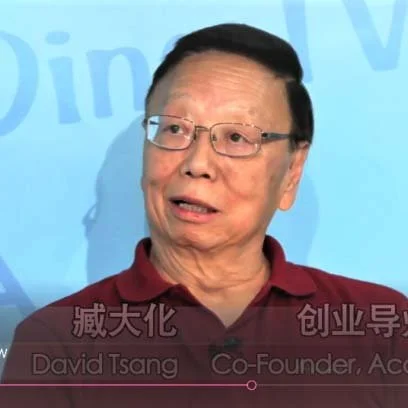
Tsang’s advice carried the same practical emphasis. “Entrepreneurship cannot be a solo business. It must be teamwork,” he said. Acorn and Ding Ding TV also co-produced an entrepreneurs forum in 2013. Teaching was part of the work, with product development and shared goals among the subjects.
Chen supplied another strand of operating experience. His company-building history included Cascade Communications and businesses later acquired by Cisco and Nortel. These were careers formed around communications infrastructure: complicated products, specialist buyers, and teams whose technical decisions could determine the company’s prospects. That background helps explain Acorn’s interest in businesses with substantial engineering underneath them.
A campus with an ocean in the middle
The historical Acorn offering combined venture funding and mentorship with office space and shared research facilities in Cupertino and Shanghai. Its interests included wireless, semiconductors, photonics, the internet, and life sciences. Selection emphasized capable teams, intellectual property with commercial value, and technologies that competitors would find difficult to reproduce.
The physical arrangement mattered. A young company needs more than a location for its laptops. It may need someone to interrogate a technical assumption, recognize a weak business model, or introduce a potential partner. Acorn bundled those needs into its incubation approach. Its customers, in that sense, were founders trying to turn technical capability into a functioning business.
Three resources. Useful when they solve the same company’s next problem.
For a founder, the practical attraction was access to several kinds of help through one relationship. A conventional funding conversation asks how much money is available. The Acorn approach invites another question: who can help make the next difficult decision? That is a more demanding test of an investor than the length of a contact list.
The wider Acorn network eventually encompassed seven venture funds across three geographies, according to its own history. Acorn Campus Ventures, Acorn Campus Shanghai, Acorn Campus Taiwan, and Acorn Pacific Ventures appear as separate members. The distinction matters. A family relationship does not turn several funds into one balance sheet.
Follow the dollars carefully
A December 2000 University of Hawaii at Hilo newsletter described Acorn Campus as a venture funded with $40 million. It is a useful period snapshot: this was an investment operation with capital behind the mentoring. It also describes a particular moment, rather than a permanent measure of the firm’s resources.
Funding reported for the incubation venture.
Acorn’s model involved equity investment in companies. Its economic fortunes therefore depended on what those companies became. For entrepreneurs, the relevant transaction involved ownership and the support attached to it. A founder assessing such an arrangement should examine both together. Mentoring can be valuable; the terms still deserve the same attention as the advice.
In March 2004, Acorn participated alongside other investors in a $50 million Fortinet financing. That figure belongs to the entire round. It does not reveal Acorn’s individual check. The distinction is small enough to disappear in a headline and large enough to change what the headline means.
Then the next check takes six years
The clearest test came at a portfolio company. Sandy Chau helped Cheng Liu start Eureka Therapeutics with $2 million in 2006. By 2008, cash was running short. Further backing arrived from Acorn and Harbinger, but Liu later described six years without new capital.
Patents had not solved the financing problem. Liu changed the business’s immediate priorities: Eureka produced and licensed antibodies for others. In a 2017 account, he put revenue from that work at $15 million, plus $5 million from a drug-candidate sale to Novartis in 2014.
“At this point I decided we had to start producing something we could sell.”Cheng Liu · founder, Eureka Therapeutics
The lesson is about sequence. Scientific progress and financial survival followed different clocks. Services and licensing bought time for research. This is a useful option only when a startup possesses something customers will pay for, and can deliver it without consuming the entire team. An investor’s patience alone cannot create that option.
Borrow the questions
There is a practical way to borrow Acorn’s logic. Ask a prospective backer about a decision they have helped a founder make. Ask which customer or supplier they could introduce, and why that introduction would matter. Ask how the company would operate if the expected financing arrived late.
Those questions fit Acorn’s place in the market: an investor and incubator for technical businesses, with operating experience and connections across the Pacific. They also expose the limits. Advice needs a capable team to act on it. Cross-border access needs a commercial reason to cross the border. And a promising invention still needs a buyer. The useful part of the campus is what happens after everyone sits down.