Consider an optical switch in Valencia. It does not write poetry, diagnose a patient, or produce a video from a sentence. Its job is to help computers communicate. In January 2025, iPronics announced a €20 million financing led by Triatomic Capital to bring its optical networking technology into AI data centers. The proposition was wonderfully concrete: all that intelligence needs somewhere to send its data.
- Triatomic finances technical businesses whose products remove constraints on other businesses.
- Its bets connect AI computing with scientific tools, including synthetic DNA and programmable chemistry.
- The practical lesson: find what prevents a customer from scaling, then make that constraint measurable.
That is a useful entrance to this venture firm. Start with the thing everyone wants to build. Then ask what it is waiting for. A processor? A connection? A molecule? Across Triatomic’s investments, the waiting list becomes an investment map. This is an interpretation of its portfolio, and a more useful one than treating every business with an AI connection as the same business.
A switch in Valencia
iPronics makes the point unusually well. Its Optical Networking Engine, ONE, addresses communication inside AI infrastructure. More computing capacity creates more traffic between machines. The networking equipment becomes part of the calculation about how much useful work an expensive cluster can perform. Buying more processors does not, by itself, resolve every communication constraint.
The financing story continued in September 2026: iPronics announced a $125 million Series B, co-led by Maverick Silicon and Light Street Capital. NVIDIA joined; Triatomic participated again. The new money was intended for commercial deployment and expansion. Those are company financing totals, shared among investors. They give the scale of the undertaking without revealing Triatomic’s individual contribution.
Follow the power bill
Now move from communication to electricity. Efficient Computer announced a $60 million Series A led by Triatomic in February 2026. Its argument concerned general-purpose processors: as software changes, hardware must remain useful while operating within limits on power, heat, battery life, and physical size. The company proposed a different architecture rather than another narrowly specialized accelerator.
“Energy is the primary constraint on all modern computing hardware.”
Efficient Computer · February 2026
By September, Efficient announced agreements for more than $97 million in Series B financing, with Triatomic among the participants. The company said its Electron E1 was in volume production. A processor reaching production matters because an architecture diagram and a deliverable component occupy different places in a customer’s purchasing decision.
d-Matrix tackles another part of the computing bill: inference, the work involved in running a trained AI model. Triatomic co-led its $275 million Series C in November 2025 alongside BullhoundCapital and Temasek. The company’s approach uses digital in-memory computing. Its announced products include Corsair accelerators, JetStream networking, and Aviator software. The financing was intended to support expansion and deployments.
These investments make an important distinction visible. AI demand is an opportunity for several kinds of supplier. A better processor, cheaper inference, and faster connections solve different problems. Their customers must still decide whether an improvement justifies introducing new hardware into systems they already operate.
The same problem, written in DNA
Biology has its own version of the missing component. A genetic-medicine program needs DNA that scientists can actually use. In May 2024, Elegen announced a $35 million Series B led by Triatomic. Peter Zhou was announced as joining its board. The company planned to extend its ENFINIA product line into clinical workflows and DNA manufacturing for genetic medicines.
Elegen’s cell-free approach addresses the work involved in conventional cloning and preparation. Its current website advertises verified linear DNA delivered in six to eight business days, with list pricing starting as low as seven cents per base pair. Those are supplier claims and starting prices, dependent on the order. The attraction is easy to understand: a research team can spend less time preparing an input and more time running its experiment.
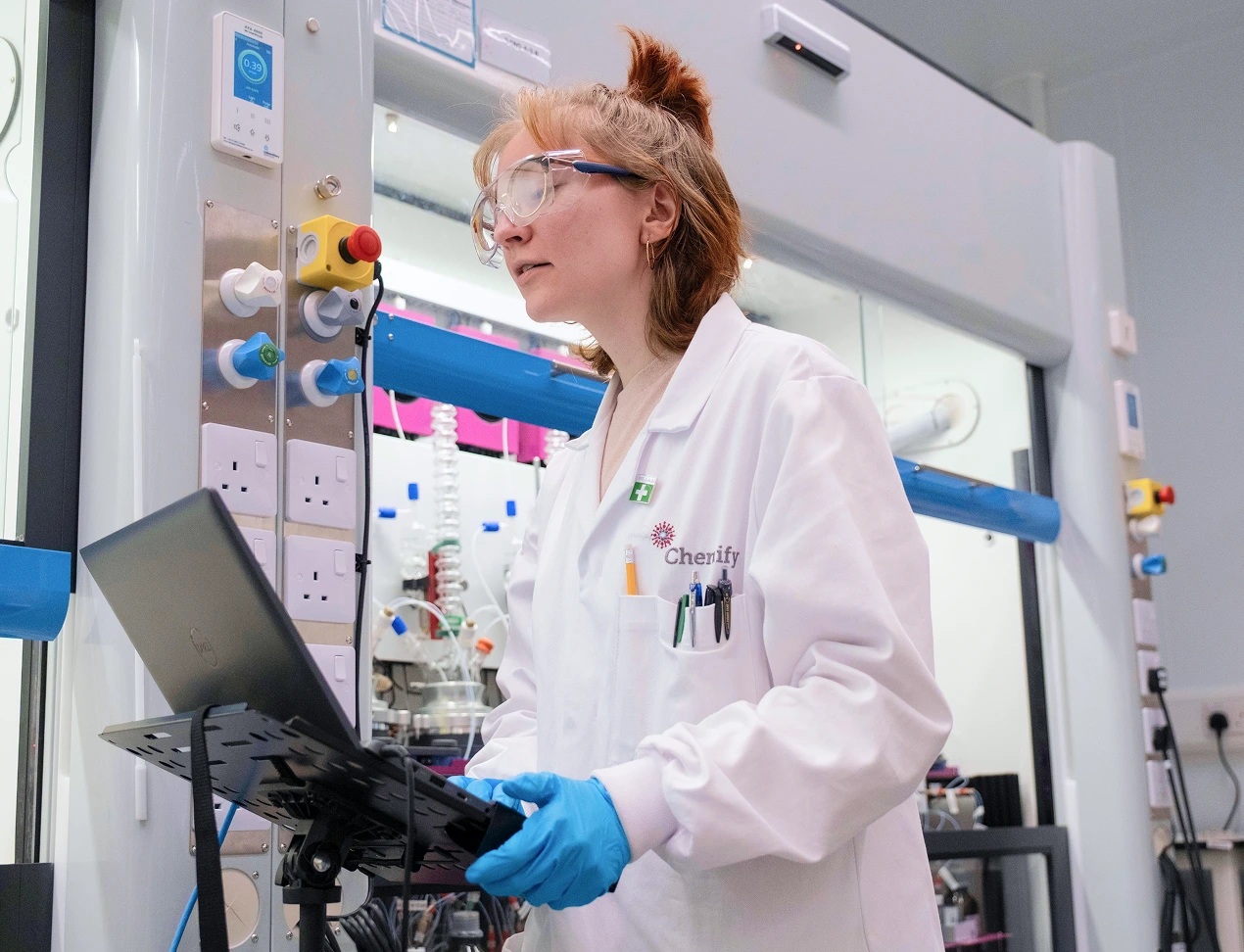
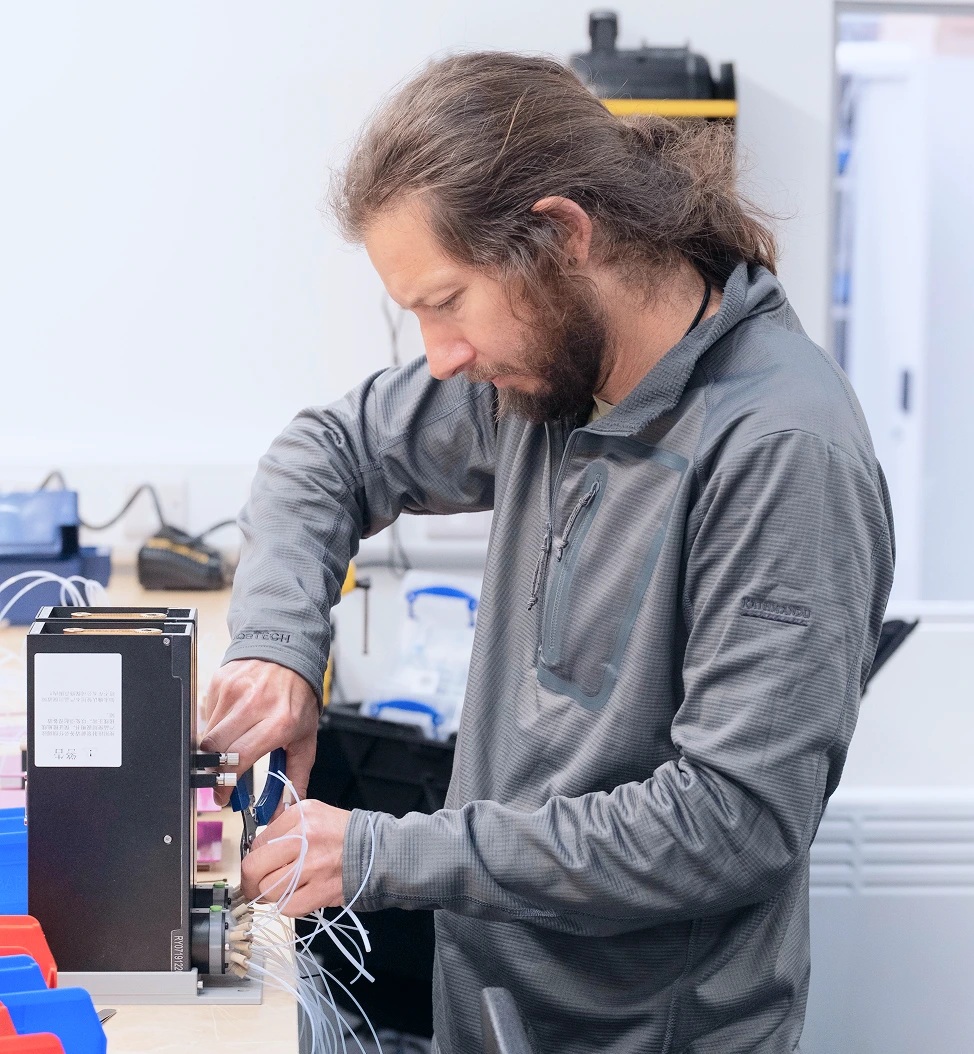
Chemify extends that logic to molecules. It combines chemistry, robotics, computation, and machine learning to make synthesis programmable. Its August 2023 announcement disclosed $43 million of funding, including a Series A led by Triatomic. Pharmaceutical, biotechnology, and industrial partners were the intended beneficiaries. A digital design becomes commercially interesting when somebody can reliably make the substance it describes.
Three careers meet at the workbench
The founding partners bring experience from different sides of that journey. Jeff Huber was GRAIL’s founding CEO and previously held senior roles at Google. Peter Zhou invested at Coatue and worked at Blackstone. Steve Hochberg’s background includes founding healthcare companies and investing at Deerfield. Software operations, investment judgment, and healthcare company-building meet in one partnership.
Founded in 2022, Triatomic describes a concentrated, research-led approach and currently advertises initial investments of $10–20 million. It can lead a round or participate. Its market position is alongside specialist venture investors willing to finance technical development. The offering to founders is capital and a working relationship; the underlying products belong to the companies it backs.
A useful question for founders
For a founder, the useful exercise is specific: name the customer’s constraint, measure its cost, and show how your product removes it. Then explain delivery. How does a promising demonstration become something a customer can buy repeatedly? The portfolio examples suggest that the answer may involve manufacturing, qualification, software compatibility, or the reliability of a biological input.
This approach depends on the constraint being real. An elegant component with no urgent buyer remains an elegant component. New hardware also asks customers to accept integration work; scientific tools must earn confidence through repeatable results. Triatomic’s investments make these questions tangible. The next useful invention may be the one that lets somebody else finally get on with the job.