A dishwasher is an awkward place to begin a venture capital story. Yet Beta Fund puts one near the center of its investment thesis. How can artificial intelligence reason about the world and still struggle to load the dishes? The question brings a grand technological promise down to a stubbornly ordinary task. Somewhere between the model and the dirty plate, a business remains to be built. Beta wants to meet the person building it.
- Palo Alto-based venture investor backing technical founders at inception, pre-seed and seed.
- Advertises a $200,000 first check and up to $2 million across early rounds.
- Looks at physical AI, AI infrastructure, and science and health - with a global remit.
That timing is the point. Beta says it will invest before a company, revenue, or even a settled idea exists. Its wager is that the ability to explore a difficult problem can be visible before a conventional fundraising story takes shape. For an engineer with a promising experiment and a distinctly unpromising slide deck, that is a useful invitation.
The check comes before the polish
Beta Fund's principal offering is early capital, accompanied by a founder community and access to technical and business support. Its Llama Beta Fellowship application describes cohorts of 20 founders. The advertised $200,000 initial investment can grow to as much as $2 million across pre-seed and seed. The sequence matters: a first check and a potential total are different promises.
An August 2026 newsletter promoted $40 million committed to a fellowship batch. Read that as the fund's stated cohort commitment, rather than a tally of completed investments. For a founder, the practical conversation concerns the initial financing, the milestones behind later capital, and the ownership terms. Beta's offer belongs in the venture-investment market; the money is capital for a company to build with.
The application offers a revealing little detail. A deck or memo link is optional. Questions about the team, its progress, and why it should build this particular thing are not relegated to an appendix. Applicants also explain their agent-native or token-native angle. You can arrive before the company is fully formed, but you still need to explain what you are investigating.
A room that doubles as a search engine
Founding partner David Chi also co-founded Beta University. Beta Fund describes itself as emerging from that organization's network of more than 900 founders and 300 industry mentors. Those are community figures, not a count of funded startups. They help explain the firm's method: spend time around people making things, then look for investment opportunities while the work is still taking shape.
Hackathons make that method visible. At the Snowflake, Beta Fund and EverMind Agent & Token Economy Hackathon, the event brief asked teams to confront the economics of intelligence. One track required a demonstrable cost reduction. Another sought willingness to pay. The schedule put a hard submission deadline at 4 p.m. and limited demos to three minutes. An interesting idea had to become something inspectable.
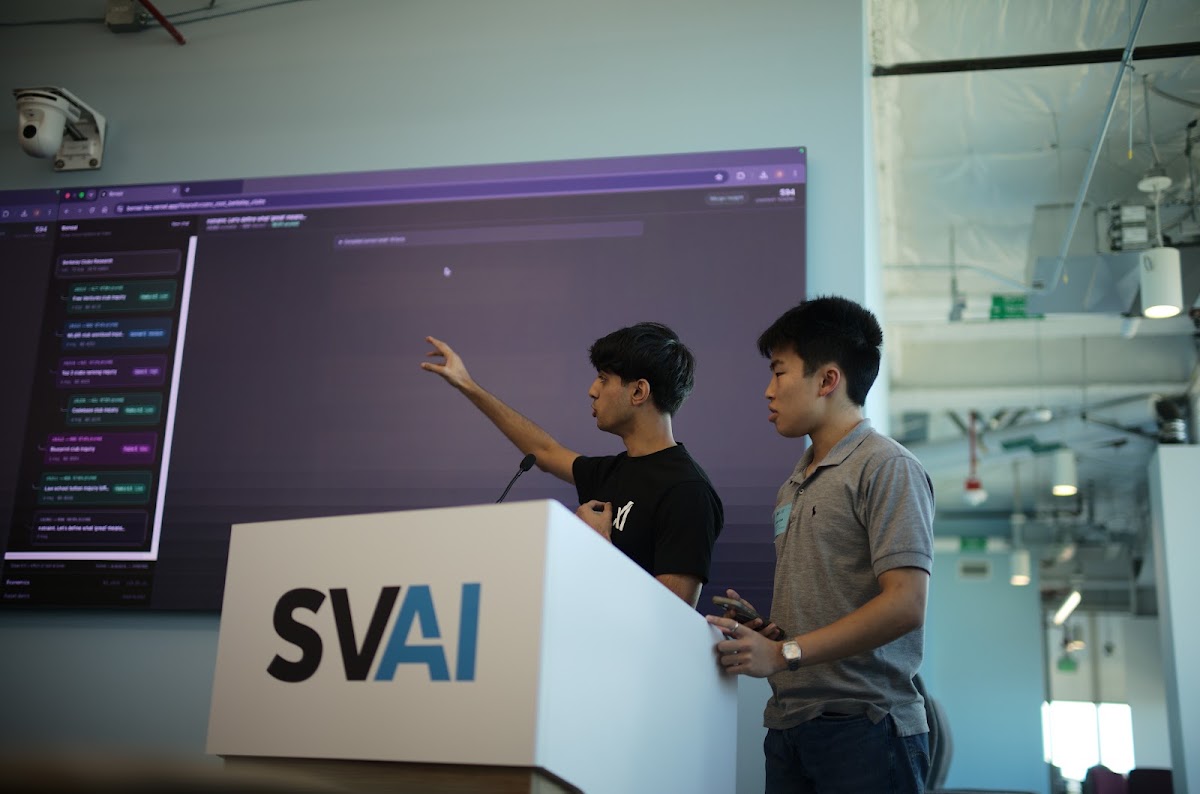
Beta's August 14 recap reported more than 600 registrations and more than 60 teams shipping in a day. Among the projects were TokenOS, which tracked and routed spending across model calls, and AfterScroll, which turned saved social posts into tasks and calendar events. These were hackathon projects; their presence in the recap does not make them portfolio companies. The distinction keeps the story honest.
There is a technique here that another founder community could copy: choose a narrow operating problem, provide usable tools, impose a deadline, and judge the resulting work against explicit criteria. Beta's recap described eight judges scoring continuity, innovation and pitch impact. The event creates both a place to learn and an opportunity for investors to watch how a team works.
Three ways to make AI useful
The portfolio gives this activity a shape. Beta's company page lists 27 names across three groups: seven in physical AI, 15 in AI infrastructure, and five in science and health. These are the firm's own classifications. Dexterity and Genesis AI sit in the first group; InsForge and Higgsfield appear in the second; Huminly and ARA Commons in the third.
Where the bets sit.
The connecting idea is software that can perform work, with the supporting machinery to make that work reliable. Beta's physical-AI thesis points to simulation, evaluation and dexterity. Its infrastructure interests extend from inference and power to memory, runtime and trust. In science and health, it seeks systems where conducting an experiment also produces information that improves the next one.
InsForge makes the infrastructure argument concrete. Its Y Combinator launch describes a backend that coding agents can operate through a consistent command-line interface. The founders said existing tools returned large payloads and left important runtime information inaccessible. They built structured responses, readable errors, scoped permissions and reversible writes. The customer problem was the friction between an agent that could generate code and infrastructure it could safely operate.
“What gets built when tokens are cheap and the user is a machine?”
Beta Fund / Request for Exploration
The useful part is what breaks
For a prospective founder, Beta's published interests suggest a practical test: identify where a capable model stops becoming useful, then measure that obstruction. A robot needs feedback it can learn from. An agent needs a budget it can respect. A laboratory needs an experiment it can repeat. A polished demonstration is the opening argument; the operating constraint is where the investigation gets interesting.
Beta's July 24 newsletter offers a small, unglamorous example. At a founders' open mic, one proposed talk concerned using agents to run a business, on a fourth attempt after three failures. The account does not specify what failed. Its value is the emphasis: a founder explaining repeated attempts can teach the room more than an architecture diagram alone. That is a useful standard for any technical gathering.
The approach has conditions. Investing before traction means judging people and experiments with less commercial evidence. A weekend deadline favors work that can be demonstrated quickly; physical machines and health applications can require much longer validation. Those are trade-offs inherent in the method, not evidence of a particular Beta investment going wrong. Founders should choose the route that fits the proof their business actually needs.
In the market for a first check, Beta competes for founders who could pursue angels, accelerators or other pre-seed funds. Its stated distinction is a combination of very early timing, technical community and an agent-focused thesis. A founder can start with the fellowship application or Builders Club. The question to bring is pleasantly concrete: what useful thing should this technology do next, and what is stopping it?
Follow the work
Start with the questions. Then meet the builders.