Ruchi Sanghvi had worked at Facebook and Dropbox. She knew the peculiar pleasure of a shared mission: difficult problems, capable colleagues, somewhere to be in the morning. Then she left. In her account, the departure felt like a crash landing. What she wanted next was unclear. What she missed was company.
- SPC helps technologists decide what to build before launch.
- Residency is free; the funded fellowship is a separate deal.
- The method is practical: test ideas with people who can challenge them.
Ten people. No pitch.
In 2016, ten people gathered around Sanghvi’s dining table to read AI papers and pursue their own projects. They included early engineers from Facebook, Dropbox and Stripe. There was no grand institutional plan. There was an agreement to keep appearing. Later that year, the group acquired a physical home in San Francisco’s South Park neighborhood.
That sequence matters. South Park Commons began with people trying to choose their next undertaking. The venture fund followed. Its expertise developed around a problem experienced builders recognized: being qualified to do many things makes choosing one surprisingly difficult.
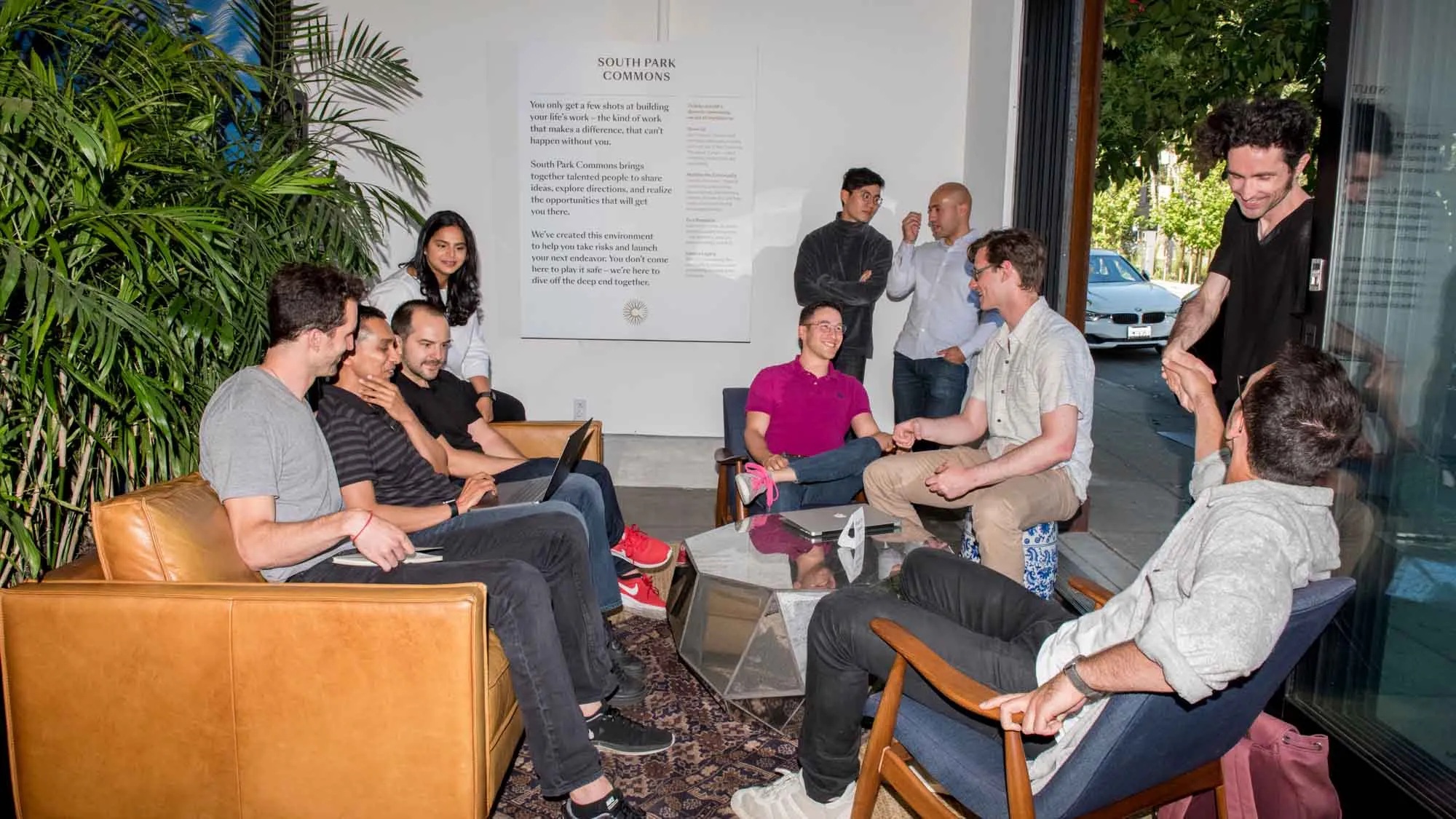
SPC calls this interval “-1 to 0.” A startup at zero has something to launch. Someone at minus one may have a résumé, savings, technical curiosity and no persuasive answer to the question at dinner: What are you working on? SPC treats answering that question as work.
The idea he could have funded
Consider Anurag Goel. Stripe’s eighth employee had an AI product idea that interested investors. His credentials could have helped him raise a seed round. In Sanghvi’s telling, the missing ingredient was his own conviction.
Goel joined SPC’s early group and kept testing hypotheses with his peers. Eventually, he committed to a different problem: the need for a new cloud services provider. That became Render. The original AI direction was discarded; there is no need to dress it up as a failed company.
The distinction is useful. Investor enthusiasm could have supplied money without settling Goel’s doubts. Exploring alternatives supplied a direction he wanted to pursue. SPC’s argument is that this choice deserves attention before salaries, investor expectations and a growing team make changing course expensive.
“Treat ideation like your job.”
Ruchi Sanghvi · What is -1 to 0?
The danger is familiar to anyone who enjoys making things: a promising prototype becomes a commitment before anyone asks whether the problem merits years of effort. With AI making prototypes cheaper, SPC thinks that danger is growing.
Free has a funding model
There are two principal doors into the community. The Member Residency offers six months of exploration without dues or equity rights. The Founder Fellowship brings capital and closer partner involvement for people committed to starting a venture-scale company. Both share the same community.
The fellowship’s advertised $1 million needs unpacking. Published Fall 2026 terms provide $400,000 upfront for 7% through a SAFE, plus $600,000 guaranteed in the next external funding round. That is a financing sequence. Founders should not budget as though the entire million arrives on day one.
7% via SAFE
Next external round
Separate from the free Member Residency.
Fellows begin with an eight-week, in-person bootcamp, then continue into a residency without a fixed end date. Partners help with customer discovery, product decisions, storytelling and fundraising. SPC also advertises initial venture investments of $1 million to $10 million outside the fellowship.
How does free residency pay its bills? SPC says management fees from its funds cover community operations. It intends to put part of eventual fund profits into a permanent endowment. The economic bet is that helping promising people choose their work will produce companies worth owning.
This gives SPC a position between a technical learning society and a venture firm. Compared with a conventional accelerator, its distinctive emphasis is the search before a settled business. Its published portfolio includes Baseten, Gamma, Goodfire, Luma and Render, businesses spanning AI infrastructure, creative software and developer tools.

Bring a demo. Bring an argument.
SPC’s published method can travel further than its offices. Pick a domain you understand. Generate several ideas within it. Choose a hypothesis you can test soon. Then create something another person can examine: a demo that reveals behavior, or a memo that makes the market argument.
Use both. Engineers can become absorbed in a prototype with a few happy users while avoiding the harder question of market size. A memo can expose assumptions that a polished demonstration conceals. Reading endlessly about a field can also become a comfortable substitute for conducting an experiment.
The social arrangement supports that discipline. SPC organizes peer groups, forums, workshops and conversations with experienced builders. Shared meals and repeated encounters make feedback easier to obtain. Researchers belong alongside aspiring founders; the community has room for open-source work and other projects that never become companies.
The breadth can be disarming. Two-time Olympic decathlon champion Ashton Eaton joined the residency in 2018. Jason Liu arrived with machine-learning experience and created an open-source library for structured outputs from language models. A researcher, an athlete and a prospective founder can all be trying to answer the same question about their next chapter. Their presence also makes the community harder to describe as a conventional accelerator cohort. For a member, the potential advantage is access to people whose expertise sits outside the narrow problem already occupying the whiteboard.
There are practical limits. Members are generally expected to commit full time and attend in San Francisco, New York or Bengaluru. A free desk does not pay the rent at home. Someone seeking occasional remote networking, or funding for a modest cash-flow business, may find a poor fit.
The room gets a bigger balance sheet
In August 2026, SPC announced a $575 million fourth fund and reported $2 billion in assets under management. The larger fund allows it to support companies further beyond launch. Those numbers describe investment capacity, not SPC’s revenue.
Then, on October 14, SPC announced another experiment: $200,000 on an uncapped SAFE, plus $500,000 in credits, for a small set of people pursuing unusually ambitious ideas. It explicitly called this an experiment rather than a formal program. That offer sits alongside the fellowship.
There is something fitting about an institution for uncertain founders leaving room to revise its own approach. The reader’s useful question is smaller than whether to join SPC: Who will inspect your next idea before you spend five years defending it?