The first thing Embedding VC asks you to do is type. Visit its website and a terminal appears where a venture firm’s polished welcome usually goes. You can enter team, investigate the portfolio, or type exit to reach the conventional website. It is a small design decision with a fairly large implication: somebody here expects the visitor to be a builder.
- Early capital for AI applications, infrastructure, and developer tools.
- A founder residency with advertised $100,000-$250,000 angel funding.
- Partners whose previous jobs included shipping machine learning products.
For an AI founder, the interesting question is what happens after the terminal trick. Embedding’s answer is to get involved before the business has settled into a business. Its public materials describe a combination of investing, prototyping, recruiting, and technical support. The proposition is straightforward: bring a difficult problem early enough that another experienced builder can still help change the product.
A CTO on the other side of the table
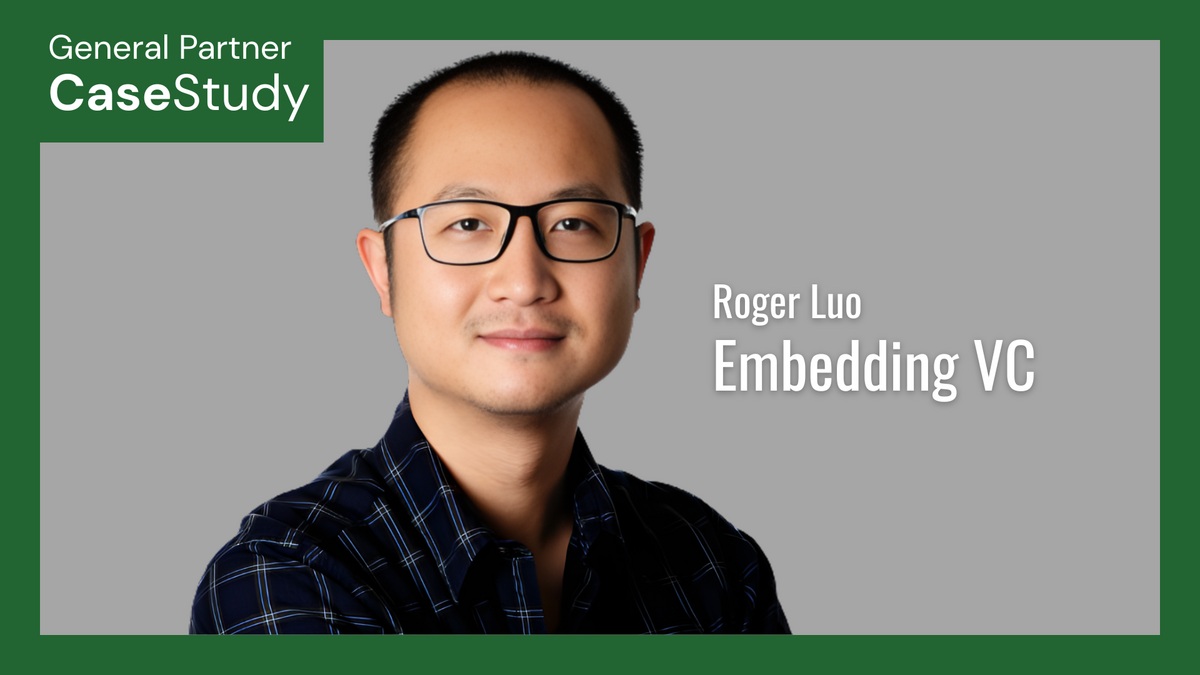
Roger Luo founded the firm in 2023. His route into investing ran through AI research and operating companies: a doctorate completed in 2011, machine learning leadership at Yahoo, Snap, and Niantic, and startup founding experience. Embedding’s own biography credits him with more than 40 AI and machine learning papers and six U.S. patents. That is a particular kind of preparation for a meeting about whether a prototype can become a company.
His colleague Congxing Cai carries an unusually revealing title: Forward Deployed Partner & CTO. Before Embedding, he worked at Google, Houzz, and Snap; the firm says he led Discover and Story engineering at Snapchat. A CTO inside an investment partnership suggests that technical judgment belongs in the working relationship, alongside the financing conversation.
Cai’s personal GitHub profile adds a welcome wrinkle. He names products that worked and products that did not, including Realm and Synco, and says he writes about why failures failed. That is a useful credential for an adviser. Shipping something popular teaches one set of lessons. Having to explain an unsuccessful product teaches another. His profile makes room for both.
Before there is a company to fund
Embedding’s Founder-in-Residence program gives that working relationship a practical shape. The job description invites experienced founders, engineers, designers, product managers, and growth practitioners to explore a problem, prototype, test assumptions, and establish early traction. It describes hybrid collaboration in the San Francisco Bay Area, with access to researchers, operators, design help, and recruiting support.
The website’s terminal supplies the financial detail: selected teams receive $100,000-$250,000 in angel funding, cloud credits, and support across product, engineering, and go-to-market. The sequence matters. Funding, design, and recruiting assistance follow a clearer direction in the residency description. The process asks people to do the uncomfortable work of narrowing an idea before building an organization around it.
A founder can copy that sequence without joining a program. Pick a specific user. Make a prototype that tests the hardest assumption. Put it in front of someone whose problem is expensive enough to matter. Then decide what deserves more money. This is an interpretation of the residency’s method, and its appeal is that each step can produce evidence against the original idea.
“Autograph exists because of Roger.”Cristian Cibils Bernardes, AutoGraph CEO, in a testimonial published by Embedding
Follow the work, and the portfolio makes sense
Consider three companies on Embedding’s published portfolio: MagicSchool, FLORA, and Superlinked. At first glance, a teaching platform, a creative canvas, and infrastructure for vector-powered software look like different conversations. Each addresses a particular place where AI capability needs to become usable work.
MagicSchool’s February 2025 announcement described partnerships with more than 10,000 schools and users in 160 countries. It also announced a $45 million Series B. Those are MagicSchool’s figures and financing. They show the scale reached by one portfolio company without implying that Embedding supplied the whole round or caused its growth.
FLORA announced a $6.5 million seed round in May 2025 and explicitly named Embedding among its investors. Its creative tooling addresses the awkward passage between generating something and controlling the result. Superlinked’s May 2024 announcement described combining structured and unstructured data for search, recommendations, analytics, and retrieval. The common thread is a practical bottleneck: teachers, creative professionals, and engineers need tools fitted to their tasks.

Small checks, consequential choices
Decile Group reported in March 2026 that Luo had closed a $16 million fund, describing pre-seed checks up to $300,000 and seed checks up to $1 million. These figures describe the fund’s reported investing capacity; the residency’s angel-funding range is a separate offer. For a founder, the relevant cost is negotiated financing, including ownership and terms, rather than a published subscription price.
Fund close reported by Decile Group
The firm occupies the early, technical end of the market, where alternatives include angel syndicates, accelerators, and other specialist seed investors. Its distinctive pitch is access to people who can engage with implementation. That advantage is most relevant when the company still has consequential product decisions to make and the founders want collaborators inside that process.
There are limits to the fit. A mature company seeking a large growth round has different needs. A founder who wants only a check may put little value on a residency. In his 2024 podcast interview, Luo warned against scaling go-to-market before product-market fit. More distribution cannot repair a product people do not need.
Embedding’s September 2026 newsletter suggests its interests are widening: a physical AI dinner, a benefits brokerage investment, and recruiting research from its incubated Base to Base business. For the founder reading along, that offers a useful way to evaluate the firm: look for help with a decision that is difficult to reverse, whether it concerns the product, the first hires, or the initial customer. The method remains recognizable. Find the people, examine the work, and get close enough to understand what needs building next.