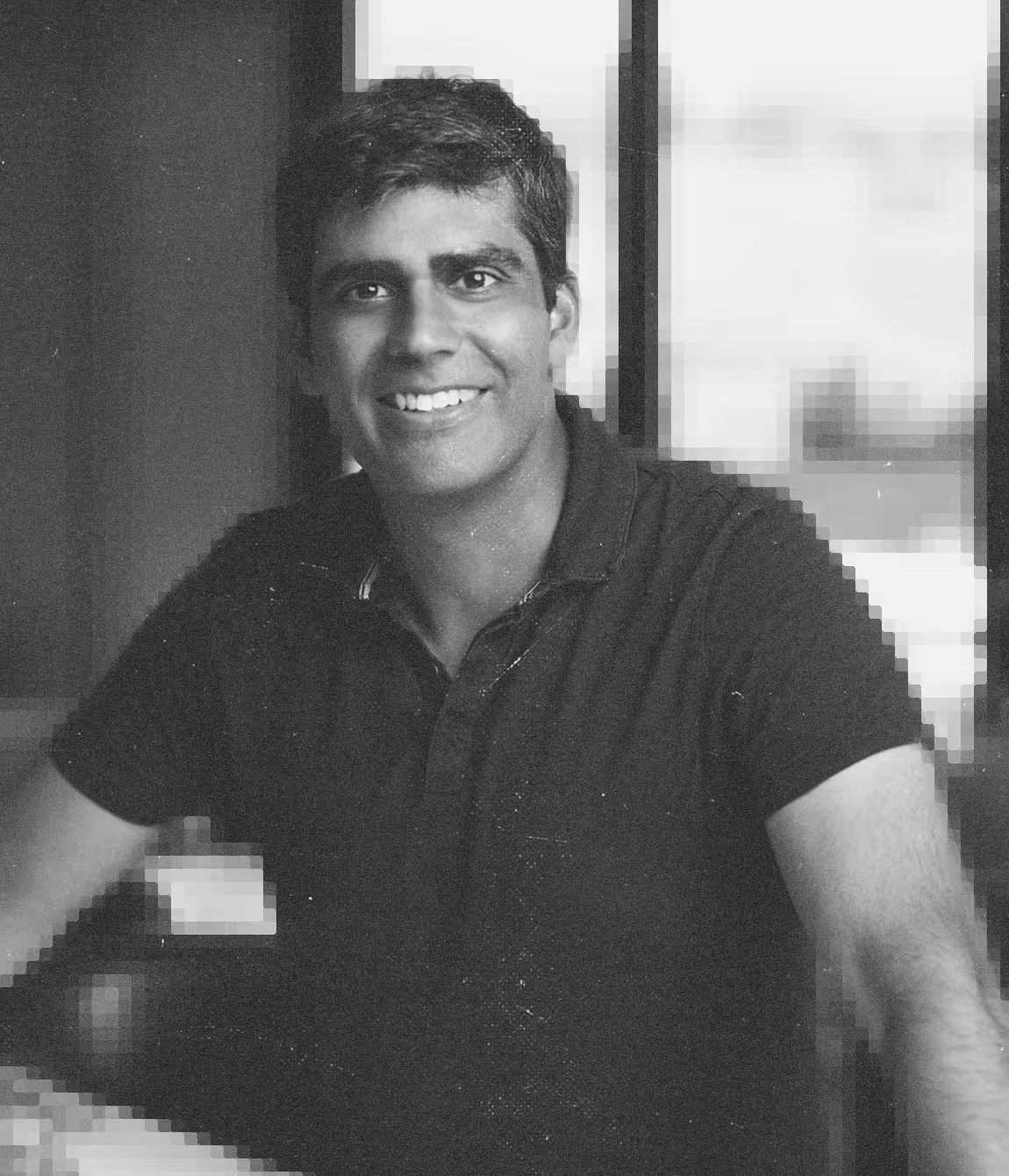
The Engineer Whisperer
In 2007, Sunil Dhaliwal watched a side project at an internal hackathon turn into what would eventually become Splunk - the log analytics company that filed for IPO at a $914M valuation. He was at Battery Ventures then, doing the long patient work of backing infrastructure companies before "infrastructure" was a category. The lesson stuck.
By 2012, Dhaliwal had left Battery after 14+ years, opened a blank spreadsheet, and wrote down a number: $40 million. That was the size of his first fund at Amplify Partners. Not small by accident. Small by design - so he could write the first check, stay close to technical founders, and not be tempted by the momentum investing that a larger fund would require.
"Early-stage venture capital should be rooted in focus, domain expertise, and a willingness to take risk," he has said. That sounds like an aphorism until you look at the portfolio. One of those early checks went to Datadog, a monitoring startup in New York founded by two engineers nobody had heard of. The year was 2012. The observability market barely had a name. Datadog's IPO in 2019 valued the company at $7.8 billion.
"I cannot think of a better partner for an early-stage entrepreneur."
- Artur Bergman, Founder of FastlyBorn to Back Builders
Dhaliwal's father was an electrical engineer who immigrated to the United States from India. When Sunil was still in grade school, his father quit his corporate job to start a company. That biographical detail isn't incidental - it explains why Dhaliwal gravitates toward founders who leave the comfortable job to build something hard in an unfashionable corner of technology.
He studied Finance and International Business at Georgetown, graduated in 1996, and went straight into technology banking at Alex. Brown & Sons. Then came Battery Ventures, where he spent over a decade developing the specific kind of investment intuition that comes only from backing infrastructure companies through multiple market cycles - watching some companies get acquired, others go public, others quietly disappear.
Among those Battery investments: Netezza (acquired by IBM), CipherTrust (acquired by Secure Computing), @stake (acquired by Symantec), and the predecessor to what became Chef. He also backed Splunk during this period. Each of these taught something about what a category looks like from the inside, before the category has a name.
What Amplify Actually Does
Amplify Partners describes itself as "the first investor for technical founders" - but that phrasing understates the specificity. Dhaliwal isn't backing every technical founder. He's backing engineers, researchers, and scientists who have lived with a technical problem long enough to understand it from the inside, not just the outside. The intimate knowledge of the problem is the proof of concept, before there's a company to fund.
The check range is $1M to $10M, which means Dhaliwal is often the first institutional dollar in. That position - first check, closest relationship, most time to help - is where he has built his edge. Founders describe him not as a board member who shows up to quarterly reviews, but as someone who gets involved when things get complicated.
"He gets behind the thesis of your business, tells you what he thinks clearly and without judgment... nobody is better when things get hard."
- Adam Jacob, CEO of The System InitiativeAmplify has now backed over 298 companies total, with 170+ still active. The portfolio includes dbt Labs (which became the de facto standard for data transformation), Temporal (workflow orchestration), Chainguard (software supply chain security), LangChain (the most widely used framework for building LLM-powered applications), Modal (serverless cloud computing for AI workloads), and Luma AI (Amplify's most recent unicorn). The through-line is not a trend - it's a type of founder.
Infrastructure Before It Was Infrastructure
One recurring pattern in the Amplify portfolio: Dhaliwal backs companies before the market has a consensus word for what they do. Datadog before "observability" was a category. dbt Labs before "analytics engineering" was a job title. Chainguard before "software supply chain security" appeared in boardroom presentations. This isn't prescience - it's a consequence of backing founders who are solving problems they personally encountered, not problems they read about in analyst reports.
The Fastly investment exemplifies the pattern. When Dhaliwal backed Artur Bergman's content delivery network startup, the conventional wisdom was that Akamai had won the CDN market permanently. Bergman built Fastly for developers who wanted programmable edge infrastructure. The market proved Bergman right. Fastly went public in 2019 at a $1.7 billion valuation.
Amplify Bio: Betting on Digital Biology
Thirteen years in, Dhaliwal is expanding the thesis. In June 2025, Amplify launched Amplify Bio I - a $200M fund dedicated entirely to digital biology, the intersection of computation and biological systems. The move reflects a conviction that biology is becoming an information technology problem, and that the founders best positioned to solve it are the ones who can move fluently between software and science.
The Amplify Bio portfolio already includes Chai Discovery (protein structure prediction), Axiom (biological design tools), Recursion (AI-driven drug discovery, now public), and Bexorg (cell engineering). The firm brought on Elliot Hershberg - who holds a PhD in computational biology from Stanford - as an advisor to help evaluate the science.
The $900M total raised in 2025 - Fund VI at $400M, Fund VI Select at $300M for follow-ons, and Amplify Bio I at $200M - marks the firm's largest capital raise to date, 22x the size of that original $40M fund. Dhaliwal has described Amplify as a "durable platform rather than a one-off vehicle," which reads as a quiet rebuttal to the VC firms that raise large funds during bull markets and go quiet afterward.
The Overlooked Opportunity
Dhaliwal is skeptical of trends, which is itself a form of competitive advantage in an industry that rewards novelty. On the Venture Unlocked podcast, he discussed finding "overlooked investment opportunities" - areas where other VCs are not paying attention because the companies are too technical, too early, or too unsexy. This is not contrarianism for its own sake. It's a recognition that the best seed investments are rarely the ones featured on TechCrunch the week they close.
He credits an early stint as an inside sales representative as some of the most valuable professional training he received - a detail that matters because it explains why he thinks carefully about go-to-market strategy even when backing deeply technical companies. Being the first investor means being present for the full journey, including the parts that have nothing to do with code.
Married with three children, a Boston Red Sox fan and Georgetown Hoyas supporter, Dhaliwal keeps a relatively quiet public profile for someone managing nearly a billion dollars of capital. He doesn't chase panel appearances or dominate conference schedules. What he does instead: he writes checks to engineers, shows up when things break, and waits for categories to form around companies he backed before anyone was watching.