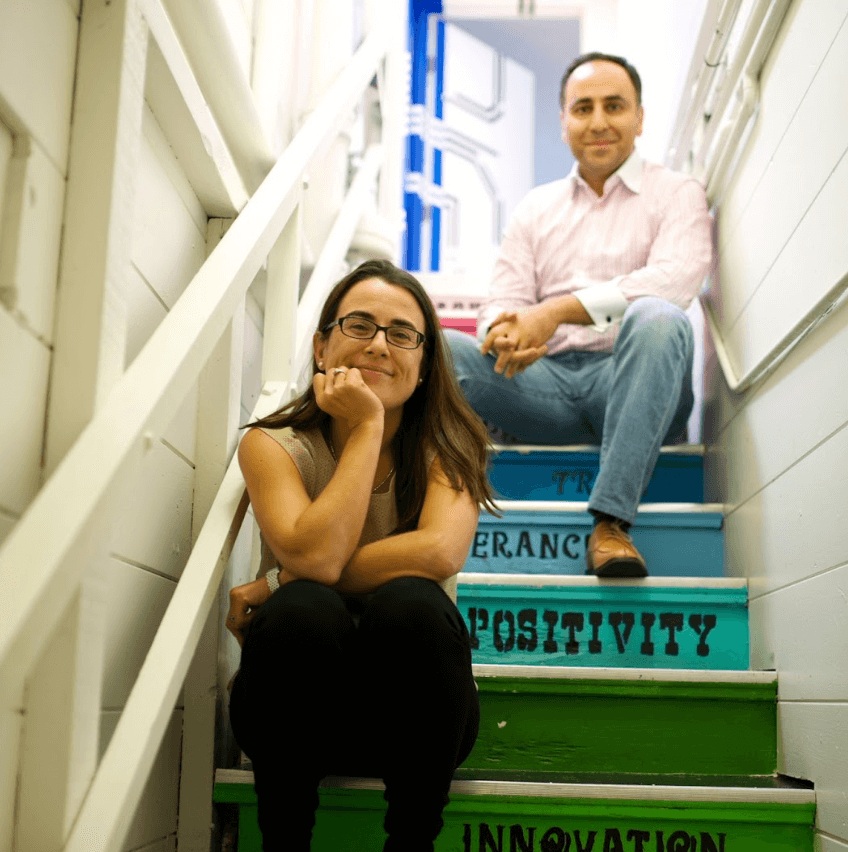
The first person Pejman Nozad had to convince was Mar Hershenson. In 2009, the angel investor approached the entrepreneur about starting a venture fund. She was reluctant. He kept asking. Four years later, they started raising money together. Before Pear could make a business of believing in founders, its own partnership needed a rather long sales cycle.
- Pear invests early and helps with hiring, selling and fundraising.
- PearX pairs a small cohort with 12 weeks of hands-on work.
- Current checks: $500,000-$2 million, typically targeting 7% ownership.
Four years to say yes
Nozad had begun investing while working as a rug dealer in Palo Alto. Hershenson, originally from Barcelona, had a Stanford electrical-engineering PhD and three startups behind her. Their experience overlapped just enough: he had backed companies; she had built them. Neither arrived with a conventional venture-firm résumé. That became a fundraising problem before it became a selling point.
Hershenson’s account describes repeated rejections from prospective investors before a few limited partners committed to a $50 million first fund in 2013. Pejman Mar Ventures became Pear VC in 2016. Founders polled about the name liked its suggestion of pairing up. A small linguistic convenience, perhaps, but a fairly accurate job description for the firm they were building.
The check comes with a recruiter
Pear’s proposition addresses an awkward feature of starting a company. The founder is suddenly responsible for jobs they may never have done: recruiting an engineer, choosing a customer segment, pricing a product, persuading another investor. Advice is plentiful. Someone who will actually source candidates or rehearse the investor meeting is a scarcer commodity.
That is the work Pear puts around its investments. Its talent service helps find and close early hires. Its go-to-market team works on customer discovery, positioning and sales. Fundraising support includes deck development, investor targeting, mock questions and post-meeting debriefs. Pear reports more than 300 hires for portfolio companies. The practical unit of value here is a task completed.
“Ocean’s Eleven”
Mar Hershenson’s nickname for Pear’s coordinated team of specialists
The movie reference is amusing because company building contains so little cinematic glamour. Somebody still has to identify the buyer. Somebody has to follow up with the candidate. Pear’s differentiation rests on how closely its investors and operators participate in those chores. Its own recruiting and sales teams make the promise more concrete than a list of advisers would.
Twelve weeks, with an equity bill
PearX packages that approach into a 12-week accelerator, run twice a year with no more than 25 teams per cohort. Its current investment range is $500,000-$2 million, with a typical ownership target of 7%. Those are starting parameters for an investment conversation, rather than a universal price list. The cash buys the company time; the ownership has lasting consequences.
Founders also commit their presence. Teams must relocate to the San Francisco Bay Area during the program. A partner meeting, group check-in and tactical sessions create a weekly rhythm. Solo founders can apply, and most participants have not raised money beforehand. This places PearX alongside accelerator alternatives such as Y Combinator and Techstars, while its small cohorts are central to its pitch.
There is a social architecture, too. Camp Pear opens the program with a three-day retreat. Pear Studio supplies workspace. Female Founders Circle, a separate eight-week San Francisco program, reports a community of more than 350 technical women. These gatherings give Pear ways to meet people before a formal financing process begins, and give prospective founders peers before they have employees.
The prototype is getting cheaper
An early Pear investment offers a useful lesson about what should happen before the pitch. DoorDash co-founder Stanley Tang recalls visiting a macaroon shop while testing an app for small businesses. The app missed the manager’s main problem. As the founders were leaving, she showed them a booklet of delivery orders she could not fulfill. That changed the conversation.
The team interviewed more than 200 small-business owners and built a delivery prototype. Pear says it partnered with DoorDash’s founders in 2013. The important detail is the rejected app. Customer discovery produced information the initial product had failed to capture. A founder can borrow that sequence without borrowing a dollar: observe the work, find the expensive frustration, then test a response.
Pear’s 2026 accelerator writing returns to the same issue through AI. As software becomes cheaper to produce, the firm argues, similar products proliferate. Its example is Piston, whose founders brought fleet-operating experience to fuel payments and fraud. Pear’s interpretation is that familiarity with a customer’s working day can matter more than the speed of assembling another prototype.
That logic has boundaries. A founder unable to relocate will struggle with PearX’s format. A business designed for steady, modest growth may have little reason to exchange ownership for venture capital. Pear’s own teaching asks whether the market is large enough for venture financing before discussing product traction. Its later test is whether someone besides the founder can sell the product systematically.
A larger firm, an early appointment
On October 14, 2026, Pear announced its $333 million fifth fund, taking reported assets under management above $1.1 billion. It also promoted Arash Afrakhteh, Ajay Kamat and Shravan Reddy to general partner. The firm now has to reproduce a personal, founder-led style of investing through a broader partnership. That is an organizational problem as much as an investment one.
The business model remains investment in startup equity using limited-partner capital. A fund’s size is money available to invest, not Pear’s revenue. The wager ultimately depends on portfolio companies becoming valuable enough to produce returns. DoorDash, Guardant Health, Gusto and Vanta establish that Pear has reached consequential companies early; their names alone cannot tell a reader the returns of a particular fund.
For a prospective founder, the useful question is smaller and more immediate: which hard job would this partner help finish next week? A first customer, an engineer, a sharper understanding of demand. Pear has built its offering around those early jobs. The pitch deck can describe a company. The work before it helps determine whether there is a company to describe.