The client could not reconcile its inventory. Spare parts were disappearing from the accounting picture, and nobody could confidently identify the losses or their cost. In a business organized around moving enormous objects across oceans, the immediate problem was surprisingly ordinary: keeping track of things already purchased.
ABS Wavesight’s published inventory-control case describes what happened next. Its Nautical Systems maintenance and purchasing modules helped locate the points where errors entered the supply chain. The operator introduced additional controls and rebuilt its spare-parts program. The reported result was annual savings exceeding $3 million. The customer is unnamed; the figure belongs to this particular vendor-published case.
- Connect maintenance, purchasing and inventory before ordering another part.
- Use fleet records for emissions reporting and digital logbooks.
- Judge the software by changes in daily work and measurable costs.
That sequence makes ABS Wavesight easier to understand than a catalogue of dashboards. A ship needs machinery, people, documents and fuel. Each creates records. When those records disagree, the disagreement can become a bill.
A new company with old sea legs
ABS launched Wavesight at the International WorkBoat Show in New Orleans in November 2022. Paul Sells was its launch chief executive. The business brought together Nautical Systems, an established fleet-management system, and My Digital Fleet, an analytics and performance-visualization platform. Together, they were already installed on more than 5,000 vessels.
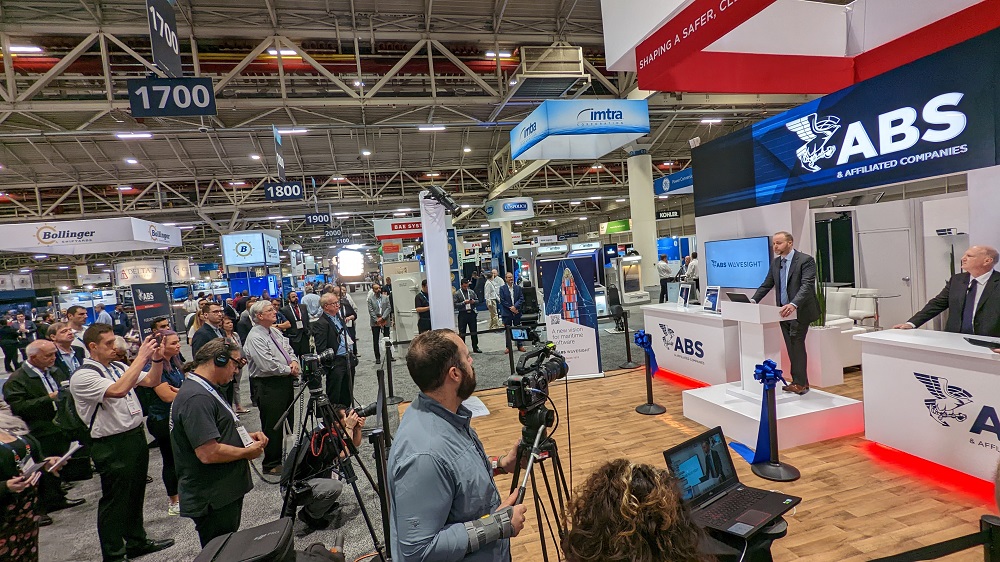
This was an unusual starting line. Wavesight did not have to persuade its first shipowner to try an entirely unfamiliar product. It inherited software relationships and the maritime experience of the American Bureau of Shipping. Its website now describes Wavesight as an independent ABS subsidiary and reports more than 5,500 vessels with its products installed, alongside more than 200 customers.
Those numbers describe a footprint, rather than a spectacular growth curve. The distinction matters. The company’s proposition is continuity plus modernization: keep the operational knowledge, connect more of the work, and make established tools easier to use.
Three products, three jobs
Nautical Systems is the operational engine room. Its interoperable modules cover maintenance, purchasing, drydocking, safety and quality, crew and payroll, documents, voyages and analytics. An engineer’s maintenance task and a purchasing department’s inventory decision can sit within the same marine enterprise-resource-planning system. That connection is where the spare-parts story begins.
An illustrative workflow, not a measured performance chart.
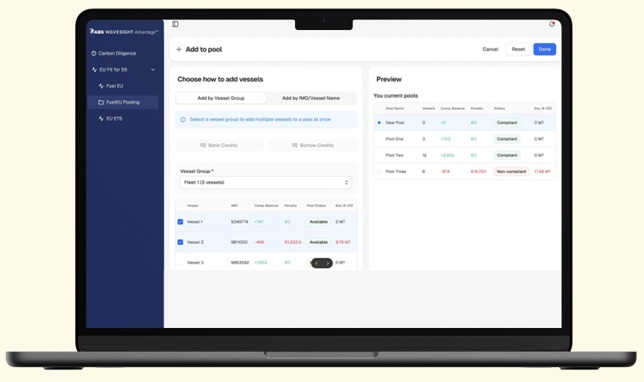
Advantage, launched in September 2025, addresses emissions and compliance. Its Carbon Diligence and Fit for 55 suites cover data validation, voyage emissions statements, carbon-intensity monitoring, allowance estimates and pooling scenarios. A fleet manager can examine compliance positions across vessels instead of assembling the picture from separate files. These are decision tools; an emissions calculation does not itself reduce fuel consumption.
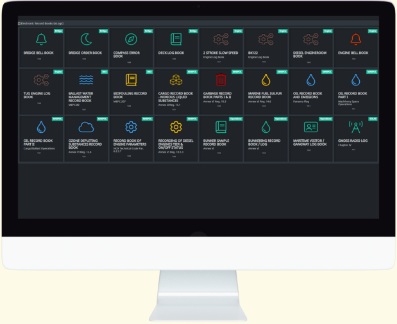
eLogs handles another familiar object: the logbook. It replaces paper records with authorized entries, electronic signatures, alerts and access for shore teams. It can operate alone or integrate with Nautical Systems. For a crew, the practical attraction is less repeated recordkeeping; for an office, it is easier access to what happened aboard.
The portfolio serves owners, operators, fleet managers and charterers. It also places Wavesight in a competitive field. DNV’s ShipManager and RINA’s SERTICA offer overlapping maintenance, procurement and compliance tools. Wavesight’s distinction rests on its particular combination of established fleet software, ABS domain knowledge and a digital route into ABS verification.
Ninety-three ships test the proposition
In March 2026, Thenamaris completed a Nautical Systems rollout across 93 vessels. The Greek ship manager moved from multiple legacy systems to one platform for maintenance, procurement, drydock management, and health, safety, quality and environment. A rollout that broad makes integration a working requirement rather than a sales-slide ambition.
Other customers illustrate different entry points. Jana Marine Service Company connected maintenance and purchasing with its procurement processes and inventory databases. Wavesight’s case study reports hundreds of thousands of dollars saved through improved order tracking. This is a separate case from the unnamed operator reporting $3 million annually; combining them would produce a misleading story.
Navios Maritime Partners selected Wavesight for digitalized FuelEU and EU ETS reporting in July 2025. Its announcement describes on-demand emissions validation, voyage statements and transmission to ABS for statutory verification. Navilands subsequently selected the Carbon Diligence suite for a selection of bulkers and containerships. The attraction was a shorter path between operational records and compliance work.
The upgrade beneath the upgrade
There is a revealing wrinkle in another Wavesight case. An established Nautical Systems user needed a Balanced Scorecard Review of its underlying data. The review examined maintenance, inventory and crewing records, produced a gap analysis, and paired recommendations with training. New functionality needed changes in everyday processes before users could benefit from it.
“Successful software implementations and upgrades need a deeper process change to embed them into day-to-day operations.”
ABS Wavesight Professional Services
That explains why implementation, data cleansing, integration and optimization services belong beside the software. Wavesight sells into organizations where a configuration choice can affect both a purchasing desk and an engine room. Its web-based crew and payroll release in 2024, with Military Sealift Command as an early adopter, also shows the gradual migration of established workflows into more accessible tools.
For a buyer, the sensible calculation includes subscription, setup, integration, training and the time spent repairing records. The transferable method is modest: pick one costly handoff, establish a baseline, assign ownership and measure what changes. If crews keep parallel records, equipment data remains unreliable or existing systems cannot exchange information, a polished dashboard will inherit those weaknesses.
Wavesight’s story starts to make sense at that scale. Find the missing connection between two records. Fix the process that separated them. Then ask whether the ship, and the people running it, are better off.