The difficulty with a construction budget is that it describes several different worlds at once. There is the work someone planned, the work someone bought, the work someone finished and the work someone has finally been paid for. Put those figures in separate systems and an apparently simple question - are we on budget? - becomes a small diplomatic mission.
Contruent sells software for that mission. Its customers build the expensive, slow-moving things that make modern life possible: transport networks, energy facilities, mines and industrial infrastructure. The appeal is wonderfully unromantic. Give the people responsible for a project a common set of numbers, early enough to do something useful with them.
- The job: connect cost, schedule, contracts and change across capital projects.
- The buyer: asset owners and engineering and construction firms.
- The pitch: established project-controls practices in a configurable SaaS product.
- The catch: a shared system still needs shared rules and people who use them.
The budget has more than one tense
Consider a hypothetical equipment package. Its purchase order has been approved, the equipment has not arrived, and the supplier has not invoiced. An accounting report may show little expenditure. A project controller sees a commitment, a delivery date and a possible consequence for the work that follows. Both views can be correct. Only one tells you much about the future.
Contruent Enterprise brings those views together. It connects project budgets and schedules with commitments, progress, changes and forecasts. Cost engineers can examine performance; contract teams can follow obligations and payments; executives can look across a portfolio rather than wait for someone to stitch reports together. The product’s organizing principle is the lifecycle of the money.
Its earned value capabilities address a particularly useful distinction: spending money and accomplishing work are different events. Integrated controls let a team compare expenditure with progress and plan. That is where the software fits in the market: enterprise financial and project control for capital programs whose complexity has outrun informal coordination.
The report nobody could combine
Covestro’s vendor-published case study supplies the clearest example. Before the rollout, regional teams used different tools and cost structures. The United States and Asia Pacific typically used spreadsheets; Europe had a separate system. Combining their reports was difficult. The first thing to fail was the common view.
The company established standards, tested a US pilot, then expanded regionally. The study described roughly 60 projects using the system at that time. Lead controller Sandip Dhanani reported almost 90% less time collecting and validating data. That number concerns those tasks, not the entire construction process. The valuable change was where a controller could spend the recovered hours: examining performance.
“Before the introduction of Contruent, we didn’t have a company-wide standardized project control system.”Sandip Dhanani · Lead Controller, Covestro
The lesson readers can borrow is to standardize the meaning of a report before automating its production. Decide which cost structures, definitions and responsibilities will travel across the organization. Otherwise, the computer can deliver incompatible answers with admirable punctuality.
A tool built because engineers needed it
Contruent’s original software came from inside ARES Corporation, an engineering, risk and project management business. Its engineers needed stronger cost controls for their own projects. Commercial customers followed in 1995, and a North American mining company implemented the product in 1996.
The name ARES PRISM lasted until the 2023 rebrand and launch of Contruent Enterprise. M33 Growth had invested in 2021; the business subsequently shifted from its legacy on-premises roots toward SaaS. These dates matter because Contruent is selling accumulated project practice alongside a newer delivery model. A browser interface is one part of the offer. Familiar cost-control logic is another.
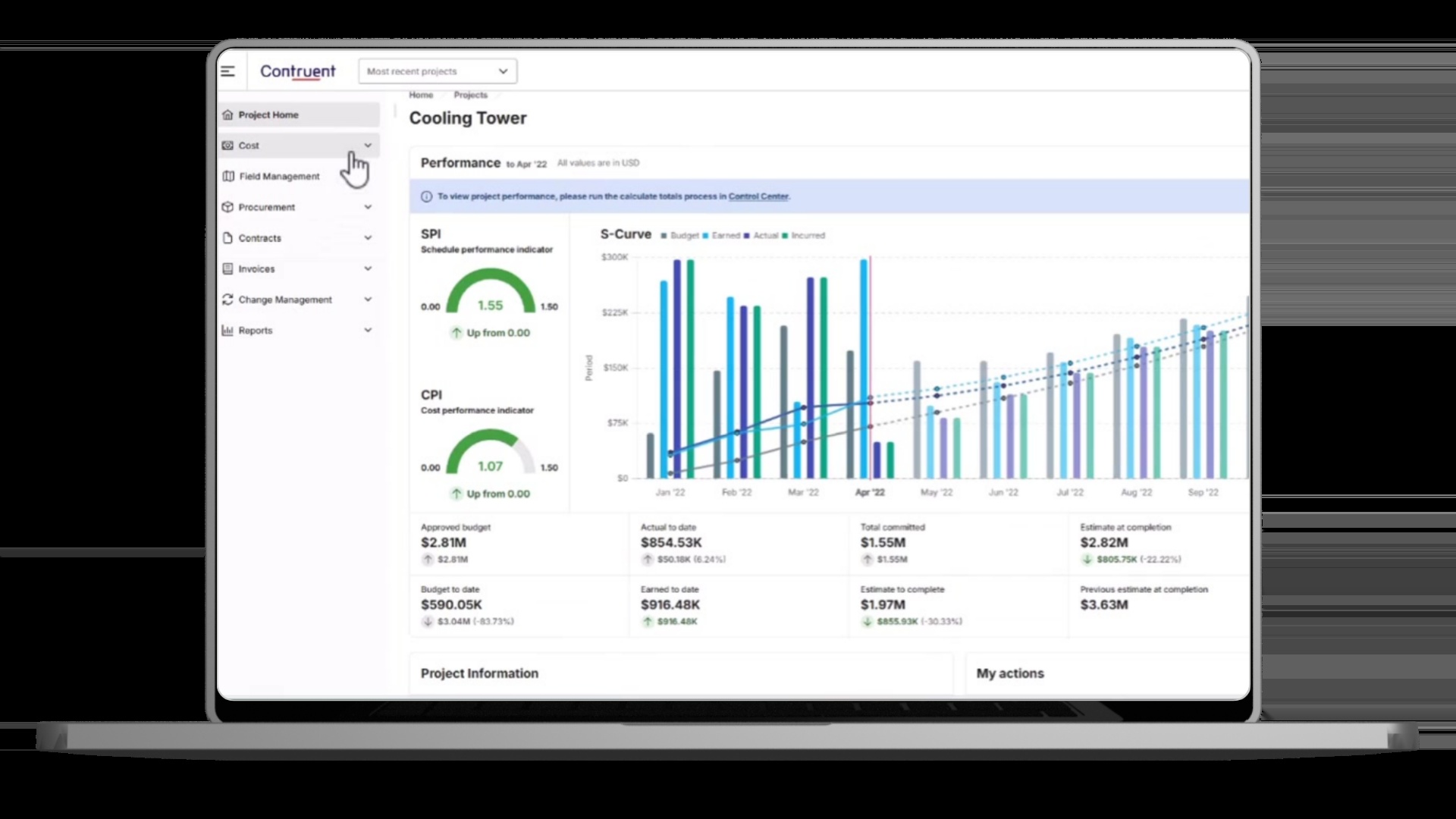
Its current product page includes Contruent Drive, which puts files inside cost, contract and change workflows. That sounds modest until a decision needs its supporting document. Keeping the document beside the transaction makes the record easier to follow. Software for large construction programs earns its keep in such small acts of administrative order.
Follow the money back to the bid
In May 2024, Contruent announced the acquisition of ProcureWare from Bentley Systems. ProcureWare handles vendors, bid solicitation, comparisons and contract awards. The move extended Contruent’s procurement offering into the decisions that precede a commitment.
A budget does not become troublesome only when an invoice arrives. Supplier selection, scope and contract terms help determine what the project will eventually spend. Procurement belongs in the cost conversation from the start. Bringing it closer to project controls gives buyers a more continuous view from the bidding process to delivery.
The wider offering spans estimating, engineering progress, cost control, contracts, changes and data insights. Implementation and integration services sit beside the subscriptions. Contruent’s integration approach connects existing financial, scheduling and other enterprise tools, so teams can bring their records together without treating every existing application as disposable.
The price of a common answer
A 2024 UK G-Cloud pricing document provides a useful, bounded view of the economics. It lists an annual Contruent Enterprise full-user subscription at £9,500 and a light user at £3,000, excluding VAT. The document requires a minimum 12-month term. These are historical framework rates; an actual purchase needs a scoped commercial quote.
The same list separates integration charges: a turnkey integration is £15,000 annually with a £4,680 setup fee; a custom integration is £25,000 annually with £52,416 for setup. Training and implementation are available separately. Connecting the organization is a budget item in its own right.
This business model suits a deliberate enterprise purchase. A buyer should map users, integrations and rollout work before comparing license prices. A small team with a straightforward job may have little reason to pay for this depth. A program with many contracts, reporting obligations and consequential changes has a different calculation to make.
Speed requires somebody to agree
Contruent markets fixed-fee go-lives in under four months. Its differentiation is the promise of starting from established configurations and project-controls practices, rather than inventing every workflow during deployment. InEight, Oracle Primavera Unifier and EcoSys occupy overlapping territory. Contruent’s claim to faster deployment deserves examination against the buyer’s own requirements, data and integrations.
The company’s case studies also show why customers reconsider their old arrangements. A Southern European developer faced limited team capacity, legacy reporting difficulties and ERP-related gaps. A US food manufacturer’s expansion exposed disconnected data and inconsistent forecasting. Scale changed the calculation: familiar manual work became harder to sustain.
There are organizational conditions here. People need consistent records, clear approval responsibilities and a reason to maintain them. If contractors do not submit progress, or departments continue using incompatible definitions, a dashboard inherits the problem. Contruent’s partner ecosystem includes implementation advisers precisely because software adoption involves process design and change management.
A second opinion, with a human attached
Riverside announced its investment in November 2025. In that month’s company announcement, Contruent said its customers managed more than $85 billion in annual construction spend through its platform. That is customer spending supported, not Contruent revenue. Its current leadership page names Jason Rupert as CEO.
A September 2026 company blog describes AI Forecasting as an independent check on the estimate at completion, using a customer’s own project data at control-account level. The stated purpose is to help controllers decide which forecasts warrant closer attention while preserving professional judgment.
It is a fitting next step for this business. The useful question has always been what the records suggest about the project ahead. A system that helps someone ask that question sooner can change the meeting: fewer people defending a spreadsheet, more people deciding what to do about the work.