At Xerox, the carbon footprint had become a problem of paperwork. The company had climate targets and years of reporting experience. What it wanted next was more detailed, auditable information. In 2023, it began working with Persefoni, migrating spreadsheet records and revisiting the processes behind them. The revealing detail is the workshop: people had to discuss data collection, governance, and documentation. Buying the software was only one part of the change.
- Persefoni turns business records into traceable emissions inventories.
- Pro offers a free starting point; enterprise collaboration and specialist outputs cost more.
- Its AI helps prepare and interrogate data. People still approve the decisions.
The case study estimates an approximately 40% improvement in inventory calculation speed. That is a useful result, though it is a customer estimate published by the vendor. It also points toward Persefoni’s central proposition: the difficult part of carbon accounting is making the number dependable enough to use.
A footprint needs a filing system
Persefoni, founded in 2020 by Kentaro Kawamori, Jason Offerman, and Kim Stroh, approaches emissions as an enterprise accounting problem. Kawamori previously served as chief data officer at Chesapeake Energy. Offerman brought operational and ERP implementation experience. Stroh brought software architecture and product development expertise. Their backgrounds help explain why this climate company talks so much about ledgers.
A carbon inventory begins with ordinary business activity: fuel burned, electricity bought, goods ordered, journeys taken. Software applies emissions factors and accounting methods to those records. But an answer without a history is awkward when somebody asks which period it covers, what changed, or why one facility looks different from another.
Persefoni’s footprint ledger preserves transaction-level detail. Its audit trails record changes. The attraction for a finance or sustainability team is repeatability: next year’s exercise can begin with an established system, rather than a search for whoever remembers last year’s spreadsheet.



The workflow has an unromantic advantage. When assumptions are visible, a colleague can question them. When a revision is recorded, the team can explain it. This makes carbon accounting a shared business process, with responsibilities that survive a change of personnel. The software becomes useful through the discipline around it.
The supplier is part of the system
That exercise reaches beyond the company’s own buildings. Scope 1 covers direct emissions. Scope 2 concerns purchased energy. Scope 3 extends into the value chain, where records belong to suppliers, customers, and other organizations. A procurement team cannot simply summon perfect information from every business it buys from.
This is where Persefoni’s free tier becomes interesting. Launched in March 2024, Pro gives smaller organizations a way to calculate their footprint and respond to requests. A supplier gets an accounting tool; the enterprise requesting its data gets a better chance of receiving something useful. Free access serves a practical purpose inside a much larger paid relationship.
The distinction matters when evaluating price. Pro is free for one user and includes Scope 1-3 measurement. Some exports, reports, and support are optional purchases. Advanced adds enterprise capabilities, including broader collaboration and integration. Buyers need a quote, then a realistic estimate of the internal effort required to prepare records. A free login does not make that work disappear.
When the footprint belongs to a portfolio
For a bank or investment manager, the accounting boundary becomes stranger still. Office lighting may be a small part of its climate story. Loans and investments connect the institution to emissions elsewhere in the economy. Persefoni’s financial-services offering supports calculations aligned with the Partnership for Carbon Accounting Financials, alongside portfolio analysis and investor reporting.
The customer mix reflects both sides of the business: manufacturers and retailers such as Xerox and At Home, and investment firms such as Oak Hill Advisors. These customers need different views of their records. Persefoni’s position in the market rests on connecting those views to a controlled accounting foundation.
Alternatives include Watershed, Sweep, and IBM Envizi, alongside consultants and existing spreadsheets. The sensible comparison starts with the buyer’s inventory: which assets, suppliers, and investments must be covered, and who must review the result? A persuasive demo cannot answer those questions on the buyer’s behalf.
At Home offers another clue about the work involved. Its account of moving calculations into Persefoni describes improving prior-year data and restating emissions. A revised footprint can reflect better accounting. Readers comparing annual totals therefore need to understand whether the business changed, the methodology changed, or both. A clean-looking trend line can conceal a complicated explanation.
The AI goes where the mess is
In May 2026, Persefoni introduced Analytics Agent, letting users ask questions about their Activity Ledger and generate charts or tables. A question about supplier emissions can become an analysis without exporting the dataset. The agent works with emissions already calculated in the platform. More detailed underlying records support more detailed answers.
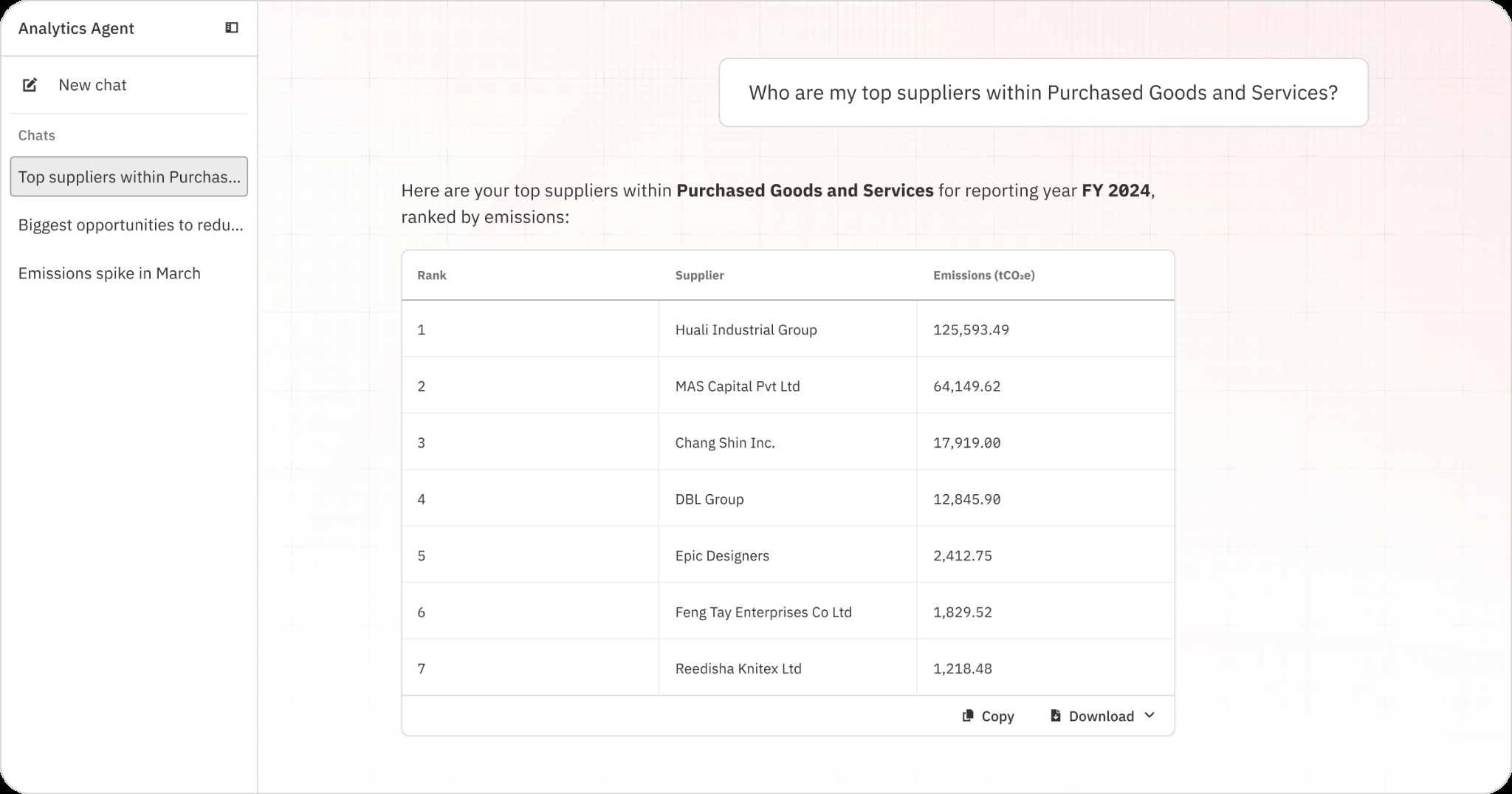
August brought Data Agent, aimed at the earlier, untidier stage: interpreting incoming files, suggesting field mappings, and flagging inconsistent units or reporting periods. Users review and approve recommendations. A downloadable decision log keeps track of AI-assisted choices. The boundary is deliberate: automation helps organize the evidence while people remain responsible for its treatment.
“We start with the customer and work backwards.”Persefoni’s published operating principles
Persefoni also announced ISO/IEC 42001 certification for its AI management system in August. That concerns governance processes. Human review still matters, particularly before formal reporting. Neither a certification nor a conversational interface supplies missing supplier records.
For a buyer, a useful trial would start with a real file and a troublesome question. Can the team follow an unusual result back to its activity record? Can a reviewer understand the mapping decisions? Those small demonstrations reveal more about everyday usefulness than a polished total on a dashboard. They also expose the preparation still needed before a reporting deadline arrives.
The number is the beginning
The business has attracted substantial backing: a $50 million Series C-1 in 2023 and a $23 million extension in 2025. In October 2025, Diligent agreed to transition its carbon accounting clients to Persefoni and take an equity position. That deal places the software closer to the governance and compliance work surrounding disclosure.
Measurement, however, does not switch off a boiler. Persefoni’s Net Zero Navigator, developed with Bain & Company, helps model reduction pathways. Actual change still requires budgets, procurement decisions, and operational follow-through. The lesson readers can copy is less expensive than any enterprise subscription: assign owners to the records, document assumptions, and preserve what changed. Then the next climate conversation can begin with a number people can examine.