Avarni
Nobody put 'mandatory climate disclosure' in your finance team's job description. Avarni makes carbon accounting the least painful thing on your FY26 plate. It's expert-guided, software-powered, and done in weeks. Audit-ready, or we keep working.
In most companies, someone in finance opened an email this year and discovered a new line item in their job. Not a spreadsheet reconciliation. Not a tax filing. A carbon report - legally required, audit-checked, and due in months. They did not train for it. Nobody did. Avarni, a small Sydney software company, exists because of that email.
Avarni builds carbon accounting software. That sentence undersells the problem it is pointed at. Australia's new climate-disclosure regime - the Australian Sustainability Reporting Standards, or ASRS, built on the AASB S2 rules - turned emissions reporting from a voluntary corporate-responsibility exercise into a mandatory financial filing. For thousands of large companies, the numbers now have to hold up the way the balance sheet does: reviewed, defensible, signed off. Avarni's pitch is blunt about who feels that pain. "Nobody put 'mandatory climate disclosure' in your finance team's job description," the homepage reads. The company's job is to make the number appear, and to make it survive an audit.
The math nobody wantsThe 75 percent that lives in someone else's factory
Emissions come in three buckets. Scope 1 is what you burn directly - fleet fuel, gas boilers. Scope 2 is the electricity you buy. Both are relatively easy to count. Scope 3 is everything else: the emissions baked into what you purchase, ship, and sell through a supply chain you do not own. For most businesses it is more than three-quarters of the total footprint, and it is the number that turns carbon accounting into a data-wrangling nightmare. You cannot meter a supplier's factory in Guangdong from an office in Sydney.
Where corporate emissions actually hide
Illustrative split; Scope 3 typically dominates and is the hardest to measure.
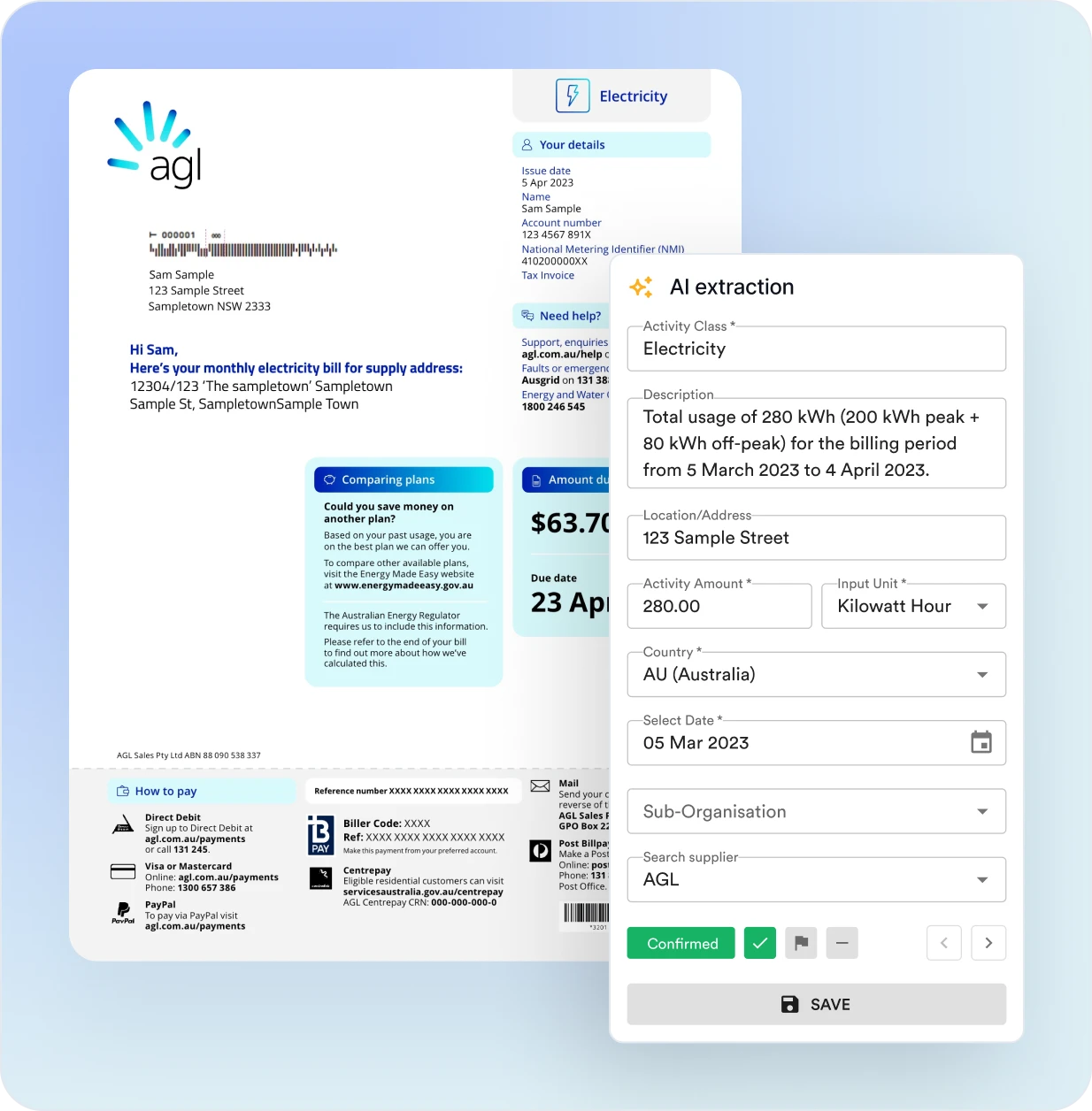
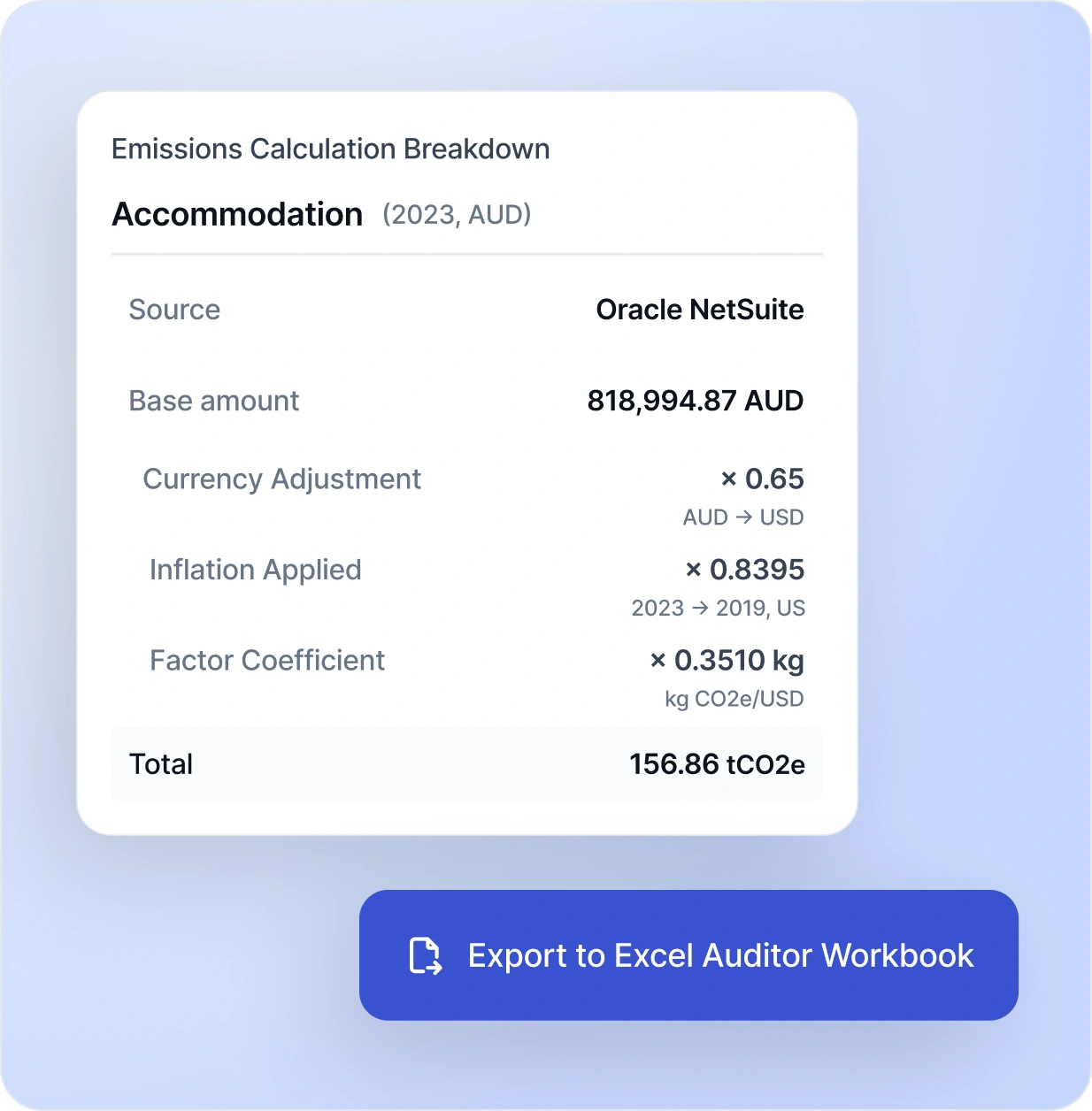
Avarni's answer is to treat this as a data problem rather than a science problem. The platform ingests what a company already has - spend records, invoices, ERP exports from SAP, NetSuite or Dynamics 365 - and works backward to emissions. An AI layer reads invoices with OCR, extracts the line items, and matches each one to an emission factor drawn from a large library the company maintains. What used to be a consultant manually keying purchase data into a model becomes an automated import.
Built for the CFO, not the polar bear
Most climate software is sold with imagery of melting ice and mission statements about the planet. Avarni sells to the person holding the deadline. Its customers are large enterprises, financial and insurance firms, and - importantly - the sustainability consultancies that used to do this work by hand and now run it on Avarni's platform. The named logos span industries that do not obviously belong together: Latitude Financial, Maersk, CSL, Schneider Electric, Hutchinson Builders, Cement Australia, 99 Bikes, Teys Australia, Kagome. The common thread is not a sector. It is a filing obligation.
That consultancy angle is the quiet strategic move. Firms like BDO can use Avarni under the hood to serve their own clients, which turns potential competitors into a distribution channel. The software does the counting; the advisor keeps the relationship. It is a rare arrangement where the tool and the human it might have replaced end up on the same invoice.
Software priced below the consultant, safety priced above
The old way to get a carbon report was to hire a Big Four sustainability team, wait a few months, and pay a six-figure bill for a static PDF. Avarni's wedge is to be both cheaper and safer at once - an unusual combination. Expert-guided so a finance team is not left alone with the software; software-powered so the work compresses into weeks; and backed by a guarantee that reads like a dare: "audit-ready, or we keep working." That single line moves the risk off the buyer's side of the table. When you are selling into fear of a regulator, removing the fear is the whole sale.
Against pure-software rivals - the Watersheds, Persefonis and Normatives of the world, plus local players like NetNada - Avarni leans on two things: a deep well of Australian regulatory alignment (ASRS, AASB S2, plus TCFD, CDP and GRI), and a dataset that compounds. Every dollar of spend it processes makes the emission-factor matching a little sharper. One of its early investors described the team as "rapidly building one of the biggest data sets available on corporate emissions." In software, that is the difference between a feature and a moat.
From a dating app to decarbonization
Avarni's founders, Misha Cajic and Anuj Paudel, met in a high-school Industrial Technology class. They kept building things together for years - a dating app, a flight-tracking app - before joining the startup program Antler in early 2021. Cajic had been a product manager at Atlassian; Paudel had worked as a cloud network engineer at Macquarie Telecom. The company they eventually landed on did not arrive fully formed.
The first idea was a personal carbon-tracking bank card. That became a B2B API for banks. When the market for that turned out to be thin, a conversation with a KPMG consultant - their first real user - pointed them toward businesses that needed to count Scope 3 emissions and had no good way to do it. Each pivot shed a customer type until the founders were standing in front of the one who actually had to file the report. Their guiding line, in Cajic's words, is a useful corrective for anyone building in a new market: "Whatever you think you know, you're probably wrong."
Backed by the national science agency's fund
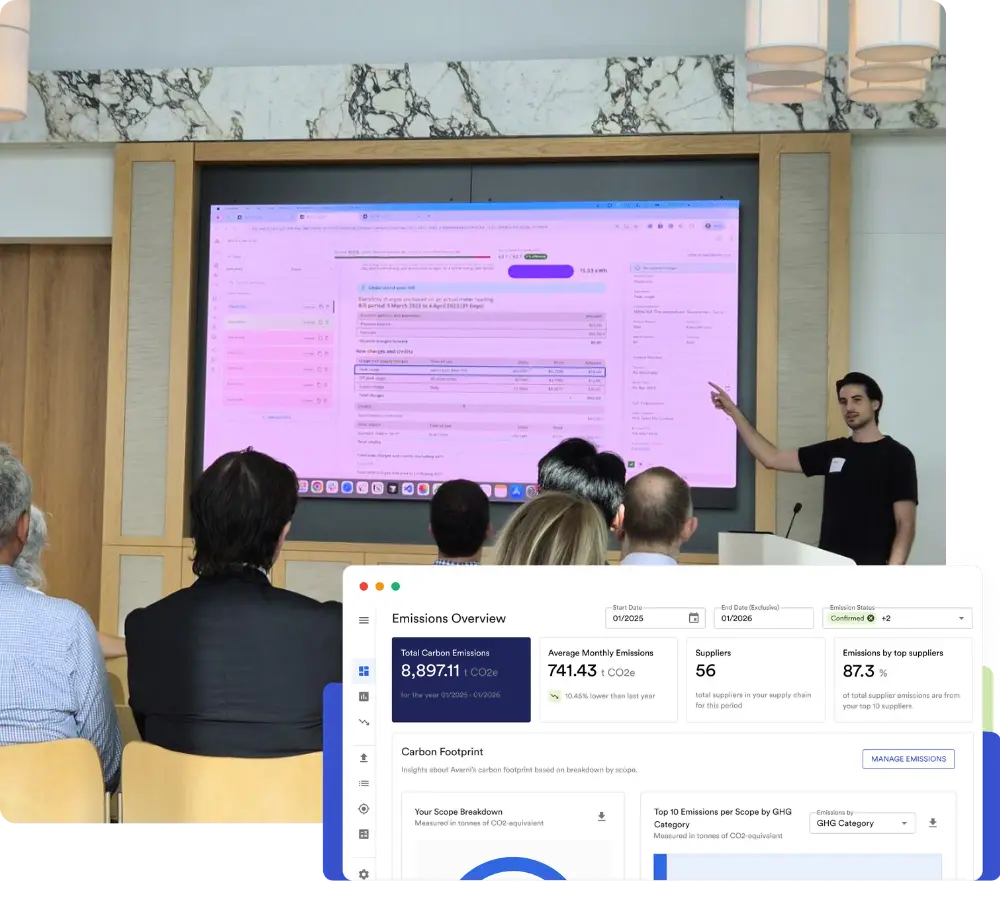
Avarni has raised roughly A$12.6M across its life. The anchor is Main Sequence Ventures, the fund co-founded by Australia's national science agency, CSIRO - an investor that tends to back companies with a defensible technical or data core rather than a marketing story. The through-line across rounds is the same bet the founders made: emissions data, gathered at scale, becomes more valuable the more of it you hold.
Founded through the Antler program after several pivots.
Led by Main Sequence Ventures, with Vulpes Ventures and Common Sense Ventures, after analyzing $100B+ in spend in year one.
From Main Sequence, Sprint Ventures and AfterWork Ventures, to push into large-enterprise decarbonization.
What the platform actually holds
Strip away the positioning and Avarni is a stack of unglamorous, load-bearing parts. There is the emission-factor database - regional and custom factors, plus the ability to configure bespoke rules when an enterprise's data does not fit the standard library. There is the AI matching engine that turns a messy line of invoice text into a defensible emissions figure. There is the supplier-engagement layer, which chases primary data from the vendors that make up the bulk of a Scope 3 footprint, because a real number from a supplier beats an estimate every time. And there is the scenario tooling that lets a company model a net-zero pathway and then track whether it is actually hitting the targets it published.
None of that is exciting to look at. All of it is the point. Carbon accounting fails in the gaps - the invoice that would not parse, the factor that did not exist, the supplier who never replied. Avarni's expertise is less about climate science than about closing those gaps at enterprise scale, then leaving behind a trail an auditor can walk through line by line. The company's own metrics lean on that reliability rather than on any green mission: hundreds of billions in spend processed, a claimed perfect audit pass rate, and a SOC 2 Type II badge that finance teams recognize before they recognize any emissions framework.
The market positionA compliance company wearing a climate badge
It is tempting to file Avarni under "green tech." The more accurate shelf is compliance software that happens to be about carbon. Its timing is regulatory: mandatory disclosure created the demand, and the reports have to be defensible enough to survive assurance. That is why the audit trail, the emission-factor rigor, and the SOC 2 Type II badge matter more to buyers than any sustainability slogan. Avarni is selling certainty on a deadline.
What a customer can actually do with it is concrete: import spend and invoice data automatically, calculate Scope 1, 2 and 3 emissions, engage suppliers for primary data, model net-zero pathways and scenarios, track targets over time, and generate reports aligned to ASRS and international frameworks that an auditor will accept. For a finance team staring at a filing they never asked for, that is less a mission and more a lifeline. Whether Avarni becomes the default for a continent's worth of newly-minted climate reporters depends on the next few filing seasons - the first real test of whether software can absorb a job that regulation just invented.