The problem with a ship is that everybody sees a different one. A charterer sees earning potential. An operator sees port calls and fuel. Finance sees a receivable. Each view is reasonable. Making them agree is where the work begins.
Veson Nautical occupies that junction. Its software follows the commercial life of a voyage, from estimating a deal to executing it and settling the accounts. The attraction is easy to understand: the calculation that persuaded somebody to book a ship should remain recognizable when the invoice arrives.
- The job: connect maritime contracts, voyage operations and financial results.
- The buyers: shipowners, charterers, commodity traders and their commercial teams.
- The expansion: vessel information, valuations and email intelligence acquired around IMOS.
- The lesson: software adoption needs people who own the change.
01 / Before the chairs arrived
In Dubai, Opulence Voyage made an unusually revealing shopping decision. The dry bulk operator, founded in July 2024, secured its IMOS license before furnishing its office. Founder Amit Kumar had a five-person team and wanted to avoid running the business through spreadsheets. Chairs could follow. Voyage calculations could not.
In Veson’s customer account, Kumar describes using the system to assess vessels, calculate freight and bunker costs, and handle carbon calculations. He calls the purchase one of the company’s biggest investments. The account reports 25 voyages meeting its targets. That is a customer’s experience, rather than proof that software alone produced the result.
The purchasing order is more interesting than the endorsement. For a small commercial desk, a system that lets colleagues inspect the same economics can be basic operating equipment. The office is where people sit. The voyage record is where they work together.
02 / A family business with a distance problem
The lineage begins with a modest calculation. Michael Veson founded Veson Inc. in 1979 and created automated port-to-port distance tables. In 2003, Eva Douzinas and John Veson co-founded Veson Nautical and acquired the predecessor’s assets. The following year, IMOS was relaunched with standardized Chartering, Operations and Financials modules.
John’s childhood supplies a useful detail. In a filmed interview, he recalls weekend trips to his father’s office and learning to code there. The business grew out of proximity to shipping’s actual work. A distance table answers one bounded question; a commercial system has to keep many answers connected.

Hosting changed how customers could get that system. IMOSLive arrived in 2013; the web-based IMOS platform followed in 2017. In its 2018 announcement marking 10,000 users, Veson said more than half its clients were using the hosted solution. That move reduced the requirement to maintain the software on a customer’s own infrastructure.
03 / The contract has a long afterlife
IMOS sits in the commercial management layer of shipping. Its capabilities cover voyage and freight estimation, planning and operations, exposure management, and post-voyage settlement. Specialized modules address activities such as bunkering, pooling and claims. APIs and analytics connect the resulting records to other business systems.
Think of a hypothetical cargo booking. Before agreement, a desk wants to compare the economics of possible ships. During execution, it needs to understand the commercial effect of revised port timings or fuel assumptions. Afterwards, someone must reconcile charges and substantiate claims. These are different jobs performed around the same contract.
- 01EstimateCompare the economics
- 02ContractRecord the agreement
- 03OperateTrack the changing voyage
- 04SettleReconcile the result
One shared record travels through the handoffs.
Veson serves dry bulk, chemical, crude oil, LNG and LPG businesses. Its users include freight buyers as well as sellers. It also offers implementation services and training. This is enterprise software sold into an operating organization, where connections to accounting and reporting matter as much as the screen a charterer sees.
Dataloy’s voyage management system is a relevant alternative. Customer stories also show Veson competing with internal tools and spreadsheet habits. The useful comparison is scope: which contracts, workflows and integrations does a buyer need? Veson’s portfolio extends from the voyage record into communications and maritime intelligence. Buyers should test that breadth against their own work.
04 / Five thousand messages and one missing memory
IBULK’s account makes the information problem tangible. The Singapore-based commercial manager describes receiving about 5,000 emails daily around an 18-vessel business. It deployed Shipfix to organize market communication and coordinate colleagues in Singapore and Dubai. Shared visibility helps charterers avoid approaching the same counterparties for the same ship.
“In shipping, you don’t know the importance of an email unless you need it.”Sencer Sahinkaya, Managing Director, IBULK
The team was also migrating six to seven years of historical emails. A searchable past can matter when an operational question or claim resurfaces. The practical insight extends beyond shipping: preserve the record in a form the next person can use. Memory is a poor filing system, particularly when its owner is asleep in another time zone.
05 / Buying the pieces around the voyage
Veson’s acquisitions reveal how it widened the business. Oceanbolt joined in 2021, adding bulk commodity trade-flow intelligence. Q88 followed in 2022 with vessel information management. VesselsValue added automated valuations and maritime market data in 2023. Shipfix joined that December, bringing AI-assisted communications and pre-fixture workflows.
The pattern suggests a commercial logic: bring the information needed to assess a deal closer to the workflow used to manage it. VesselsValue also reaches banks, investors and advisers, widening the audience beyond operating desks. The portfolio now addresses both decisions about a voyage and decisions about the vessel itself.
Institutional capital accompanied the expansion. Pamlico invested in 2017 as Veson’s first institutional equity partner. Francisco Partners announced a significant equity investment in March 2022 alongside existing shareholders. The announcement explicitly connected that funding to product development and targeted acquisitions.
The business earns money through software access and maritime data products, supported by services. A buyer’s real commitment includes integration, migration and training as well as licensing. Opulence’s early purchase illustrates priority; IBULK’s archive migration illustrates effort. Both belong in the buying calculation.
06 / The inbox moves next to the numbers
In June 2026, Veson introduced a unified platform bringing IMOS together with CoCaptain, Mail and Insights. The promise is less application switching: commercial records, messages and supporting intelligence share an interface. CoCaptain adds conversational access to voyage information, while Mail places communication alongside the associated work.
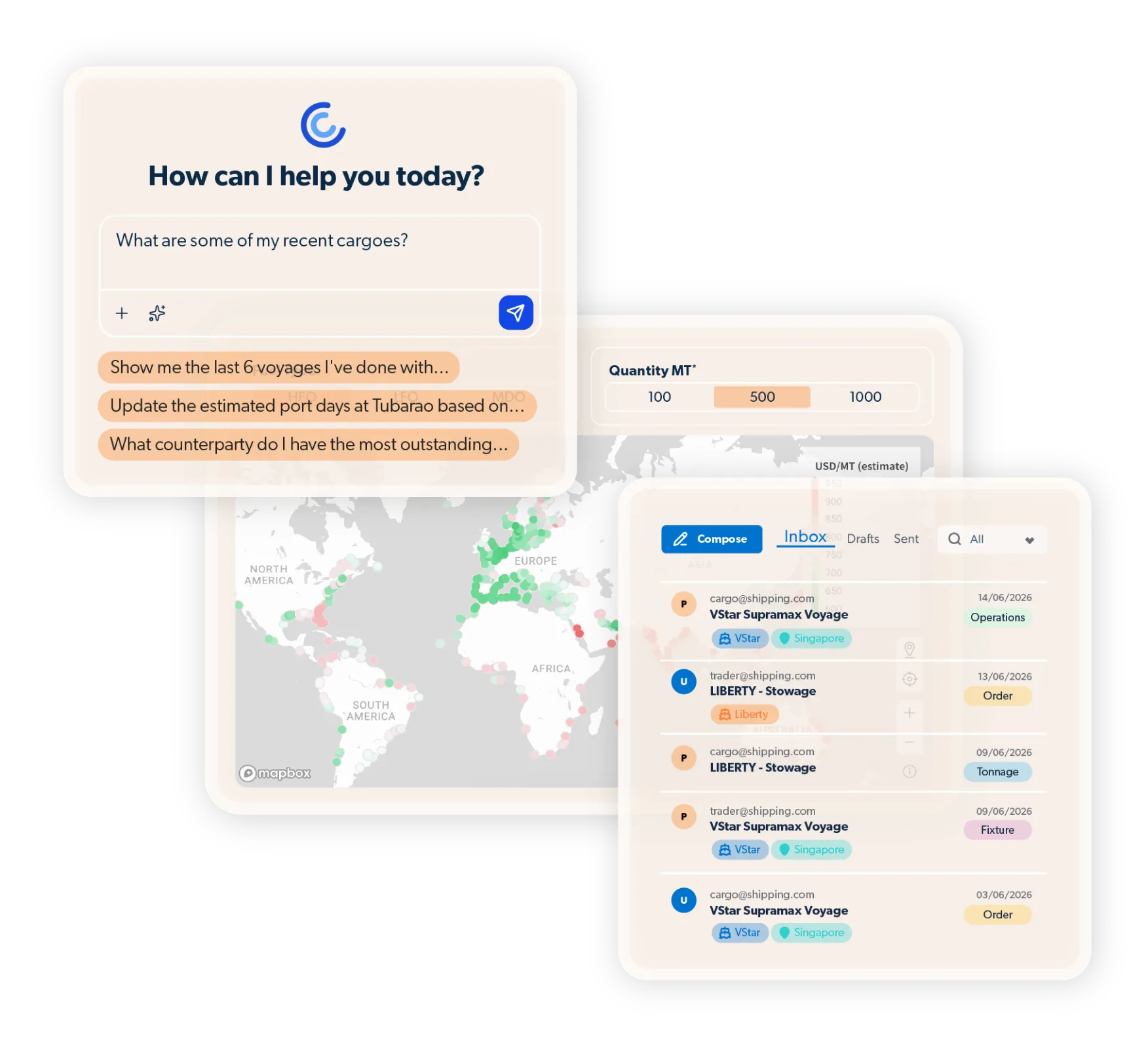
The distinction is context. Asking about a voyage is useful only if the answer relates to the right records. The platform’s Vessel Insights draws from portfolio data sources; Bunker Insights supplies modeled daily fuel-price predictions. Predictions remain inputs to a commercial decision. The software does not remove the need to inspect assumptions.
annual commercial voyages reported across Veson’s ecosystem
Company-reported scale, 2026Veson’s website also reports 38,000 users across more than 100 countries and $122 billion in annual marine freight sold. Those figures describe activity supported by its products. They should not be mistaken for Veson’s revenue. An enterprise software company can sit beside a very large flow of commerce without collecting that commerce as income.
Customers and partners are extending the connections. Cargill broadened access to Veson’s portfolio in March 2025. An EEX integration announced in February 2026 connects freight trade and price information with IMOS. April’s Veracity by DNV partnership brings verified emissions figures into voyage financials. Each addresses another point where teams would otherwise move or reconcile data.
07 / The part a buyer can borrow
SC Shipping offers the clearest adoption lesson. As its fleet grew, substantial manual entry and disconnected reporting made its in-house system burdensome. The company moved to IMOS, emphasizing integration with ERP and reporting tools. Operations head Shane Duan describes the connected arrangement as “one connected wheel.”
He also credits internal super users with driving adoption. That is the copyable part: appoint people who understand the work and can help colleagues use the new system. Budget for the connections and the migration. Judge a demonstration by a real workflow, including the awkward handoff, rather than by a tidy opening screen.

This approach makes sense where maritime contract complexity and coordination justify it. A company with little commercial shipping activity would have less use for the specialized machinery. Even an appropriate buyer needs reliable records and colleagues willing to work through the shared process. Veson’s opportunity lives in that practical agreement: the voyage everyone can recognize, from the first estimate to the last bill.
Follow the working voyage
Explore the Veson Platform, IMOS capabilities and company blog. Follow Veson on LinkedIn, X, Instagram and Facebook.