The accountant recognised the supplier. The email looked ordinary. The request was familiar, too: please change our bank details. At a large Australian construction company, it was an administrative chore between a coffee and a payment run. Except the supplier’s email had been compromised. The person asking for the change was a fraudster, borrowing the credibility of a relationship somebody else had spent years building.
- Eftsure independently checks vendors and their bank details before payment.
- It combines database matching, automated signals and human verification.
- Finance teams buy a subscription priced around spending and supplier onboarding.
- Sis ID and Relish have expanded its geographic reach and product scope.
The company had already installed Eftsure. Its team sent the request through the verification process. The impostor completed the form, then added a small excuse: they did not have their phone and could not complete the usual SMS check. Verification specialists investigated. The request was fraudulent. According to Eftsure’s account, tens of thousands in potential payments were spared. The dramatic part of the story was an email; the decisive part was an inconvenient form.
The name on the invoice is only half the story
Eftsure occupies a peculiar corner of business software. It sits between an organisation’s intention to pay a supplier and the bank details that determine who actually receives the money. Accounts payable may approve a perfectly legitimate expense while sending the payment somewhere entirely wrong. A tidy invoice and a familiar sender are evidence about a commercial relationship. They cannot, by themselves, establish ownership of a bank account.
Founded in 2014 by Ian Mirels, Mike Kontorovich and Mark Chazan, the Australian company built its proposition around independent payee verification. Its submission to Australia’s Treasury dates the platform launch to 2016. The initial insight was straightforward: compare supplier banking records with information beyond the paying company’s own files. An accounting system can faithfully reproduce a mistake. A second source can challenge it.
Verification belongs before the money moves.
- 01Vendor details arrive
- 02Independent checks
- 03Resolve discrepancies
- 04Release payment
An illustrative workflow, rather than a promise that every check is instantaneous.
A green thumb still needs a human hand
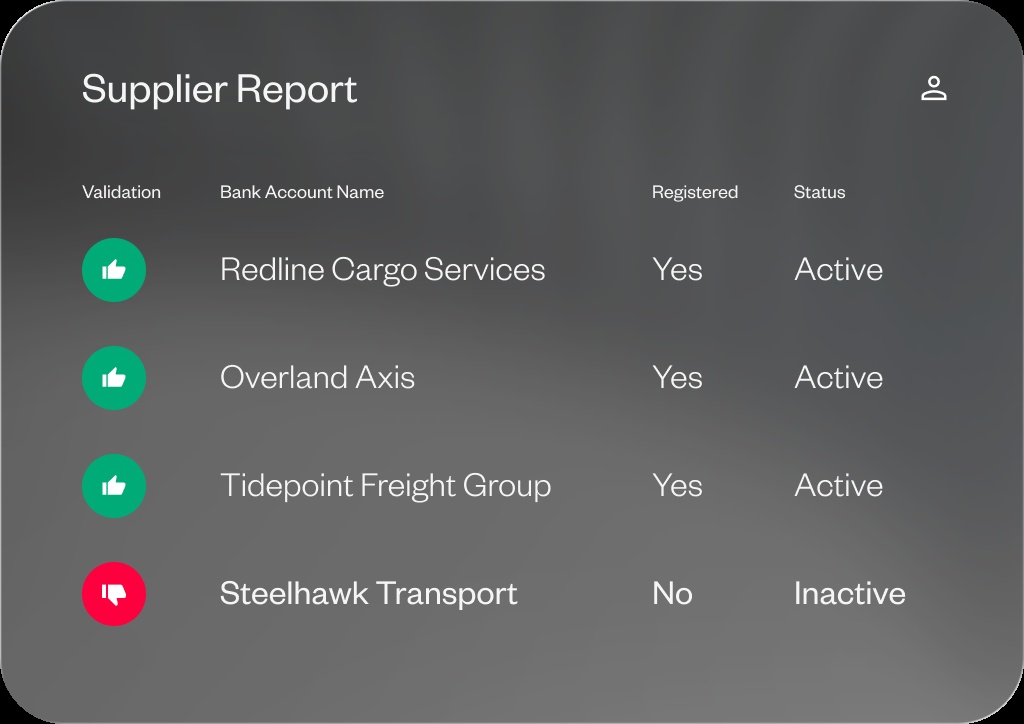
Customers can onboard suppliers, validate their identity and banking information, and screen payment details before release. Eftsure’s payment-protection interface uses thumbs: green for verified details, red for discrepancies that require attention. Its vendor-management, permissions and reporting tools turn the check into a repeatable process. The point is to give finance staff something more dependable than a hunch when a payment is ready to leave.
Eftsure describes several verification layers, including business identity, account ownership, network intelligence and analyst review. Its software flags inconsistencies; specialists investigate unresolved cases. That division of labour matters. A hurried team might wave through the hardest supplier to verify. Customers retain the responsibility to respond to warnings and resolve exceptions before paying.
Trust had a twelve-year head start
Another customer story begins after the damage. An unnamed logistics firm discovered that an employee of twenty years had created false invoices and diverted hundreds of thousands of dollars through a fraud lasting twelve years. A routine accounting question produced evasive answers and exposed the scheme. By the time solicitors were involved, the employee had left the country.
That experience changed the firm’s appetite for relying on familiarity. It adopted Eftsure to obtain visibility into vendor banking details and changes. An accounts payable officer reported saving at least thirty minutes per payment run. Its new rule:
“If it’s not a green thumb, we don’t pay it”Team principle, anonymous logistics customer
This is a useful distinction between prevention and recovery. Eftsure was adopted after that fraud was discovered; the case does not credit it with detecting the original scheme or recovering the loss. Its value was a different routine for future payments. For readers, the copyable habit is concrete: make altered bank details a fresh verification event, even when the supplier or colleague is familiar.
The price of an independent second look
Eftsure sells a business subscription. Its published pricing basis combines annual expenditure with the number of new vendors onboarded monthly. A team processing a few stable suppliers presents a different workload from one constantly adding contractors. Customers request a quotation. The pricing page also lists preparation stages: a vendor-file health check, attempts to verify anomalies and suppliers outside the database, and two hours of staff training.
The guarantee adds another consideration. Eftsure advertises up to $1 million in indemnification for eligible verified payments lost to social engineering fraud, subject to its terms and service addendums. It says the guarantee is included for customers signing agreements after March 10, 2025. Buyers should compare the applicable eligibility and currency terms alongside the fee. The headline number is a ceiling on conditional protection, rather than a forecast of what any incident will repay.
From the receiving account to the invoice itself
Eftsure serves finance and procurement teams across sectors where supplier relationships proliferate: construction, mining, education, government and logistics. Its published customer stories include Georgiou, Ramelius Resources and the University of Wollongong. Nacha named it a Preferred Partner in July 2025 for account validation, fraud monitoring, and risk and fraud prevention. That recognition places it within the US payments ecosystem; it does not remove the need for a customer’s own controls.
The business has also widened. France-based Sis ID joined in 2025, extending international verification. In August 2026, Eftsure announced a Singapore expansion. The following month Relish joined, bringing vendor-data validation and invoice automation. The combined company reports more than 4,000 customers and 11 million monitored vendors. Those are measures of its network, not proof that every possible supplier can be verified.
Company-reported, September 2026
Relish brings the proposition further upstream: examine the data and invoice before checking the destination. Eftsure says the combined capabilities connect with more than thirty-five enterprise platforms. Some additional benefits remain integration plans, rather than finished features. Under global CEO Jon Soldan, the direction is clear: make payment assurance span more of the finance workflow.
Useful friction, properly placed
Alternatives include Trustpair, PaymentWorks and independent manual checks. Buyers should examine country coverage, account-ownership methods, integration and exception handling. Eftsure’s appeal lies in combining those checks with onboarding, payment screening and human support. It is most useful when teams will investigate a warning; a red thumb ignored cannot keep money in the bank.
The construction accountant’s story offers the smaller, better lesson. A fraudster borrowed a supplier’s identity and asked for a routine change. The business made that change slightly less routine. Sometimes the most valuable thing finance software can do is give a busy person a reason to pause.