A tumor is a noisy neighborhood. Cancer cells occupy the address, but immune cells, blood vessels and connective tissue are all talking. Grind the whole block into one sample and sequence it in bulk, and you get a useful average. You also lose the quiet voices. Abiosciences has made a business out of listening for them.
The South San Francisco company prepares and sequences single cells, analyzes their molecular signals, organizes existing studies into searchable datasets, and uses those maps to look for drug targets. It has research sites in Beijing and Shanghai as well as California. The idea is simple enough to draw on a napkin: if disease depends on a particular cell state, first find that cell state. The difficult part is proving that a promising pattern means something beyond the dataset in which it appeared.
- Customers include pharma, biotech, hospitals and research groups that need experiments, analysis or target discovery support.
- The offer runs from tissue preparation to single-cell and spatial data, then to interactive exploration through OmniBrowser.
- The company also develops targets and antibody assets for licensing or co-development.
- Its database page reports 120 million cells; that is a search space, not a count of validated drugs.
The average can be a liar
Suppose a therapy fails because a small group of tumor cells escapes the drug. A bulk sample may report the dominant cells faithfully and still bury the group that matters. Single-cell sequencing can separate those groups by gene expression. Spatial methods add another question: where are they? A cell near a blood vessel or an immune cluster may behave differently from an apparently similar cell elsewhere in the tissue.
Abiosciences sells the full chain. Its service menu includes single-cell RNA sequencing, immune receptor profiling, RNA plus protein measurements, chromatin accessibility assays and spatial transcriptomics. It works with fresh and frozen tissue and preserved FFPE samples. Its bioinformatics team then handles work such as quality control, cell type annotation, differential expression, trajectory analysis and cell-to-cell communication. A customer can commission the experiment and the interpretation together, which is particularly useful when the biological question is still taking shape.
The fourth step deserves an asterisk. Sequencing and analysis can nominate a target; they cannot by themselves establish that changing it helps a patient. That requires independent experiments, safety work and eventually clinical evidence. The distinction matters because the distance between an interesting cell and an effective medicine is substantial.
A browser for the cellular crowd
The less visible half of the business is a growing store of data. Abiosciences says its Omni Single Cell Database contains 120 million cells drawn from more than 4,300 datasets and 2,200 studies. Its OmniDatasets offering packages curation, integration and reports; OmniBrowser provides interactive search and analysis. Those figures are company-reported, and the value of the collection lies in how consistently the studies can be compared.
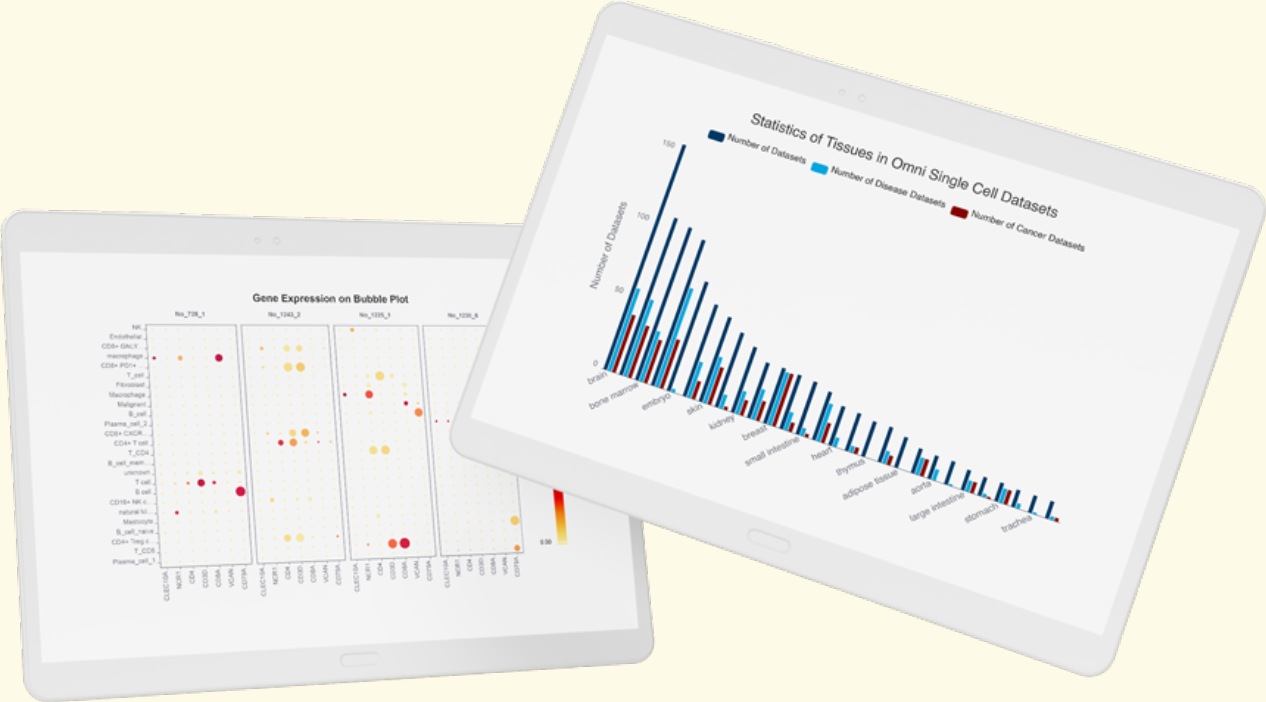
Imagine a drug team investigating a receptor in one cancer. Rather than begin with a single specimen, it could inspect the receptor across annotated cell populations, healthy tissues and disease studies. A candidate that appears only in a rare tumor-associated population might become more interesting. A candidate abundant in essential healthy cells might become less so. The browser is a way to ask sharper questions before expensive laboratory work; it is not a shortcut around that work.
The useful unit of biology is sometimes the exception, not the average.Editorial observation
The laboratory has a licensing desk
Abiosciences’ model is unusual in its breadth. It earns business by running research services and offering data tools, while also pursuing its own therapeutic targets and antibody assets. Its site invites partners to license validated targets or co-develop therapeutic leads. That creates two routes from a cell atlas to revenue: help another organization make a discovery, or take a discovery forward as an asset.
The company has said its antibody R&D center studies innate immunity and the tumor microenvironment. That focus fits the single-cell thesis: tumors are ecosystems, and immune or connective-tissue cells can influence whether a treatment works. But public material does not price the services, disclose target-license terms, or identify an approved therapy arising from the platform. The commercial story, for now, is a set of offerings and collaborations rather than a clinical victory lap.
One concrete collaboration came in December 2022. Mission Bio and Abiosciences announced a plan to co-develop bioinformatics packages for hematologic cancer research in China. Mission Bio brought its Tapestri single-cell DNA and multi-omics platform; Abiosciences brought analytical expertise. The stated goal was to look for disease signatures and resistance patterns that could support translational research. It was an announced development partnership, not evidence of a finished diagnostic product.
What a customer can actually copy
The company was founded by Zemin Zhang, a cancer genomics researcher. Its founding story, as told publicly by a former genomics director, began with a wish to use single-cell data to find therapeutic targets and clinically relevant biomarkers. The practical lesson is less grand than “collect more data.” Start with a decision: which cell population or state would change the choice of target? Then choose the assay and sample type that can answer it. Put cell annotation, tissue context and independent validation into the plan before interpreting an attractive cluster as a breakthrough.
There is also a business lesson. A research company can build expertise by doing difficult customer work, then turn repeatable methods and accumulated data into tools. Abiosciences’ service work, database and target programs each have a different payoff horizon. The short job produces an analysis. The browser helps a scientist explore. A licensed target could take years to prove. Keeping those horizons distinct is more honest than calling every interesting cell a medicine in waiting.
The approach is best suited to questions in which cellular differences matter and usable tissue or comparable datasets exist. It will be weaker when sample quality is poor, annotations are unreliable, or the disease mechanism is not captured by the measured molecules. Single-cell maps can make a hypothesis more precise. They cannot decide, on their own, whether the hypothesis survives biology.