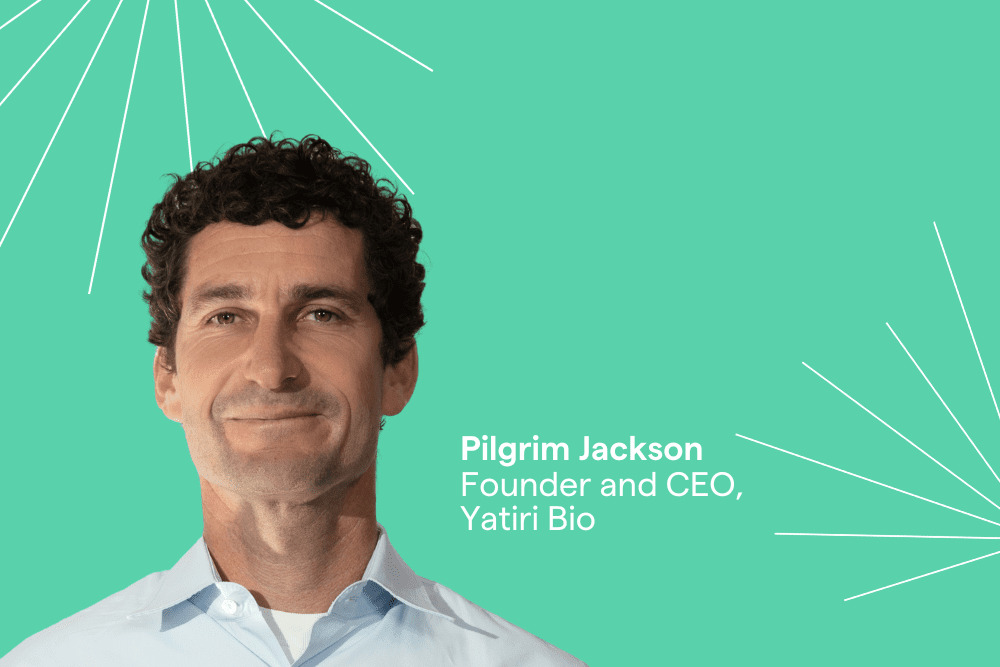
Pilgrim Jackson learned to read a shifting system before he learned to run a company. He was raised on a sailboat, loved the ocean, and imagined a future as a marine biologist. The sea offered an early education in variables: weather changes, equipment protests, and a line that looked sensible an hour ago needs correcting. Years later, his laboratory would trade rigging for mass spectrometers. The habit remained. Look closely at what is happening, not merely at what the plan predicted.
At Yale, Jackson moved from observational science toward experiments that could corner a hypothesis. He studied molecular biochemistry and biophysics, worked in Lynne Regan's laboratory on protein design and structure, and captained the mountain-bike club. The combination feels almost suspiciously tidy in retrospect: proteins, teams, difficult terrain. He earned his bachelor's degree in 1998, then completed a doctorate in biochemistry at the University of California, Santa Cruz, in 2005.
His career then settled in San Diego at Celgene, although very little about the work was settled. Across 13 years, he built and led multidisciplinary groups confronting drug-discovery problems in inflammation and oncology. He eventually headed systems proteomics, charged with producing large volumes of biologically relevant data and turning them into decisions. According to his company biography, projects he worked on delivered six therapeutics to the clinic across biologics, protein degraders, and small molecules, and resulted in four patents.
A gap worth leaving for
Jackson remembers the earlier Celgene as a rare creature: big-pharma revenue with a biotech spirit. Then Bristol Myers Squibb bought the company. Big integrations have their own tide tables. Marketed products come first, clinical programs follow, and early research waits farther down the line. After remaining for a year, Jackson decided that the wait would be measured in years.
“I like filling a gap.”Pilgrim Jackson
The gap he chose was both scientific and organizational. Cancer trials often group together people whose diseases share a name but not a working molecular state. A compound may help one subset and do little for another. When the results are averaged, the responsive signal can disappear. The drug looks weak. The trial fails. A useful medicine may be abandoned because the study asked one broad population to behave as one biology.
Jackson co-founded Yatiri Bio with Afshin Mahmoudi in 2020. The name is taken from an Aymara word associated with a wise person or healer, while the enterprise itself is stubbornly empirical. Yatiri measures proteins in patient samples, positions living experimental models within those proteomic landscapes, adds clinical context, and trains computational systems to spot response and resistance patterns. The intended output is not a prettier chart. It is a more informed choice about which therapy belongs with which molecularly defined group.
The blueprint and the building
To explain the premise, Jackson uses architecture. RNA is the blueprint of a house; proteins are closer to the structure that was actually built. The analogy earns its keep. Genetic information remains essential, but a cell regulates, modifies, and degrades proteins after instructions are copied. Those changes affect the machinery that drugs encounter. If the aim is to understand a medicine's target or a pathway's activity, proteins can reveal behavior that upstream measurements miss.
Proteomics, however, does not become useful merely by producing more columns. Samples must be comparable. Clinical metadata must be trustworthy. Measurements must be reproducible. Models must represent the patient landscape rather than a convenient corner of it. Machine learning can find structure across these layers, but Jackson's public comments keep returning to the quality of what enters the system. The fashionable part is the algorithm. The hard part is earning the right to believe its answer.
That insistence has roots deeper than the startup. Jackson's published work ranges from the structural evolution of agouti proteins to a spleen tyrosine kinase inhibitor studied in inflammatory models. At Celgene, he was among the researchers examining how cereblon-associated proteins could serve as biomarkers of response or resistance to certain medicines. His patent record likewise follows the path from mechanism to selection, including inventions involving PD-1 binding proteins, CD47 antibodies, and methods for predicting clinical sensitivity. The subjects differ, but the recurring problem is recognizable: a target or therapy only becomes useful when its biological context is understood.
Systems proteomics gave that problem a wider lens. Instead of treating one protein as the entire plot, the approach follows networks, pathways, abundance, and modification across many proteins at once. It is the molecular equivalent of refusing to judge a city by a single traffic light. The cost is complexity. The reward is a chance to see why two samples with similar genetic labels can behave differently when exposed to the same compound. Jackson's contribution was not simply generating this information. His company biography emphasizes the next move, turning it into actionable knowledge.
Yatiri started with acute myeloid leukemia, or AML, and ovarian cancer. Both are heterogeneous diseases with significant development activity, which makes them useful tests of the company's premise. In 2023, Jackson and collaborators at Yatiri and Fred Hutch presented an American Society of Hematology abstract describing a proteomics-informed AML subset sensitive to venetoclax. The work linked patient clustering with diverse ex vivo models, making the company's central claim visible as an experimental workflow rather than a slogan.
The current AML platform has grown well beyond that first public poster. Yatiri reports more than 250 profiled samples, 40 functional ex vivo models, and more than 5,500 dose-response curves across 50 compounds. These are company-reported platform figures, not a universal scorecard. Their importance lies in the shape of the evidence: patient-level observations connected to something that can be tested, perturbed, and compared.
“We don't know as much as we think we know, so follow the data.”Pilgrim Jackson
From measuring drugs to owning a decision
For a young company, Yatiri's progress has arrived in distinct steps. It was named among Connect's Cool Companies in 2023 and reached the final group at the 2024 San Diego Angel Conference. A Gates Foundation grant announced in 2025 supports work on proteomics interoperability, beginning with cervical-cancer datasets. The problem there is less glamorous than a new model and perhaps more consequential: measurements made on different platforms cannot help a global research community if they refuse to speak to one another.
The strategic turn came into sharper view in March 2026. Yatiri entered an exclusive global option with South Korea's Oscotec to license denfivontinib, a multikinase inhibitor, for AML. Yatiri says its ProteoCharts platform identified a biomarker profile, independent of the familiar FLT3 mutation, associated with a responsive population. The agreement places the company nearer the consequence of its prediction. Instead of supplying analysis to someone else's program, it can use its platform to shape the development of an asset it may license.
That shift reveals Jackson's larger ambition. A platform business can sell insight by the project. A therapeutics business must decide which insight deserves capital, regulatory work, and time. Yatiri has not escaped uncertainty by measuring more proteins. It has chosen a method for making uncertainty more specific.
A founder who still thinks like a lab leader
Jackson's public advice is refreshingly short on founder theater. Young scientists, he says, should stay true to the science, think beyond inherited boxes, and work on goals that matter to them. Would-be biotech CEOs should surround themselves with a strong team whose members trust one another. This sounds less like a commencement speech than a memory of how hard multidisciplinary research becomes when confidence inside the group is thin.
His own connections trace that collaborative style. The founding team includes colleagues with long drug-discovery histories. The AML work has involved Fred Hutch researchers. Yatiri has described collaborations or planned work with academic and clinical organizations, while its San Diego Proteomics Day events gather mass-spectrometry and computational researchers around questions of data quality. Jackson's LinkedIn posts celebrate team milestones more readily than a mythology of solitary invention.
Even his preferred self-description, “motivated drug hunter,” is revealing. A hunter follows signs, tests terrain, and accepts that the thing being sought will not arrange itself for easy discovery. The job is part patience, part pattern recognition, part refusal to confuse a map with the place.
The sailboat has become a company, the changing weather a molecular landscape, and the destination a trial designed around people who might plausibly benefit. Jackson's route from Yale proteins to Celgene systems and then Yatiri has been less a reinvention than a narrowing of responsibility. At each stage, he moved closer to the decision hidden inside the data.
There is wit in the predicament. Modern drug discovery can measure a patient in astonishing detail, train a neural network across thousands of proteins, and still stumble over the old human question: who is this for? Jackson has made that question his company's compass. The honest answer will vary from drug to drug. He would probably distrust any method that promised otherwise.