Aashi Vel had done the research. In Mexico in 2011, she had looked through recommendations and reviews, trying to find the food people actually ate. Yet the search kept delivering her to restaurants crowded with other travelers. Then, passing a home, she saw a woman cooking through a window. The dinner she wanted was happening somewhere she had no invitation to enter.
It is a familiar travel predicament, with an awkward social obstacle attached. You can book a flight across an ocean more easily than you can arrange lunch with somebody who lives at the other end. Vel wanted the meal and the company: to hear the cook’s stories, understand her food and spend time in the place where she made it. A restaurant recommendation could only get her so far.
That wish became part of the foundation of Traveling Spoon, the company Vel would start with Steph Lawrence. It connects travelers with local hosts for private meals, cooking experiences and market visits. The idea required a website, certainly. It also required persuading people on both sides of a front door that opening it could be worthwhile.
The table she already knew
Vel grew up in South India, the middle child between two brothers. Saturday lunch had its own family rule: no meat. Her father intended the restriction as a lesson in self-control. The menu made restraint rather appealing. There was rasam, the peppery tomato broth eaten with rice and ghee; beans poriyal with curry leaves and coconut; potatoes or tapioca; peas and potatoes; and dahi vada.
She has said she still enjoys making those traditional dishes. The memory offers a useful way into her later work. A family meal can contain rules, jokes, preferences and a parent’s attempt at moral instruction, all served together. Somebody encountering only a dish’s name on a menu misses much of what makes it belong to that household.
For Vel, this interest eventually became a career choice. She earned her MBA with the intention of starting a food company. Before business school, however, she had spent years learning another profession, one concerned with observing people closely enough to understand what they needed.
Pork tacos, then a pilot
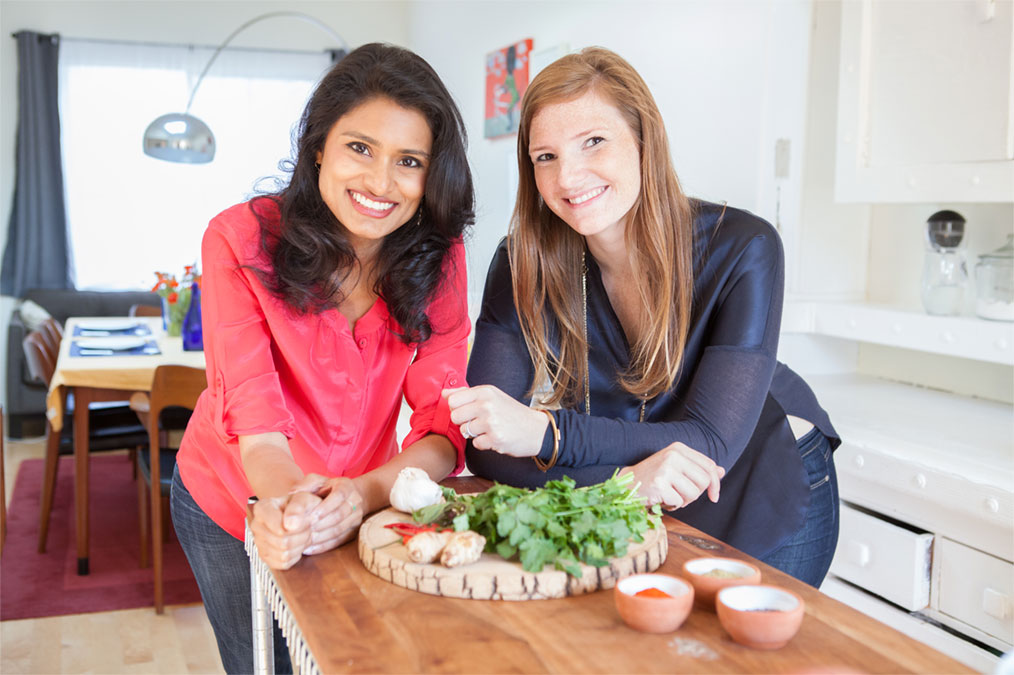
Vel and Lawrence met at Berkeley Haas orientation in August 2011, over pork tacos. Their dissatisfaction with travel food had different geographical coordinates. Vel had Mexico. Lawrence had China, where she had wanted to learn family cooking and struggled to find a way into the experience. They recognized a shared interest before they had a finished company.
Their combination was practical. Vel brought industrial design; Lawrence brought a background in marketing and international development. They worked on Traveling Spoon through their MBA classes. By December 2011, they had a pilot underway, with the first customers taking food experiences in India in January 2012. The business was being tried while its founders were still students.
That sequence matters. A charming idea about strangers eating together can survive indefinitely in a classroom conversation. A paying guest arriving at a host’s house asks harder questions. Who wants to host? Who will book? What should the experience contain? The pilot gave the women something more useful than agreement: people doing the thing they hoped to build.
- 2011Meet at Haas; begin the pilot
- 2012First pilot guests in India
- 2013MBA graduation; July company launch
They graduated in 2013 and launched Traveling Spoon that July. Early hosts were in India, Thailand and Vietnam. The company’s first proposition was small enough to explain without a presentation: go to a local person’s home, share their food and learn something about the place through the person who cooked it. Doing that reliably would occupy rather more time than explaining it.
A designer at the dinner table
Vel’s earlier career lasted 11 years and included work at Eclipse PDC and Eleven LLC. She managed designers and engineers, conducted user-centered research and developed products. She is a patent holder, and her designs received design and packaging awards. At Savannah College of Art and Design, she graduated magna cum laude before later completing her Berkeley MBA.
These are useful qualifications for someone building a business around experiences that happen away from her desk. Industrial design asks what a person is trying to accomplish, where the difficulty occurs and how a product might help. A food experience has its own sequence of decisions, from finding the host to understanding what happens when you arrive.
Vel has discussed applying her design skills to Traveling Spoon’s website and user experience. The connection is easy to see. The traveler needs enough clarity to book; the host needs a workable arrangement; both need the afternoon to resemble what was promised. A pleasant photograph can begin that conversation. The design work continues long after the photograph has done its job.
Her public interests include creative problem-solving, product innovation and foraging. The last item makes a pleasing companion to the first two. All involve looking more carefully at what is already there. In a business about local knowledge, that habit seems especially at home.
The work behind the welcome
One early concern was whether residents would welcome strangers into their homes at all. Vel traveled to India at her own expense to recruit hosts. Then came the other side of the marketplace: discovering whether travelers would pay for the invitation. The founders had to establish demand in both directions, with a meal at the point where the two met.
Traveling Spoon’s approach centers on vetted hosts and private experiences. Guests can share a home meal, add a cooking experience or visit a market with their host. The setting gives the host a role that extends beyond producing lunch. They can explain ingredients, household customs and the reasons a recipe takes the form it does.
“Our hosts are our pride and joy.”
Aashi Vel
There is an economic purpose alongside the conversation. Home cooks can earn money from skills they already possess. The founders have described this as an opportunity for hosts to become microentrepreneurs. It gives a family recipe a second setting: still made at home, now also part of somebody’s livelihood. The kitchen does not need a restaurant dining room to have something visitors value.
By 2015, the company had built and automated an online marketplace and offered experiences in 20 countries. Its network included former Expedia CEO Erik Blachford as an investor and Alice Waters as an advisor. Those connections brought travel and food experience to a venture whose central transaction was unusually personal.
Vel has also been frank about asking for expertise. She and Lawrence lacked a computer science background, so they sought technical help, including Airbnb’s first engineer, Nick Grandy, as an advisor. Her advice to would-be founders includes sharing ideas, finding trusted people and helping others in return. The dinner company itself began with two people saying what they wished existed.
The papaya that stayed on the tree
One of Vel’s remembered visits was to Dewa, a Traveling Spoon host in Bali. Walking through his garden, she noticed a ripe papaya and wondered why they were not eating it. Dewa explained that there had been two that morning. The household had taken one and left the other for monkeys to spread the seeds.
The answer stayed with her. She had gone to a host’s home to explore food and found herself considering what a household chose to leave alone. Grinding curry pastes, learning about plants and cooking with the family belonged to the same experience. The unpicked fruit explained something the finished plate could not.
There is a welcome reversal in that anecdote. A founder building a travel experience gets to be the person asking the obvious question. Her host supplies the knowledge. For a company organized around introductions, the story makes a persuasive case for leaving enough time after the introduction to listen.
Room for another chair
Traveling Spoon reached 65 countries by 2022. In a fall 2025 Berkeley Haas alumni update, Vel reported the company in 65 countries and more than 230 cities. Those figures describe its geographical reach. The experience remains deliberately intimate: one booking, a host and the people coming to eat.
A large map, assembled from individual invitations.
Her involvement in food tourism has extended beyond her own marketplace. She has co-hosted the World Food Travel Association’s interview podcast and served on its board, discussing the industry with people working across countries and culinary cultures. Listening to how others approach the field fits naturally beside a business that depends on hosts knowing things its visitors do not.
In a January 2025 conversation on Soul of Travel, she discussed foraging, regional food differences and an interest in bringing more indigenous and sustainable food experiences into the company’s offering. The ambition makes the host’s knowledge central. A recipe can be taught as a set of instructions, but understanding its ingredients and setting takes another kind of attention.
Vel’s stated vision has been for travelers to have an authentic food experience at least once on every trip. It is a modest-sounding addition to an itinerary with considerable consequences for how an afternoon gets spent. Someone who might have researched another restaurant instead learns a cook’s name, asks about a plant or helps prepare a family dish.
Back in Mexico, Vel had been close enough to see the meal and too far away to join it. Her company has spent years working on that distance. The destination was already in view. What she wanted was a place at the table.
Keep a place at the table
Explore Traveling Spoon and its founders’ story. Connect with Vel on LinkedIn or Travel Massive. Follow the company on Instagram and Facebook.