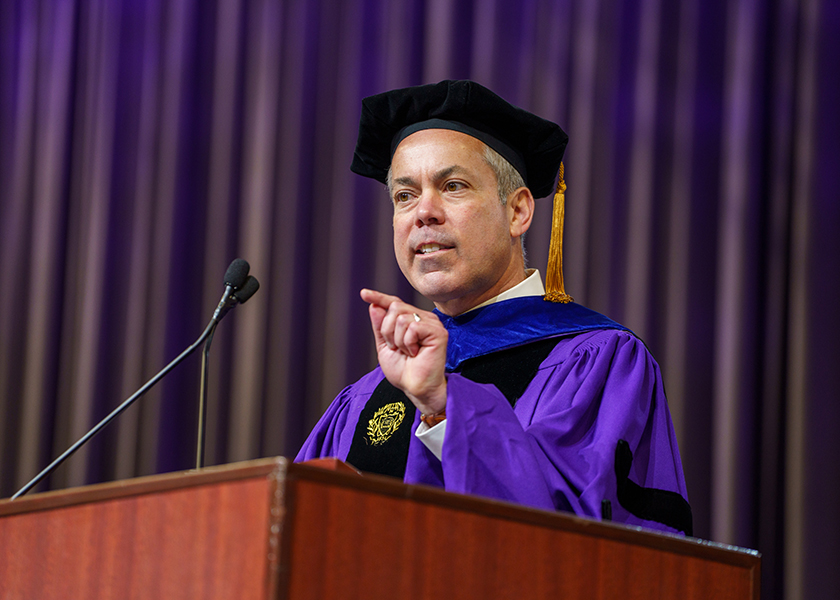
In June 2026, Aaron Saak returned to Northwestern with an unusual message for newly qualified engineers: being “directionally correct” could take them further in business than being “precisely accurate.” He had earned his doctorate there in 2000. A quarter-century later, he was running Crane NXT, a company whose customers have rather less room for approximation when deciding whether something is genuine.
It is a useful tension to begin with. The person running an authentication business must make strategic bets about an uncertain future. The products his teams build must give people and machines dependable answers in the present. Saak’s career has brought those two kinds of judgment into the same office.
Before the ticker, the engineering
His education began with ceramic engineering at the University of Illinois at Urbana-Champaign. He followed it with a master’s in industrial engineering and management science and a Ph.D. in materials science and engineering at Northwestern. The combination covered both the substance of manufactured things and the systems used to make them. It makes a sensible introduction to the executive he became.
Saak spent ten years at General Electric. His assignments included technology, marketing and product management. He then spent eight years at Tyco International, taking on progressively larger responsibilities. Those are long apprenticeships in organizations where an attractive idea eventually has to survive a budget, a production process and a customer.
At Tyco, his work included North American installation and services, global fire sprinkler and special hazards businesses, and leadership of SimplexGrinnell. The scale mattered. Its customer base exceeded 400,000, while the business had a century of operating history. A leader in that setting inherits commitments made long before arriving. There is no clean sheet of paper, however appealing the stationery.
In February 2018, he became president of Gilbarco Veeder-Root. GVR was an approximately $2 billion business with sales in more than 40 countries. In June 2022, he moved into the president and CEO role at Vontier’s Mobility Solutions. By November, another assignment was beginning.
A new company with an old inheritance
Crane announced Saak’s appointment in October 2022, ahead of the planned separation that would produce two independent public companies. He was being hired to lead Crane NXT through that transition and beyond. His experience matched the assignment: technical businesses, international operations and organizations large enough to require more than personal supervision.
The separation was completed on April 3, 2023. Crane NXT began trading the next day on the New York Stock Exchange under CXT. Saak’s task was to give an existing collection of businesses a future as an independent company. He had inherited products, people, customers and industrial habits.
There was also an inheritance that a newer technology company might envy: physical things already doing useful work. Currency security and payment equipment put Crane NXT inside everyday transactions. Saak could pursue growth from that base, while investors could begin judging the company on its own results. Independence supplied a clearer boundary around both the opportunity and the responsibility.
The tiny moving picture in your pocket
One way to understand the business is to look at a $100 bill. Its blue security ribbon contains images that appear to change as the note moves. Crane’s micro-optics help produce that effect. A complicated piece of engineering asks the person holding the money to do something pleasantly uncomplicated: look, tilt, notice.
Saak did not invent that ribbon, and its history predates his arrival. What it gives his strategy is a tangible starting point. A security feature earns its place by helping distinguish a genuine object from a convincing imitation. The same commercial problem appears beyond currency, wherever someone has an incentive to borrow another organization’s identity or reputation.
There is a second audience for the technology. Machines need to verify banknotes too. Crane’s Detect material uses near-infrared sensing and can be combined with micro-optic features without changing their visible effects. A person sees one set of clues. Equipment reads another. Designing for both expands the work far beyond making a clever visual flourish.
This is where Saak’s technical background gives the story some continuity. His business depends on materials, sensors, software and manufacturing working together. The final customer may see only a momentary decision at a machine. Behind that moment sit several disciplines, each with its own practical demands.
Visible micro-optic movement helps someone recognize a security feature.
Near-infrared sensing reads a material signal beyond human vision.
Buying the next piece of the answer
Saak’s next moves widened the range of objects the company could help verify. In 2024, Crane NXT acquired OpSec Security. The announced agreement put the cash price at $270 million, subject to adjustments. OpSec brought brand protection, optical security and software capabilities, including product traceability and tools for addressing online brand abuse.
The acquisition also brought relationships with brand owners, licensors and government customers. Those relationships matter when introducing a technical capability into a new market. A manufacturer can possess an ingenious security feature and still need a route to the people who specify, buy and use it. Saak was acquiring a commercial channel alongside technology.
There was an early example of those connections taking shape. In his 2024 shareholder letter, Saak reported the first contract to sell micro-optics through the OpSec channel. That is a more specific measure of an acquisition’s usefulness than simply putting two names on the same slide. One business had provided another with a route to a customer. The same letter recorded 13 new currency denominations specifying Crane’s micro-optic technology during the year, showing the existing business continuing to win work as the portfolio widened.
The organizational chart changed to reflect that direction. Crane Currency became part of a broader Security and Authentication Technologies segment, alongside OpSec. Sam Keayes, who had led Crane Currency, was promoted to oversee the segment. The product offering was expanding, and responsibility for connecting its parts needed to expand with it.
Then came De La Rue Authentication Solutions. Crane NXT completed that acquisition on May 1, 2025, adding security technologies for government-issued identification documents and credentials. OpSec and the acquired authentication business were placed together in a new unit called Crane Authentication. A company associated with banknotes was assembling a broader set of answers to questions of identity.
The price agreed for De La Rue’s authentication business was £300 million in cash, subject to adjustments. Saak was committing substantial capital to the direction he had chosen. Whether those purchases create value depends on more than the appeal of their markets. The businesses have to serve customers, improve operations and justify what was paid for them.
After the announcement comes the factory
In March 2026, Crane NXT completed the acquisition of Antares Vision. The following day’s announcement introduced another organizational change: Antares would sit alongside CPI in the newly established Detection & Traceability Technologies segment. Inspection, detection and tracking added another set of capabilities to Saak’s portfolio.
The work after closing is central to his assignment. By August, he was talking about implementing the Crane Business System inside Antares. His emphasis was on putting a management system to work inside an acquired organization.
“We are quickly implementing the Crane Business System to drive growth and margin expansion.”
Aaron Saak / August 2026
The results require a careful reading. In the second quarter of 2026, Crane NXT reported sales of $493.2 million, up 22 percent year over year. Organic sales growth was 2.8 percent. Acquisitions helped enlarge the company; growth inside the existing portfolio was a different, smaller number. Both belong in any assessment of Saak’s progress.
His 2025 shareholder letter presented a similar distinction: nearly $1.7 billion in annual sales, approximately 11 percent total growth and roughly 1 percent core growth. It also described continued investment in existing businesses alongside acquisitions. For Saak, the task is to make those two engines contribute together over time.
Saak’s approach pairs a focus on customers with measurement and continuous improvement. Those priorities have practical consequences. A product must answer a customer’s problem; an acquisition must earn its place; a management team must be able to judge progress. As more businesses join, he has to make those priorities useful across a wider organization. Technical expertise may help a CEO understand the products. Colleagues still need clear responsibilities and a reason to work together.
People remain part of that equation. In August 2026, Crane NXT appointed Jason Lund to lead CPI and the Detection & Traceability Technologies segment. Lund brought experience at Novanta, Vontier, Fortive and Danaher. Saak emphasized his operating discipline and customer focus. The appointment put another experienced executive in charge of making the enlarged portfolio perform.
Saak also became a director of A. O. Smith in April 2026. His responsibilities now include a seat on another manufacturer’s board, alongside the daily demands at Crane NXT. Across those roles, the recurring subject is how technical businesses turn their capabilities into dependable performance.
Back at Northwestern, he offered graduates a more personal measure of accomplishment: “I hope your answer is a story.” He recalled a graduation photograph with family and his future wife, Jennifer, in Shakespeare Garden. The executive’s account of progress still had room for the people in the picture.
His own professional story remains in motion. The acquisitions have expanded what Crane NXT can do. The next evidence will come from the businesses themselves: how well they operate, how customers use their technology, and whether the broader company earns the confidence placed in it. For someone selling ways to establish authenticity, that is a fitting test.
Follow the work
Company, conversations and further reading.
- Aaron Saak at Crane NXT Official biography
- Aaron Saak on LinkedIn Professional updates
- Back at Northwestern June 2026 address
- Watch Saak’s graduation address YouTube
- Watch the full recognition ceremony YouTube
- Crane NXT’s 2025 annual report Strategy and results
- Second-quarter 2026 results August 2026