Rick Olson had an exit plan before he had much of a career. He would join The Toro Company, collect a few years of practical experience, then go and run a business of his own. It was a sensible arrangement for a young manufacturing engineer. Toro would get his work; he would get an education; eventually, someone else would print his business cards.
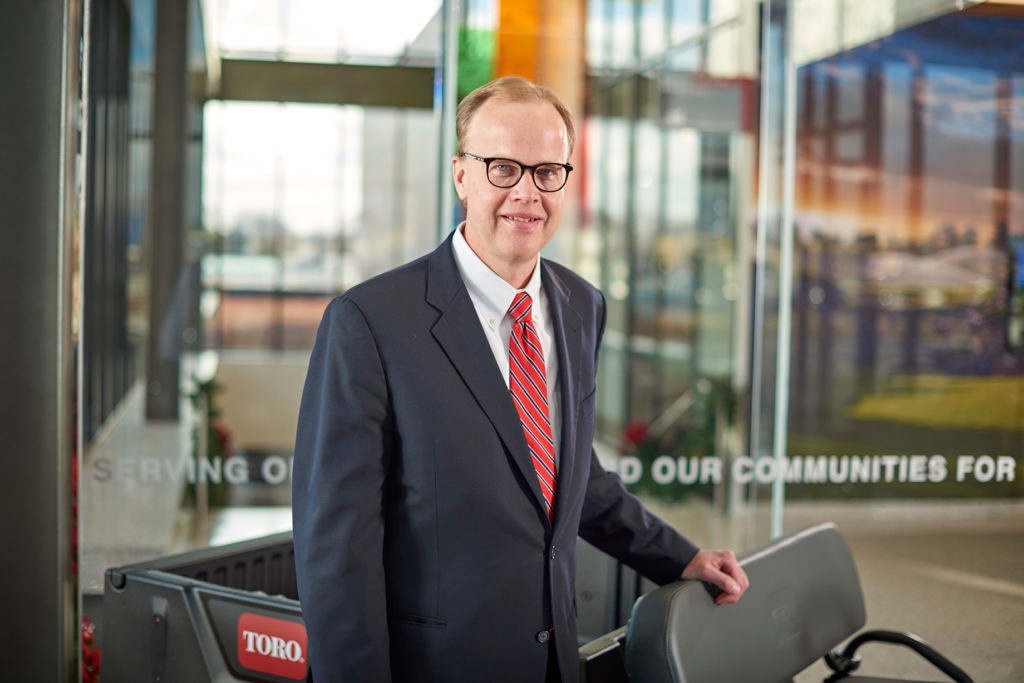
He arrived in 1986. In October 2026, he is still there, serving as chairman and chief executive officer. On November 1, Edric Funk is scheduled to succeed him as CEO, while Olson becomes executive chairman. The brief apprenticeship has occupied forty years. There are longer detours, presumably, but few come with this much lawn equipment.
His story poses an appealing question: how much can a person change while staying with one employer? In Olson’s case, the answer runs through factory operations, Nebraska, international markets, acquisitions and machines that can mow without a driver. The company name remained familiar. The work underneath it kept changing.
Before the factory, the farm
Olson grew up on a family farm in Iowa. His father also worked full-time at Winnebago Industries, leaving the younger Olson to spend summers and after-school hours working on the farm and leading work crews. Manufacturing was close by, too: he eventually became an industrial engineering intern at Winnebago. The two settings gave him early exposure to both making things and organizing people.
He earned a bachelor’s degree in industrial technology at Iowa State University. At Toro, his first job was as a manufacturing process engineer in Windom, Minnesota. That starting point matters to the shape of his career. A process engineer’s territory is the business of how something gets made, where an idea has to survive contact with production.
His later assignments included advanced manufacturing, commercial engineering programs, plant operations in Shakopee and northern manufacturing operations. These are less glamorous entries on a résumé than chief executive. They are also useful places to discover the difference between a promising product and a product that can be built reliably. Olson reached the executive floor after spending years with those practical questions.
A business of his own, inside somebody else’s
The entrepreneurial ambition did eventually find an outlet within Toro. In 2010, Olson became general manager of Exmark, based in Beatrice, Nebraska. He was appointed its vice president in 2012. Running the mower business brought the functions together: development, manufacturing, marketing, sales and service. He could see the consequences of a decision travel from one part of the business to another.
He had also gone back to school. His Carlson School of Management MBA, completed in 2010, added formal business training to the operations experience. The sequence is telling. Business school came after years of work, with a substantial collection of actual problems to bring into the classroom.
Then the geography widened. He became vice president of international business in 2013, followed by a group role covering international business, micro-irrigation and distributor development in 2014. The company served more than 125 countries. Selling a machine was now inseparable from the people who distributed it, supported it and understood the local customer. A factory education had acquired a much larger map.
The ladder had a shop floor
In September 2015, Olson became president and chief operating officer, overseeing Toro’s businesses and global operations. Michael Hoffman, then chairman and CEO, pointed to his knowledge of both manufacturing and the company’s individual businesses. The promotion made formal what the preceding assignments had been assembling: a view across the enterprise.
Olson joined the board in January 2016 and became CEO that November. The chairmanship followed in November 2017. There was no founding myth to polish and no outsider’s dramatic arrival. This was succession through accumulated experience, with a predecessor who had himself spent decades at Toro.
That continuity can sound uneventful when compressed into dates. Stretch it back out and it contains several different jobs: improving a manufacturing process, running a plant, leading a brand and working across borders. Staying put had required him to move. It is a useful complication to the familiar idea that ambition is measured by how frequently an executive changes companies.
- 1986Process engineer
- 2010Exmark general manager
- 2016Chief executive
- 2026Executive chairman, effective Nov. 1
The business beneath the grass
The clearest physical change during his CEO years sits underground. In April 2019, Toro completed its acquisition of Charles Machine Works, parent of Ditch Witch and other construction brands. The announced price was approximately $700 million. Directional drills, trenchers, vacuum excavators and pipe rehabilitation equipment expanded the meaning of Toro’s outdoor business.
The rationale was concrete. Aging infrastructure needed work. New infrastructure, including networks supporting technologies such as 5G, needed to be installed. Toro already participated in specialty construction; the acquisition enlarged that position. For a company readily associated with the surface of a golf course, it was a substantial commitment to what happens below the surface.
It also changed the cast. Angie Drake, who had been chief financial officer at Charles Machine Works, joined Toro through the acquisition and later became Toro’s CFO. Acquisitions bring people and experience along with machines. Olson’s expanded company would depend on colleagues whose histories began somewhere else.
Fiscal 2019 sales reached $3.138 billion, up 19.8 percent. Charles Machine Works and snow products contributed to the year’s performance. The number marked a change in scale, while the mix explained something more interesting: Toro was gathering businesses whose customers had different jobs to finish, in different places and seasons.
More ways to earn a day’s work
The additions continued. Venture Products, maker of Ventrac equipment, joined in 2020. Left Hand Robotics and Portugal-based Turflynx followed in 2021, adding expertise in autonomous equipment. These transactions connected two strands of Olson’s tenure: a broader collection of professional machines and more technology inside them.
In January 2022, Toro acquired Intimidator Group for about $400 million. Its Spartan zero-turn mowers complemented Toro and Exmark, with an established dealer network and an audience in southern rural markets and among customers with larger properties. The deal also included utility vehicles.
A collection of brands still has to work as a business. The Intimidator announcement discussed shared technology, design, procurement and manufacturing opportunities. Those are familiar concerns for someone who began in process engineering. A purchase price gets attention on announcement day; the less photogenic work involves making the combination useful afterward.
By fiscal 2025, Toro reported $4.51 billion in net sales. That was a 1.6 percent decline from 2024, partly reflecting divestitures of company-owned dealers and the Pope product line. The professional segment grew and represented roughly four-fifths of the portfolio. The record is more informative with the uneven years left in: larger businesses still have inventories to manage and markets that refuse to follow a script.
A wider business, in two snapshots
A fairway with nobody at the wheel
At Toro’s Bloomington headquarters on July 10, 2024, visitors watched autonomous mowers at work on a one-hole demonstration course. The occasion combined a Manufacturing Express stop with Toro’s 110th anniversary. A golf setting usually invites attention to the person holding the club. Here, the absence of a driver was part of the attraction.
The scene makes Olson’s technology interests easy to picture. A machine is doing a recurring job while the people stand elsewhere. At his October 2025 Carlson appearance, in conversation with Minnesota Public Radio’s Chris Farrell, Olson discussed autonomous fairway mowing and artificial intelligence. He described custom internal agents for work including product innovation and customer support, alongside opportunities to provide new capabilities to customers.
The practical test remains the customer’s day. A golf superintendent and an underground contractor operate different businesses, but both need equipment that helps them accomplish work. Olson’s enthusiasm for technology returns to that question of productivity. The older manufacturing vocabulary and the newer software vocabulary meet at the same place: how the job gets done.
Listening is an operating skill
For all the machinery in his working life, Olson’s account of leadership gives considerable room to other people. Asked what he values in a leader, he singled out listening and engaging the abilities and perspectives around the leader. His advice to students was compact: “Business is a team sport.”
The phrase puts a limit on the solitary-CEO portrait. An executive can approve an acquisition; other people have to design, build, distribute and service the products. Olson’s long association with Toro also extends into professional and educational circles. He has served on Donaldson’s board since 2022 and on the Carlson School’s Board of Overseers.
His interests away from the job include vintage cars and outdoor activities. There is a pleasing mechanical rhyme between the cars and a career in equipment, though a hobby needs no corporate justification. Sometimes a car is simply a car, and nobody needs to turn the ignition key into a leadership principle.
“Business is a team sport.”
Rick Olson · Carlson School Q&A, 2025
The next name on the door
The handover announced in July 2026 has a familiar outline. Funk joined Toro as a design engineer in 1996, led technology and business units, and became president and COO in September 2025. Ten years separate their starting dates. Both built careers through engineering and increasingly broad business responsibility.
In September 2026, Toro reported quarterly sales of $1.23 billion, up 8.4 percent from the previous year. Its professional business remained the principal driver, with residential results also improving. Olson’s final weeks as CEO thus include the ordinary public-company work of results, inventory and expectations, alongside the unusually personal milestone of passing on a job held for a decade.
Executive chairman keeps him connected to the company after November 1. It also gives the old exit plan a rather different ending. He came to learn how a business worked. He stayed through enough changes to help reshape one. The young engineer’s proposed departure became, over forty years, a succession plan for somebody else.