The awkward thing about a warehouse full of tools is that every item was supposed to be useful. A drill. A saw. A mower. Yet by the second quarter of 2022, Stanley Black & Decker had $6.6 billion tied up in inventory. Demand was softening. Supply constraints were easing. Products were arriving into a market that had changed. The company began curtailing production. Making more was suddenly the wrong answer.
- The problem: too much inventory, and a complicated machine behind familiar brands.
- The response: simplify products, factories and sourcing, then reinvest in tools customers need.
- The test: turn lower costs into growth without weakening the products or service.
The warehouse delivers the verdict
This is a company with considerable practice at adding things. Frederick Stanley founded the original business in 1843. Duncan Black and Alonzo Decker established theirs in 1910. The two combined in 2010. Along the way, the family accumulated names that can make a hardware aisle look more competitive than its ownership chart: DEWALT, STANLEY, CRAFTSMAN, BLACK+DECKER.
Those names serve different jobs. The complications sit behind them. Acquisitions bring factories, suppliers, distribution routes and product variations. A variation can delight a buyer while adding another component to buy, another item to forecast and another box to store. The warehouse eventually sends its opinion.
The response was concrete: consolidate sourcing, reshape manufacturing and distribution, reduce product complexity and simplify management. By the end of 2025, Stanley reported approximately $2.1 billion in pre-tax annualized savings from its global cost program. That describes the lower ongoing cost base; it is not a pile of cash collected in one year.
Approximate cash investment in the supply-chain savings program. About 30% was capital expenditure. This excludes the cost of every other restructuring action.
The original supply-chain investment estimate had been $900 million to $1 billion. The eventual figure was about $600 million. Even so, there was an immediate penalty for slowing factories: in the fourth quarter of 2022, production curtailments and selling down expensive inventory reduced gross margin by roughly six to seven percentage points. Fixing the imbalance hurt before it helped.
One parent. Several toolboxes.
For customers, the attraction is easier to explain than the restructuring. DEWALT equips tradespeople who drill, cut, fasten and manage dust for a living. CRAFTSMAN reaches garages, workshops and home projects. STANLEY supplies hand tools and measuring equipment. BLACK+DECKER addresses household tasks, from drilling to cleaning. Cub Cadet serves outdoor work. Engineered Fastening supplies components and assembly systems to manufacturers.
The business earns money selling these products through retailers, dealers, distributors and industrial sales teams. Accessories, replacement tools and batteries give the relationship reasons to continue. Home Depot and Lowe’s alone represented approximately 27% of 2025 sales. A familiar brand still needs a route onto the shelf.
“You buy a machine and what you really get is satisfaction, entire satisfaction.”
Raymond DeWalt, quoted on the company’s brand history
The cordless battery makes that relationship especially interesting. DEWALT introduced its 20V MAX system in 2011, FLEXVOLT in 2016 and pouch-cell POWERSTACK batteries in 2021. Once someone owns compatible batteries and chargers, the next tool has a practical advantage: some of its supporting equipment is already paid for.
Milwaukee, Makita, Bosch and Hilti offer competing professional systems. Stanley’s breadth puts several buyer groups within one portfolio, but breadth alone does not settle a purchase. The useful comparison is the equipment required for a whole job. For a homeowner, that might mean a drill and occasional hedge trimming; for a crew, runtime, service and dust collection can decide the bill.
A robot with a very particular job
Consider DALE, the downward-drilling robot developed by DEWALT and August Robotics. Data centers need holes in concrete for rack stops and supports for mechanical, electrical and plumbing systems. Repetition gives automation an assignment it can measure. DALE combines autonomous navigation and fleet coordination with drilling equipment and dust extraction.
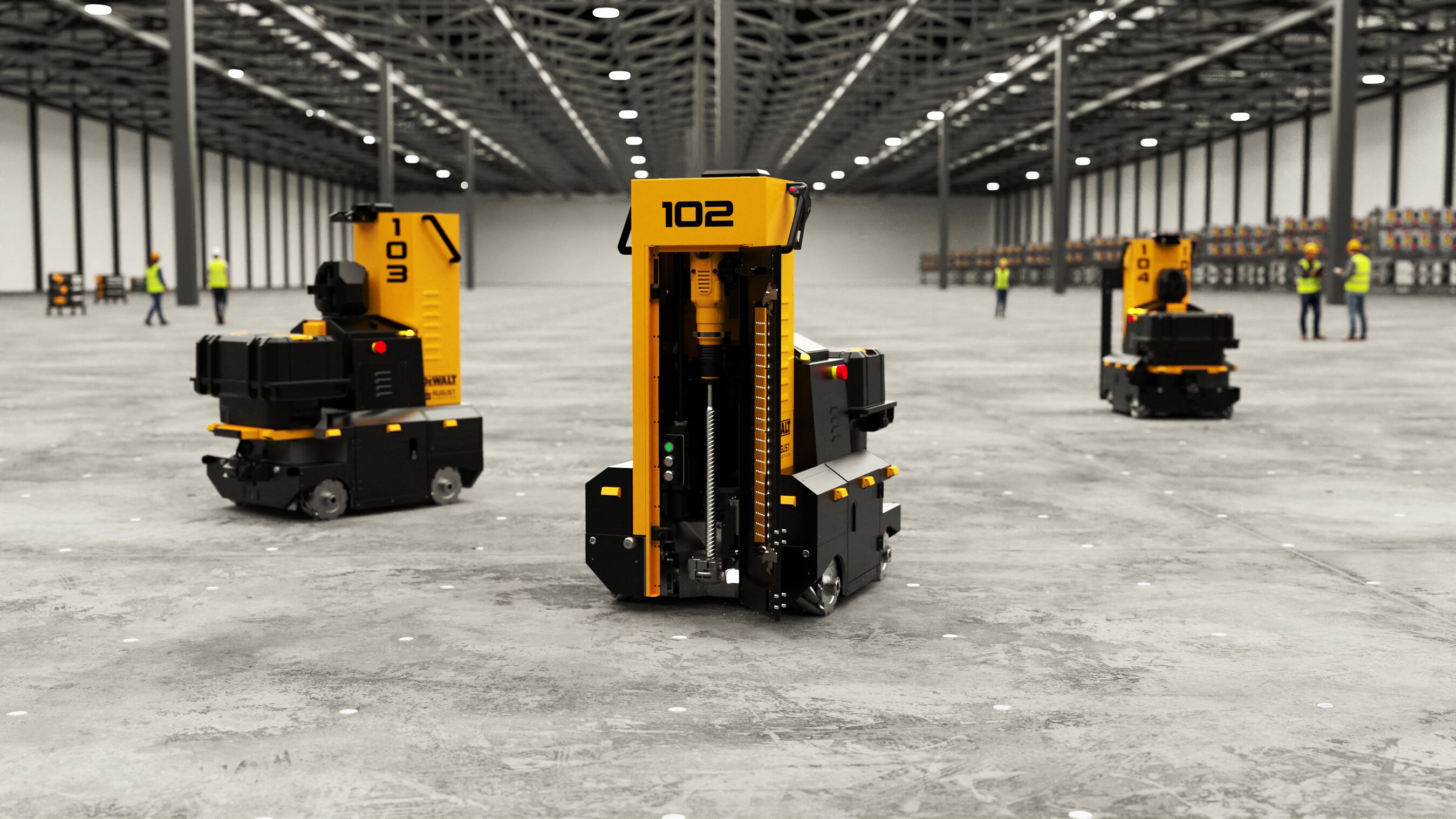
Commercial orders opened in July 2026. By October, the companies reported more than 385,000 holes across 44 data-center construction phases, drilling speeds up to ten times conventional methods and over 99% accuracy. These are company-reported results from particular deployments. A faster drilling operation does not make an entire construction project ten times faster.
The limits matter. August Robotics specifies supported hole dimensions and provides training and technical support. A contractor still needs suitable work, layout information and a site the equipment can navigate. The economic case is most persuasive where repetition is abundant. For a handful of awkward holes, setup and coordination could consume the benefit. That is an inference about workflow, not a published return guarantee.
The business gets an edit

Chris Nelson became CEO in October 2025. The portfolio keeps changing: CAM, the aerospace manufacturing business, went to Howmet for about $1.8 billion in April 2026. In September, Stanley agreed to sell Excel Industries, primarily the Hustler mower business, to Bad Boy Mowers, subject to closing conditions. Keeping outdoor equipment does not require keeping every outdoor business.
There is reinvestment too. In August, Stanley announced a planned $1 billion U.S. investment through 2028, roughly half for research and development. Its employer materials emphasize development and workplace safety. Its trades programs had contributed $27 million by the end of 2025. Helping train people who use the tools connects community spending to the company’s future market.
Rounded share of $15.13 billion revenue; includes CAM before its 2026 sale.
The unfinished part is demand. Sales fell 2% in 2025. Second-quarter 2026 sales were roughly flat; adjusted gross margin improved, with a material benefit from tariff refunds. The lesson worth copying is to remove internal variations customers do not value, then spend on problems they do. Cut useful capacity or service along with complexity, and the logic unravels. The next verdict will come from the people holding the tools.
Open the toolbox
Explore the products, people and demonstrations.