Ric Phillips expected the chief executive’s job to come with decisions. What surprised him was how much of the work happened in conversations with one other person. At Elkay, he discovered that time spent with individual colleagues changed the quality of his judgment. For a position associated with having the final word, it was a useful discovery: there was considerable value in letting someone else finish.
That observation offers a way into a career that can otherwise look like a procession of corporate appointments. Consulting. Distribution. Plumbing products. Electronics. Phillips has moved between businesses whose products have little in common. His recurring subject has been the organization behind them: how people work together, what customers need, and whether the company’s ambitions can survive contact with its daily habits.
Now the chief executive and a director of Kimball Electronics, he is working through another change of identity. The business began introducing the Kimball Solutions name in 2026. The broader label describes an expanding range of manufacturing and engineering work. It also gives Phillips a familiar assignment: help an established organization become something larger without treating its past as an inconvenience.
The education of a newcomer
Phillips has traced his appetite for unfamiliar environments to a childhood in which his family moved frequently. New surroundings became places to learn. Later, consulting offered an adult version of that experience, with different companies presenting different problems. He found that the part he enjoyed most was helping a team succeed.
His business education included finance at Indiana University and continued with a Master of Management at Northwestern’s Kellogg school. At McKinsey & Company, he became a partner in 2005. The progression put him on the advisory side of consequential operating decisions before he took responsibility for a business himself.
A consultant can recommend a course of action and move to the next assignment. An operator inherits the following Monday. That difference matters in Phillips’s story because his subsequent jobs involved businesses with warehouses, factories, suppliers and customers who required more than an attractive presentation. A strategy eventually has to find its way onto a loading dock.
He joined the workplace-products distributor Essendant in 2013, taking on increasing responsibility. In 2017, after serving as interim chief executive, he was appointed president and CEO. The board pointed to his work turning around the industrial business and running growth businesses. This was a promotion into unfinished work, with the company pursuing a transformation while overall sales remained under pressure.
- 2005Partner
McKinsey & Company - 2017President & CEO
Essendant - 2019President & CEO
Elkay - 2023CEO & director
Kimball Electronics
A century-old company, a new set of questions
In October 2019, Elkay named Phillips to succeed Tim Jahnke. The appointment brought him into a family-owned manufacturer whose output included sinks, water-delivery products, commercial kitchen equipment and interiors. These were familiar objects backed by a business considerably more complicated than the objects themselves suggested. Even a kitchen sink has a supply chain.
Before joining Elkay, Phillips had rebuilt Essendant’s strategy, overseen its largest restructuring and guided the company through a transaction completed in January 2019. He brought 14 years of experience at McKinsey. His arrival at Elkay therefore combined two sorts of experience: diagnosing organizations from outside and living with the consequences from inside.
While at Elkay, he wrote about how a company prepares for change. His starting point was the purpose served by a product. A business that understands the need it meets has more room to evolve than one whose identity ends at its current catalogue. He paired that argument with an emphasis on critical thinking and the practical development of new products and processes.
He also described Elkay’s Culture Steward Program, which taught leaders to reinforce attributes such as growth, empowerment and a willingness to try new ideas. This is where his interest in culture becomes operational. It requires teaching, repeated behavior and room for other people to act. A value printed on a wall makes very few decisions on its own.
The distinction helps explain his attraction to organizations with an existing history. A company’s habits can support change or quietly defeat it. His writing suggests that leaders should spend time understanding those habits before assuming that a new plan will automatically become a new way of working.
The handover, with the bell still ringing
Kimball’s transition was unusually visible. On February 22, 2023, the company marked Don Charron’s retirement and welcomed Phillips with a Nasdaq closing-bell ceremony. For a manufacturer whose work often sits inside someone else’s product, it was a public moment between two leadership eras.
Phillips formally became CEO on March 1. Charron had led the business for nearly a quarter century, including its 2014 separation from Kimball International. The incoming chief executive was taking charge of an established independent company, with a global footprint and relationships built over many years. The chairman’s role went to lead independent director Robert Phillippy.
That division of responsibilities is worth keeping in view. Phillips became the executive responsible for running the business; he did not assume his predecessor’s combined chairman-and-CEO position. The change placed a new operator inside a governance structure with a separate board chair.
By July, Phillips was meeting global leaders in Chicago. The summit’s agenda moved through strategy, operations, growth, business cases, leadership development and questions for the executive team. Business development and information technology colleagues also gathered. It was a practical expression of the collaborative language he had used elsewhere: get people from different parts of the business into the same conversation.
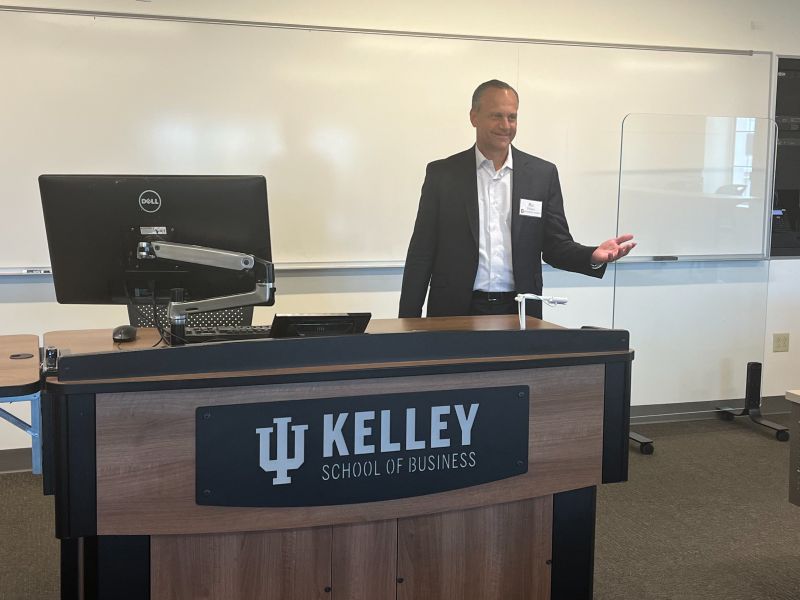
That spring, he also returned to Indiana University to speak with students in the Phi Gamma Nu business fraternity about their future careers. He serves on the Kelley School of Business Dean’s Council. The visit places a modest, human scene beside the bell ceremony: an experienced executive back in a classroom, discussing work with people near its beginning.
When optimism meets inventory
Phillips joined Kimball with growth in prospect. The company had new program wins, recently expanded facilities and a substantial order backlog. His arrival statement emphasized those ingredients. The subsequent years supplied a reminder that manufacturing demand has its own timetable, regardless of a chief executive’s starting date.
Fiscal 2024 brought weakening demand across Kimball’s markets. Sales for the year were approximately $1.715 billion, down from the prior year’s record. The company reduced inventory by $112 million and generated $72 million in operating cash flow. Those measures describe a different kind of progress from selling more: freeing resources already tied up inside the business.
Phillips’s response involved adjusting costs, examining the organization and narrowing strategic priorities. His 2024 message to shareholders described visits to company locations and customers alongside work with the leadership team on the business’s structure. Listening and restructuring occupied the same calendar. There is no reason to pretend that one makes the other painless.
“Communicate openly and proactively”Ric Phillips, 2024 letter to shareholders
The company’s longstanding customer relationships gave that work context. In the same shareholder letter, Phillips said 76 percent of revenue came from customers Kimball had served for at least a decade. That is a revenue measure, rather than a count of customers. It captures how much of the business depended on relationships that predated his appointment.
In discussing commercial choices, he put a boundary around ambition: “We don’t chase business that’s not a fit for Kimball.” That selectivity is particularly relevant to a company producing electronics for applications including steering, braking and industrial controls. Winning an order creates an obligation to perform. The press announcement is the easy part.
Changing the name, keeping the obligation
In July 2026, Kimball announced the acquisition of Helvoet Polymer Technologies for €90 million before customary adjustments and related costs. Helvoet brought manufacturing operations in Tilburg in the Netherlands and Pune in India, together with precision-molding expertise. For Phillips, the transaction added another integration assignment to a career already familiar with organizational change.
Two weeks later, the company announced the first phase of its rebrand to Kimball Solutions, effective July 1 at Jasper and Indianapolis. The new name was intended to encompass work extending from design and supply-chain management to manufacturing and complete product assembly. Other locations were scheduled to follow in stages.
The proposed corporate legal-name change was targeted for July 1, 2027, subject to shareholder approval. The timing matters: adopting a new identity across facilities and changing the legal entity’s name are separate steps. Phillips’s current company remains Kimball Electronics while the Kimball Solutions identity takes shape around its operations.
$1.431bnFull-year net sales
$42.4mQ4 operating cash flow
Results released in August offered a measured account of progress. Full-year sales were below fiscal 2025, while the fourth quarter delivered $42.4 million in operating cash flow. Debt at June 30 was $116.6 million, its lowest level in more than four years. The fiscal 2027 sales outlook anticipated growth; it remained an outlook, with the work of delivering it still ahead.
The time a company gives away
There is another way Phillips has described an organization’s priorities: look at the time it allows employees to spend outside it. In a 2021 essay about civic engagement, he connected volunteering with stronger working relationships and pride in a company. He wrote from his own involvement with Habitat for Humanity.
His example was specific. Elkay offered time for company-sponsored volunteering and a separate allowance for employees to support a charity of their choice. He argued that leaders should participate themselves and make the practice consistent. A charitable intention is easy to announce. Making room for it in a working week requires a decision.
Read alongside his corporate career, that emphasis supplies a useful scale. Phillips works with acquisitions, factories and forecasts, but he keeps returning to how people spend time together. A colleague explains something in a private meeting. Students ask about a career. Employees work on a community project. These activities rarely become the headline figure in a results release. They help describe the person responsible for it.