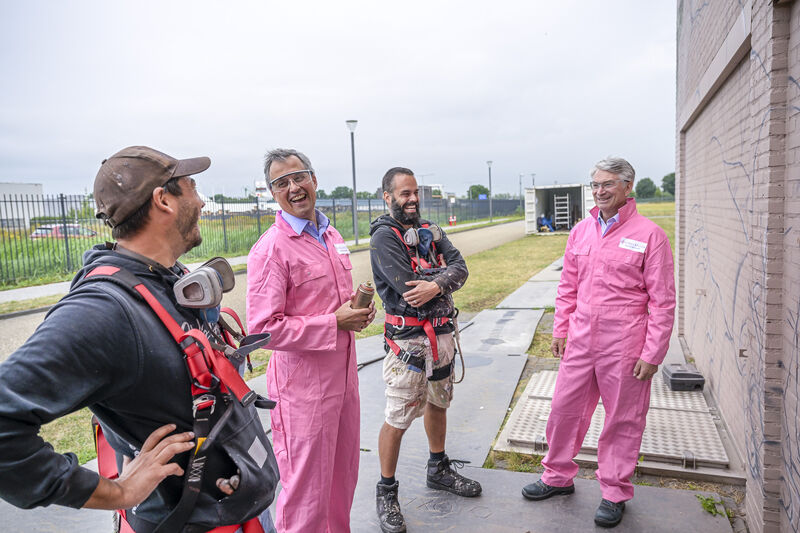
Joseph Morrissey is standing beside a wall in the Netherlands, wearing pink overalls. Around him are colleagues, artists and the practical equipment of a mural in progress. His fellow visitor, Organon general counsel Kirke Weaver, has also dressed for the occasion. A corporate site visit has acquired an unusually cheerful dress code. Somewhere between the protective clothing and the paint, the usual distance between an executive and a production site has become a little harder to maintain.
The visit was to De Geer in Oss, where Morrissey and Weaver joined a mural project while exploring Organon's new production site. It is a useful place to begin understanding Morrissey, now the company's chief executive. Before taking that job, he had spent decades dealing with the places, processes and people behind a global business. The pink overalls are incidental. The habit of turning up at the site runs through his career.
His route to the top job passed through more than 30 years at Merck, an engineering degree at Lafayette College, an MBA at Villanova University and responsibility for Organon's manufacturing and supply network. There is no abrupt leap from outsider to corporate saviour in that sequence. There is accumulated responsibility, followed by a promotion that arrived under difficult circumstances.
The long apprenticeship inside one company
At Merck, Morrissey's assignments extended across manufacturing, facilities, supply chains and corporate strategy. These are different vantage points on the same organisation. A facilities role concerns the physical estate. A supply role concerns the connections between locations. Strategy concerns the choices that determine what those locations will eventually be asked to do. His experience covered all three.
That range matters when considering his later move into general management. A chief executive must connect decisions that different departments experience separately. Morrissey's earlier responsibilities had already required him to cross some of those boundaries. His education paired engineering with business administration; his working life gave that pairing a much larger canvas.
He held a senior manufacturing leadership position from 2014 to 2016, then led another global manufacturing and supply organisation within Merck from 2017 to 2021. Those dates describe a substantial stretch of responsibility before Organon became an independent company. By the time he joined its executive team, he had managed within a large multinational for decades.
- 2014-16Senior manufacturing leadership at Merck
- 2017-21Global manufacturing and supply leadership at Merck
- 2021Organon executive team
- Oct 2025Interim chief executive
- Apr 2026Permanent chief executive
A new company with old addresses
Organon emerged from Merck as a standalone business in 2021. Morrissey became its executive vice president and head of manufacturing and supply. The company was new in its independent form, but its production sites carried histories of their own. For an operations leader, that combination presents a particular task: establishing the habits of a new organisation while working with teams whose experience predates its latest corporate identity.
In 2023, he visited Campinas, Brazil, for the site's 65th anniversary. He described its history in terms of overcoming challenges and facing change, and recognised its place in the wider manufacturing network. The anniversary put a local workforce's long experience beside the shorter history of the independent company. Both belonged in the same story.
At Heist in Belgium, his public account of a leadership-team visit concentrated on capacity expansion, capital investment and working practices. In Singapore, he highlighted a session where colleagues from different functions presented their work through posters. The details are pleasantly unglamorous. A poster session rarely threatens to become a celebrity event. It does offer people a way to explain their work to visitors who otherwise might receive only the executive summary.
These visits show the geographical breadth of his old job. They also give it a human scale. Brazil, Belgium and Singapore cease to be points on a presentation slide when an anniversary, an investment discussion or a room of colleagues enters the picture. Morrissey's public accounts regularly make room for the teams he has met.
The numbers belong to the team
In Pandaan, Indonesia, he celebrated the facility's 50th anniversary and singled out a 50% increase in packaging volume. He credited the local team. The occasion included a historical exhibition, an employee dinner and science awards for local high-school students. An operational milestone sat within a larger account of a site's relationship with its community.
The improvement Morrissey credited to the Pandaan team in his account of the site's 50th anniversary.
The distinction between a company result and an individual's achievement is easy to blur in an executive profile. Here, his own description helps keep it straight. The volume increase was work delivered by a team. His role in the account was to recognise it and connect it to the wider organisation. The number is useful precisely because it comes with people attached.
Cramlington, in northeast England, offered another anniversary in 2025: half a century since the site began. Morrissey joined other executives there and called attention to continued investment in capacity and capability. Celebrating a factory's past can easily become an exercise in commemorative stationery. His attention also went to what the site would be able to do next.
Across these occasions, a pattern emerges from the subjects he chooses to discuss: local history, capacity, investment and the contribution of colleagues. It is the public vocabulary of an operations executive. The company is made tangible through the work happening at particular addresses.
The promotion came with unfinished business
On October 26, 2025, Morrissey became interim chief executive. Organon announced the appointment the following day, alongside Kevin Ali's resignation after an audit committee investigation into improper sales practices. Board chair Carrie Cox took on the additional role of executive chair. Morrissey was stepping into a leadership transition with immediate questions of execution and accountability.
His first stated business priorities included reducing debt, cutting costs and achieving revenue growth. Those aims can pull against one another. Cost reductions affect the resources available to deliver growth; debt places its own demands on cash. His appointment brought an executive with extensive operating experience to the task of managing those tensions across the whole company.
There was also a change in the scale of his responsibility. Manufacturing and supply had been his particular remit. As chief executive, he would answer for the organisation beyond that network. Familiarity with its operations was part of his preparation; the new office widened the questions he had to address.
“Listening shapes what's next.”
Joseph Morrissey, reflecting on his first months as interim CEO
A meeting in Lucerne, and an instruction to listen
Near the end of 2025, Morrissey described conversations with colleagues in Lucerne, Switzerland, as part of his reflection on becoming interim CEO. He mentioned town halls, virtual forums and individual meetings. Listening, he wrote, helped build trust, generate ideas and strengthen belonging. These were his stated convictions, expressed while he was still new to the office.
At the year-end Founders Forum, he also drew attention to the company's employee survey. He reported that 95% of its global “founders” had contributed views on strengths and areas for improvement. Organon uses the word founders for its colleagues. That terminology gives an established multinational's workforce a rather entrepreneurial collective noun.
The survey figure measures participation. It does not tell us whether every participant approved of every decision. What makes it relevant to Morrissey's account is his willingness to describe employee feedback as covering opportunities to improve as well as strengths. A listening exercise has more practical value when the uncomfortable answers have somewhere to go.
His public thanks are often specific. In Lucerne he named colleagues involved in the exchange. At the forum he acknowledged Aaron Falcione's contribution on employee feedback. On site visits he recognised local teams alongside visiting leaders. Names bring these accounts down from the altitude at which corporate prose so often cruises.
The wider leadership team gives those conversations an organisational setting. Juliana Drinane now leads manufacturing and supply, the function Morrissey previously ran. Matthew Walsh is chief financial officer; Nico Van Hoecke heads international commercial operations. Kirke Weaver, his companion at the mural in Oss, is general counsel and corporate secretary. Their responsibilities illustrate the span of the CEO role: operations, finance, markets and governance have to meet in the same company decisions. For Morrissey, taking the top job also meant changing his relationship with the function he knew most closely, while working alongside colleagues responsible for other parts of the business.
A permanent title, another transition ahead
On April 26, 2026, Organon's board made Morrissey's chief executive appointment permanent. That same date, Organon and Sun Pharma announced an acquisition agreement offering Organon shareholders $14 a share in cash, with an enterprise valuation of $11.75 billion. The announcement anticipated closing in early 2027, subject to approvals and other conditions. An agreement to change ownership had entered the picture just as his interim title disappeared.
For Morrissey, the sequence brings his career back to a familiar organisational question: how does a business keep working while its structure changes? He had joined Organon's leadership as it became independent. Now, as CEO, he was leading during a proposed move into another group. The transactions differ, but both put a premium on continuity across people, locations and responsibilities.
Return to the photograph in Oss. Morrissey stands in pink beside a wall being turned into something else, with the people doing the work close enough for a conversation. It is one moment in a long career, and a rather good photograph. It also captures something concrete about his path to the chief executive's office: years spent visiting the places a company depends on, before being asked to take responsibility for the whole.