On a Sunday evening in 1956, someone rang Barclay Simpson’s doorbell with a roofing problem. Could he make something to connect the ends of two-by-fours? Simpson worked in the family’s window-screen business. He and his plant foreman sketched a solution and made a joist hanger with a punch press. A roof needed a connection. Here was someone who could make one.
That little transaction became Simpson Strong-Tie, the principal operating business of Simpson Manufacturing. Today its connectors, screws, anchors and reinforcing systems serve wood, concrete and steel construction. They work at the places where one building element hands its load to another. Simpson has made a substantial business of that invisibility.
- Makes the connectors, anchors and fasteners joining structural materials.
- Pairs manufactured hardware with testing, design tools and technical support.
- Reported $2.33 billion in 2025 sales; housing demand still sets limits.
Four pages, then a better nail hole
The first Strong-Tie catalog, published in 1957, ran to four pages. One item was the A35 framing anchor. By 1962, its shape had been revised to use less steel while preserving load performance. In 1972, speed prongs arrived: little projections that hold a connector temporarily while the installer drives the nails. Anyone who has wished for a third hand can appreciate the research question.
This is a useful way to understand Simpson’s expertise. It includes structural engineering, metallurgy, corrosion, manufacturing and the practical business of getting hardware installed. A tiny improvement repeated across a job can matter. The company supplies joist hangers, hurricane ties, holdowns, truss plates and shearwalls, alongside mechanical anchors, adhesives and materials that strengthen existing concrete.
Its customers include engineers and architects specifying a building, contractors assembling it, component manufacturers making parts, and dealers and retailers supplying the site. Homeowners encounter the same business while building decks or pergolas. Simpson sells physical products through distribution and retail channels and directly to some customers, with software and services supporting design and adoption. The drawing office and the lumberyard both matter.
Take the building. Shake the building.
In 2009, a research team put a seven-story condominium test structure on Japan’s E-Defense shake table. Simpson participated with academics and other researchers. The nearly 800,000-pound building combined wood framing with a first-story steel frame; Strong-Tie connectors and continuous anchor rods helped secure it. Researchers subjected it to motions modeled on recordings of the 1994 Northridge earthquake.
The experiment had two phases. After testing the seven-story structure, researchers braced the first-story steel frames, effectively testing six stories of wood above. The final run reached 180% of the recorded Northridge ground motion used for the tests. The reported damage was very light. That result belongs to an engineered assembly and a particular test program; it cannot promise the same outcome for every building wearing a Simpson connector.
Simpson’s own laboratories make testing a routine part of product development. In Stockton, equipment subjects full-scale components to simulated ground motion and repeated loading. In West Chicago, researchers test anchors and adhesives in concrete, including conditions that cause cracking. Branch laboratories investigate regional requirements and installation questions. The proposition is straightforward: a designer should have evidence for the connection being specified.
One moving foundation.
A steel-and-wood test structure, followed by a six-story wood-only test configuration.
FINAL TEST: 180% OF RECORDEDNORTHRIDGE GROUND MOTION
The expensive part surrounds the steel
A connector can look simple on a shelf. The surrounding work is harder to see: testing, published capacities, product selection, technical support and training. Simpson reported $82.5 million in research, development and other engineering expense in 2025. That includes the continuing cost of maintaining engineering around manufactured parts.
MiTek is an alternative in structural connectors and truss-related construction products; other competitors vary by anchor, fastener and software application. Simpson competes through its product range and the support surrounding it. Its filings acknowledge a crucial limit: engineers, inspectors and customers must continue to believe the premium brand warrants its price. Trust has to survive the next installation.
Simpson completed its purchase of European fastening business ETANCO in April 2022 for €725 million, approximately $800 million at closing, net of cash. It borrowed $700 million under revolving and term facilities to help fund the transaction. The purchase broadened its European offering and access to commercial construction. This was a sizable investment in adjacent products and established customer relationships.
Listen to the person holding the drill
Barclay’s customer philosophy was blunt: “Our customers are our bosses.” His business principles also called for a long view, employee recognition and humility. Those are company-stated values; a concrete example is easier to examine. For the 2025 Habitat for Humanity Carter Work Project in Austin, Simpson contributed money and products, and six employees volunteered on a home. Their tasks included cabinets, doors, caulking and painting.
Listening also means letting a familiar product go. Simpson retired its desktop Connector Selector after roughly 30 years, explaining that usage had shifted dramatically toward web applications. For another business, the lesson is practical: preserve the useful job your product performs while changing the delivery method when customers move.
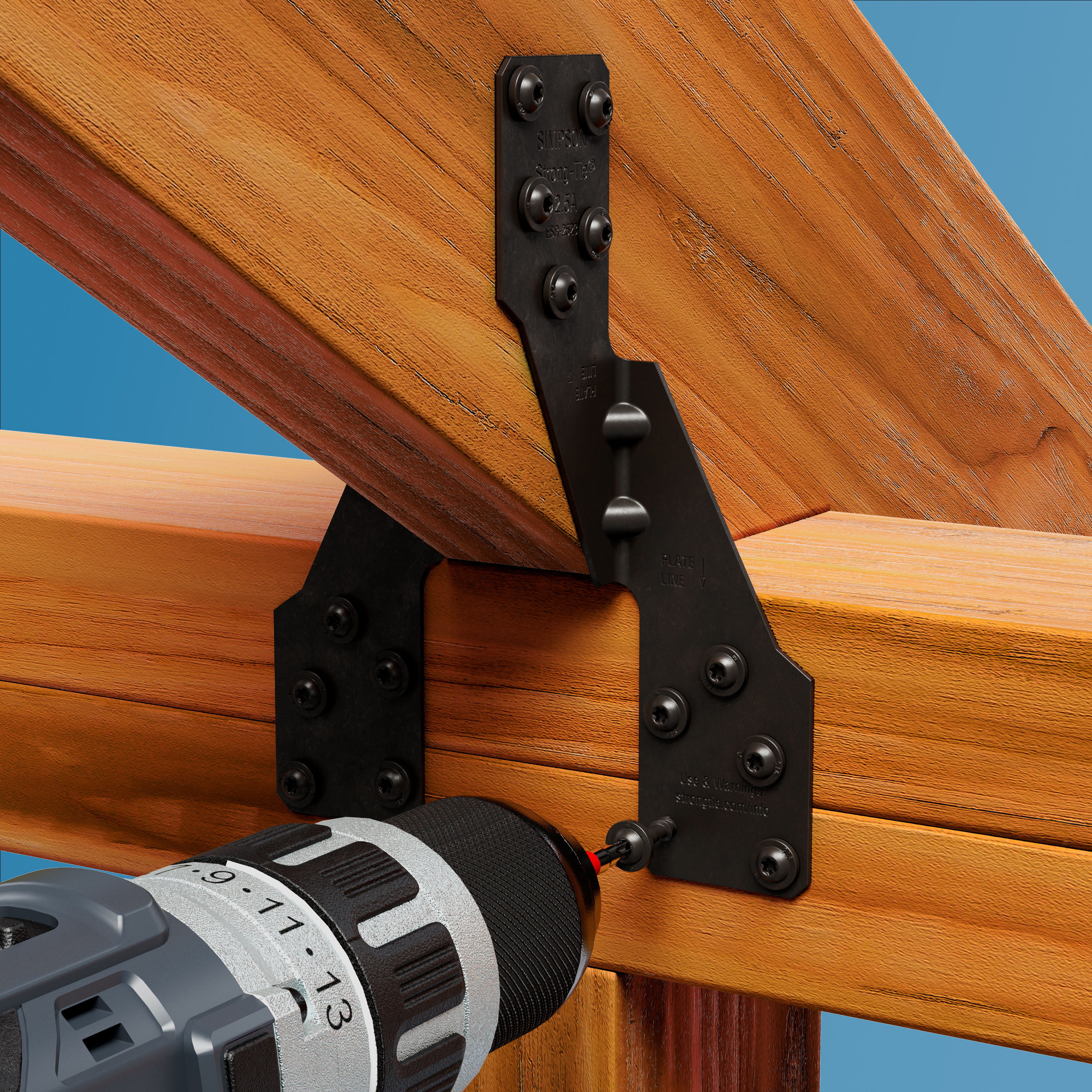
Some recent development is more visible than the hardware behind drywall. Outdoor Accents gives structural connections a coordinated black finish for decks and pergolas. In September 2026, Simpson added a button-head connector screw designed for its Mission and Avant collections. Even here, appearance meets a specific mechanical detail: the geometry under the screw head is sized for the connector holes.
“Our customers are our bosses.”Barclay Simpson
A good connection still needs a good market
Simpson recorded $2.33 billion in 2025 sales, up 4.5%, while unit volume declined approximately 1%. Prices, acquisitions and currency helped the revenue line. In the second quarter of 2026, sales reached $671.1 million, up 6.3%. CEO Mike Olosky said North American growth came primarily from earlier price increases, partly offset by softer volumes. More revenue does not automatically mean more hardware going into more houses.
For a builder or designer, the useful starting point is the actual connection: material, load, environment and installation requirements. Product guidance and qualified design review matter. For someone studying the business, the copyable idea is equally specific: solve one awkward customer problem, improve the installation, and build evidence around the result. It requires patient spending and customers who value evidence. A cheaper substitute, incorrect installation or fewer construction projects can still spoil the arithmetic.