When Ty Silberhorn became Apogee Enterprises’ fifth chief executive, he inherited a small distinction that would eventually make a magazine publisher very happy. Deb Levy had interviewed every person who had held the job. In May 2023, she and editor Ellen Rogers visited his Minneapolis office and completed the set. In a business devoted to glass, this was an unusually well-preserved streak.
Silberhorn acknowledged the occasion on LinkedIn, thanking the interviewers and saying he was happy to have kept the streak alive. It is a modest episode, but a useful place to begin. His public story is largely about institutions: two decades at 3M, nearly five years leading Apogee, and a seat on the board of LP Building Solutions. Here was a brief glimpse of someone enjoying the human bookkeeping that happens around a long-established company.
His assignment at Apogee was considerably less ceremonial. Taking charge on January 4, 2021, he had to decide which parts of an architectural products business should grow, which should work together, and which should stop doing what they were doing. By fiscal 2025, the company had beaten two of the three financial goals attached to his strategy. The third remained stubbornly out of reach.
A large-company education, a smaller-company appetite
Before Apogee, Silberhorn had spent more than 20 years at 3M. His last position there was senior vice president of Transformation, Technologies and Services, working on business processes and digital transformation. Earlier responsibilities crossed several global businesses, including industrial adhesives and tapes and display materials and systems. Sales, marketing, management and Six Sigma also appear in his career history.
The résumé contains a detour that deserves its own line: he had run an e-commerce startup. He also worked at Ashland. That combination gave him experience with organizations operating at very different scales. A startup founder and a global division leader can have the same concern about customers while possessing wildly different quantities of people to call for help.
His formal education was in business: a bachelor of science from Indiana University’s Kelley School of Business and an MBA from the University of Minnesota’s Carlson School of Management. The move to Apogee kept his professional life in Minnesota. It also gave him responsibility for an entire public company, after years spent managing businesses inside a much larger one.
In 2023, he described wanting a smaller company where strategy and execution could be brought together and the effects of a team’s decisions could become visible sooner. Apogee offered that opportunity close to home. He was living in St. Paul when the job came along.
The first decisions had addresses
A new strategy can remain pleasantly abstract until it reaches a factory. Silberhorn’s reached several. In August 2021, Apogee announced plans to close Viracon’s Statesboro, Georgia, facility and transfer its work to Owatonna, Minnesota. It would also leave the Velocity business and close the associated Dallas facility. The glass segment would concentrate on premium, high-performance products.
The same announcement reorganized framing businesses and proposed moving Sotawall into Architectural Services. That placed its capabilities alongside an operation focused on integrated design, manufacturing and installation for larger curtainwall projects. The logic was to make the company’s structure better reflect the work it wanted to win.
There was a substantial human cost. Apogee expected the announced restructuring to reduce its workforce by approximately 400 employees. Any account of the subsequent financial improvements belongs beside that figure. Simplification is a tidy word on an organizational chart; it becomes much less tidy when attached to a place where people work.
Three years. Three financial targets. A business with less room for activities that failed to earn their keep.
At the November 2021 investor day, Apogee set goals of return on invested capital above 12%, operating margin above 10%, and revenue growth exceeding 1.2 times growth in the nonresidential construction market. Those were public commitments with numbers attached. They gave investors a way to judge the strategy after the presentation slides had been put away.
The plan emphasized choosing attractive markets, managing the portfolio and improving execution. Read together, the targets reveal the balancing act: generate more from the capital already employed, retain more from sales, and still find enough new business to grow faster than the market. Progress on one measure would not automatically deliver the other two.
A bell, then back to the machinery
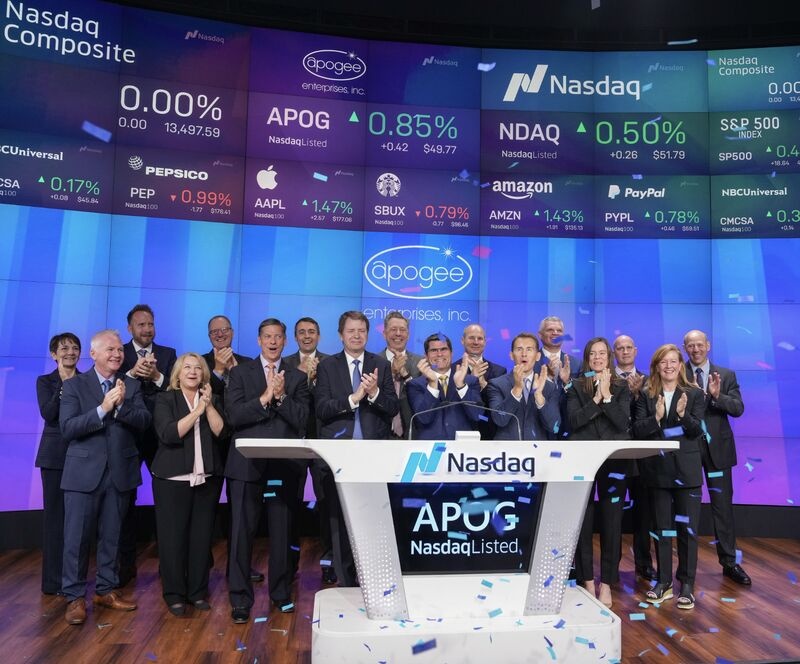
On August 22, 2023, Silberhorn stood with Apogee’s board chair, Don Nolan, and other members of management at Nasdaq’s MarketSite in Times Square. The occasion marked 40 years of the company’s Nasdaq listing. A business whose products usually sit quietly in buildings had a morning on television.
“40 years on the exchange - wow,” Silberhorn said. He credited the employees who had built the business and spoke about strengthening operations, adding capabilities and investing for growth. The ceremony offered a moment to enjoy a history he had joined relatively recently. The operational work would, of course, resume without confetti.
That October, two segment presidents exchanged assignments. Brent Jewell moved to Architectural Glass; Nick Longman moved to Architectural Framing Systems. Silberhorn described matching their strengths to the businesses’ needs while broadening their experience. The change showed another way to use the enterprise: give established leaders a different problem and build a deeper pool of experience across the company.
In January 2024, Apogee announced Project Fortify. The framing business would eliminate certain lower-margin offerings, simplify its brands and commercial model, and move production from Walker, Michigan, to facilities in Missouri and Wisconsin. Consolidation was still part of the program, three years after Silberhorn’s arrival.
The company later reported that the first phase finished in fiscal 2025, with $16.7 million in restructuring charges and approximately $14 million in annualized pretax savings. Those figures describe a trade: spend money and reorganize work now to lower recurring costs. Whether a business also creates enough new demand is a separate question.
What a glass company learns to carry forward
Apogee celebrated its 75th anniversary in 2024. Its origins were hardly a blueprint for the portfolio Silberhorn was managing. Harmon Glass began in Minneapolis in 1949, replacing automotive glass. The company later expanded into building installation, architectural glass and framing systems. Reinvention had preceded him by decades.
That history appealed to Silberhorn. In discussing the anniversary, he emphasized carrying technical capabilities into new markets. Knowledge of glass and coatings could outlast a particular application. He also challenged the idea that construction was simply an industry wedded to old habits, describing opportunities for innovation and collaboration among the people who develop, design, supply and install buildings.
His account of customer value was practical: the right product needed to arrive when the project required it, and purchase price was only part of the calculation. The argument suits an industry in which a component becomes part of something far larger. A window cannot make an appointment to arrive fashionably late.
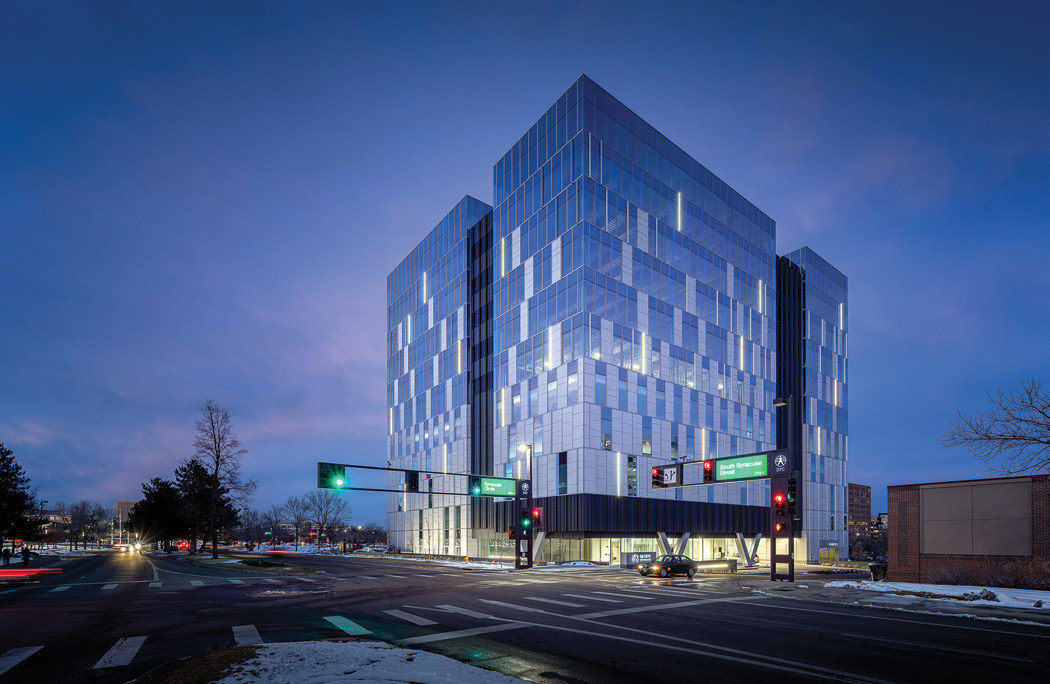
In November 2024, Apogee completed the $242 million cash acquisition of UW Solutions, a manufacturer of coated substrates for graphic arts, building products and other uses. It expanded the capabilities and markets of the business then called Large-Scale Optical. This was a different kind of change from closing a facility: the company was purchasing additional ways to apply its expertise.
At closing, Apogee expected UW Solutions to contribute about $100 million in fiscal 2026 revenue and an adjusted EBITDA margin of approximately 20%. Those were expectations, rather than completed results. Their importance to the story is what they show about the direction of travel: toward specialized materials and applications beyond the familiar outline of an office tower.
“Are we building something sustainable long-term?”
Ty Silberhorn, 2023
Two targets cleared. One left standing.
Fiscal 2025 supplied a useful reckoning. Apogee’s adjusted return on invested capital reached 14.9%, and adjusted operating margin reached 11.0%. Both exceeded the thresholds set in 2021. Adjusted diluted earnings per share reached $4.97, more than double the fiscal 2022 figure. The margin improvement over that period was 4.7 percentage points.
Adjusted measures are non-GAAP. The growth target compared Apogee with the nonresidential construction market.
Growth fell short. In his shareholder letter, Silberhorn acknowledged the miss and attributed it partly to deliberately leaving less differentiated, lower-margin business. Market composition mattered too: industrial facilities, data centers and warehouses had driven construction growth in areas where Apogee historically had less presence.
The reported financial results also deserve space alongside the adjusted measures. Fiscal 2025 diluted earnings per share were $3.89, compared with $4.51 a year earlier; consolidated operating income was $118.1 million, compared with $133.8 million. The record adjusted earnings figure describes one view of performance. The reported figures provide another necessary part of the account.
This is the interesting complication in Silberhorn’s tenure. A business can become more selective and improve its underlying margins while struggling to expand its sales. The challenge then moves from repairing the economics of existing work to finding more work with the desired economics. The acquisition was part of that effort, rather than proof that the effort was finished.
The next seat at the table
There is a smaller-scale story about Silberhorn’s calendar. In 2023, he said his youngest daughter had started a tradition of father-daughter event trips. His other two daughters adopted the idea. He also mentioned enjoying golf, with the familiar qualification that finding time was difficult. Apparently even a transformation executive cannot restructure the length of a weekend.
His Apogee chapter ended on October 31, 2025, when he departed as chief executive and a director. Nolan succeeded him as CEO and became executive chair. Silberhorn expressed pride in the company’s progress. The transition closed a tenure of nearly five years, leaving a record that contains substantial operating changes, improved adjusted profitability and an unmet growth ambition.
Another board assignment had already begun. LP Building Solutions appointed him a director effective February 6, 2025. He remains an independent director, serving on its compensation and governance and corporate responsibility committees. LP’s description of his qualifications emphasizes experience across sales, strategy, product development, acquisitions and operational efficiency.
The job is now conducted from a different seat. At Apogee, Silberhorn had to put his decisions into operation. At LP, his experience contributes to board oversight. Both roles concern what a company should carry forward, what it should change, and how to judge the result. His years at Apogee provide a particularly concrete set of answers, with factory addresses, a purchased business and three targets that did not all end the same way.