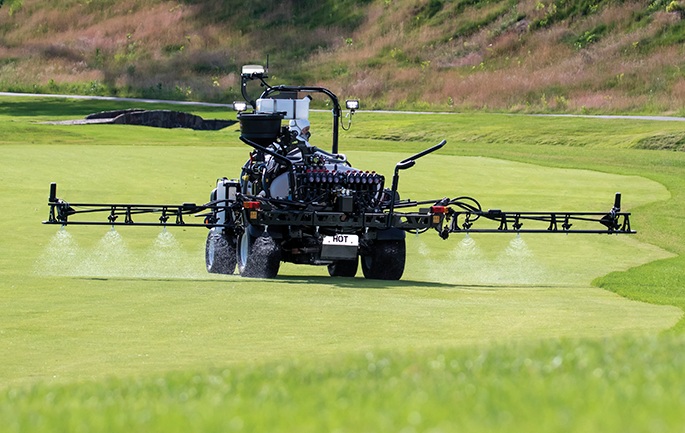
Watch a turf sprayer reach a patch of grass it has already treated. With Toro’s GeoLink system, individual nozzles can switch off automatically. The operator keeps moving. The machine remembers. It is an unglamorous little event, but a useful place to begin understanding The Toro Company: someone has found a repeated piece of waste and given it an off switch.
- The familiar name: mowers, irrigation and outdoor equipment.
- The bigger business: professionals generated about 80% of fiscal 2025 sales.
- The useful idea: sell a finished job, then support the person doing it.
The red mower in the garage explains only part of Toro. Its customers also maintain golf courses, clear snow, grow crops and install buried utilities. What connects these jobs is the cost of an interruption. Grass keeps growing. A contractor still has another property to visit. Equipment has to earn its place in the workday.
A golf course changed the assignment
Toro began in 1914 making engines for the Bull Tractor Company. Even its name carried the relationship: toro means bull in Spanish. Co-founder and first president John Samuel Clapper helped build a company whose enduring opportunity would emerge somewhere rather different from the farm.
In 1919, Toro developed a mechanized fairway mower for the Minikahda Club in Minneapolis. The important change was the assignment. A golf course needed a repeatable way to maintain a large expanse of playing surface. By 1922, Clapper had established a national golf equipment distributor network, bringing equipment, advice and service closer to superintendents.
That sequence offers a practical lesson. Start with the work a customer must repeat. Build the machine around it. Then make help available when the machine needs attention. A century later, the sequence remains recognizable across Toro’s collection of brands.
The machine comes with a relationship
The business now reaches more than 125 countries through distributors, dealers and retailers. Toro sells machinery and irrigation products, with parts, accessories and support extending the relationship. Buyers range from homeowners to rental fleets, municipalities, grounds crews and professional landscape contractors. Those customers have different budgets, but each needs equipment suited to a particular job.
Look at the revenue mix. In fiscal 2025, the Professional segment produced $3.624 billion of $4.5104 billion in total sales. Residential contributed $858.4 million. The distinction matters because a superintendent evaluates a mower as part of a working operation. Reliability, cut quality, repair access and the time needed to complete a route all enter the purchasing decision.
Professional equipment’s share of company sales
That is also where comparison shopping gets interesting. John Deere offers golf mowing alternatives; Vermeer supplies directional drilling equipment. Toro’s case rests on the combination of specialized machines, a broad portfolio and distribution support. Buyers still have to judge the local dealer and the specific machine. The corporate name cannot make that decision for them.
$685 million below the surface
In 2019, Toro bought Charles Machine Works, parent of Ditch Witch. The announced price was $700 million; the later annual filing put total consideration at $685 million. The purchase added directional drills, trenchers, vacuum excavators, locating equipment and pipe rehabilitation products, along with an established dealer network.
A utility trench can seem a long way from a putting green. Commercially, the connection is easier to see. Both involve professionals buying specialized equipment to finish outdoor work. Toro expanded into another demanding workflow, with its own customers and service requirements. In December 2025, it added Tornado, the hydrovac truck manufacturer, deepening that underground construction portfolio.
Acquisition is an expensive way to copy the idea. The more accessible lesson is to look for adjacent work where existing strengths still matter. Here, distribution and equipment support traveled with the strategy. That does not make the integration automatic, or every acquisition a good one.
The forecast that missed the lawn
The counterexample arrived in 2023. Toro reported weaker homeowner demand for lawn-care equipment across both its Residential and Professional segments. Higher interest rates, spending shifts and unfavorable weather helped disrupt expectations. Dealers reduced orders and retail channels cut inventory. Improved supply was meeting customers who were becoming less willing to buy.
“a sharp and accelerated reduction in homeowner demand”
Richard M. Olson / September 2023
Toro recorded a $151.3 million gross non-cash impairment charge related to the Intimidator Group. The machines did not need to stop working for the investment assumptions to weaken. Management said it was aligning production and costs with demand expected to remain softer into fiscal 2024.
For another business, the useful distinction is between shipping a product to a dealer and seeing a customer use it. A full channel can disguise a change in appetite. Toro’s experience makes the limit plain: professional branding does not remove exposure to household spending, and a larger portfolio does not eliminate forecasting errors.
Teach the machine where to stop
GeoLink offers a smaller, more measurable proposition. Its GPS-based system maps spraying locations and controls individual nozzles to avoid repeat application. Lynx irrigation controls address a related problem: organizing watering information, scheduling irrigation and reporting what actually ran. Neither requires a sweeping theory of the future to explain its purpose.
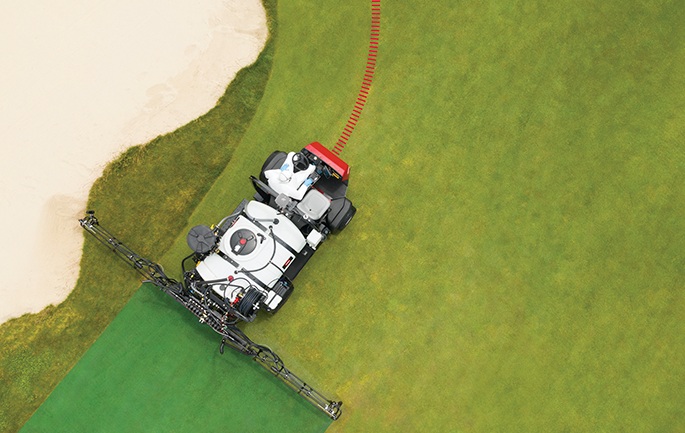
For a buyer, the sensible next step is a demonstration on representative ground, followed by a calculation using actual operating hours, inputs, maintenance and training. Low utilization can make sophisticated equipment hard to justify. Mapping and calibration still matter. These are purchasing considerations, not a promise of a universal payback period.
The company is preparing another handoff. Edric Funk is scheduled to succeed Richard Olson as CEO on November 1, 2026. A newly announced chief technology officer, Neal Lackritz, starts November 2 with responsibility for coordinating technology strategy. The test ahead is concrete: can the next set of connected, autonomous and alternative-power products make a customer’s working day measurably better?