Brent Yeagy had a plan for Wabash: stay three or four years, then move on. Detroit seemed a plausible destination. A career in the big automotive companies beckoned. The trailer manufacturer in Lafayette, Indiana, would be a useful stop along the way. Then his boss offered him a job he had never done and gave him 24 hours to decide.
The offer was director of manufacturing. Yeagy’s experience lay in engineering and related functions. He went home to discuss the decision with his wife, accepted, and changed the direction of his working life. The executive who pushed him was Dick Giromini, whom he would eventually succeed as CEO. A temporary stop had acquired a rather permanent address.
That episode, which Yeagy recalled in April 2026, makes a useful entrance to his story. Advancement arrived as an invitation to leave familiar work. There was a deadline, a conversation at home, and a willingness to learn in public. The rest of his career would give that willingness plenty of exercise.
A sailor’s attention to detail
Before there were trailers, there was the Navy. Yeagy served from 1991 to 1994 and graduated from its Naval Nuclear Power Program. It was an education in systems whose parts had to work together, where precision carried consequences beyond a missed production target. He later described his work as a nuclear machinist’s mate as preparation for the responsibilities of industrial leadership.
“Incredible attention to detail and incredible process-driven outcomes,” was how he described the program in a 2022 interview. Running nuclear equipment required judgment about risk as well as technical knowledge. A decision could reach far beyond the machinery immediately in front of its operator. A reactor offers fairly persuasive arguments for reading the instructions.
Yeagy connected that training to helping colleagues navigate ambiguity. His account of leadership gives uncertainty a practical treatment: establish a direction, understand the risks, and keep people moving toward an outcome. Manufacturing has its own version of that problem. Orders, materials, equipment and people must meet at the right moment. An organization can possess all four and still struggle to make them cooperate.
“Incredible attention to detail and incredible process-driven outcomes.”
Brent Yeagy, on the Navy’s nuclear training
The education between the job titles
His civilian career included plant engineering at Rexnord, beginning in December 1995, followed by work at Delco Remy International from 1999 to 2003. There he worked across engineering, safety management and human resources. Wabash hired him in 2003. He subsequently became vice president of manufacturing, a general manager, and the leader of its commercial trailer products group.
His formal education crossed similar boundaries. He earned bachelor’s and master’s degrees in environmental engineering science and safety engineering at Purdue, followed by an MBA at Anderson University. Executive programs at Michigan’s Ross School and Stanford added further study. Taken together, the qualifications connect the physical workings of a factory with the decisions involved in running one.
He became Wabash’s president and chief operating officer in October 2016, then president and CEO in June 2018. That sequence matters. He had worked inside the company for roughly fifteen years before taking the top job. His authority came with experience of the operations he would ask other people to change.
What a lighter box can change
At the 2018 Work Truck Show, the incoming CEO was talking about materials. Wabash was showing a delivery truck body using DuraPlate Honeycomb Core panels. Yeagy described a weight reduction of about 200 pounds alongside durability benefits. For a delivery operator, the box behind the cab is a working asset, and pounds belong in the business calculation.
He also discussed a refrigerated trailer using molded structural composite technology, with an initial run headed for fleet testing at Werner Enterprises. The emphasis was on useful combinations: floor capacity, loading access and thermal performance. These were engineering details with operational implications. A trailer’s usefulness depends on what can go inside, how it gets there, and what the equipment costs to keep working.
Those interests help explain the scale of his ambitions without requiring grand language. A panel can alter weight. A floor can alter loading options. A different body can make an asset suitable for another assignment. Much of transportation’s progress is available in such unglamorous increments. The goods still have to arrive on Tuesday.
A company with fewer dividing lines
By 2022, Yeagy was explaining a broader Wabash identity. The company had simplified its name and was seeking longer relationships with customers buying across its range. Dry and refrigerated bodies, flatbeds, tanks, parts and service could form a portfolio. That gave the manufacturer more choices about where to use its production capacity.
His description of multiyear agreements was concrete. Customers could secure access to capacity over several years; Wabash could build a deeper service relationship and discuss additional products. Both sides gained time to plan. A trailer order can therefore become a conversation about the next several years of a fleet’s work, including the equipment already on the road.
It is an operator’s view of strategy. The promise has to survive the distance between a sales conversation and a production schedule. Longer commitments create opportunities, but they also create obligations. Capacity must exist when it has been promised. A simplified company name is easy to print. Making the organization behave coherently is the continuing assignment.
“Alphabetically or…?”
Asked in a 2024 company Q&A what kept him awake at night, Yeagy answered, “Alphabetically or…?” The joke suited the list that followed: warehouse inventories, labor, the changing geography of manufacturing, and the delivery demands of online shopping. The concerns crossed company boundaries. So did his proposed response: bring the people making things and moving things into the same discussion.
His caution about technology was especially practical. He argued that adoption determines whether a new tool succeeds. Training and change management deserved attention alongside research and development. A technically feasible solution still had to fit a business. Anyone who has watched an expensive system wait patiently for somebody to use it will recognize the distinction.
The point connects back to that manufacturing promotion. New capability requires people to change their work. Buying equipment or commissioning software begins an assignment that continues through instruction, use and adjustment. Yeagy’s interest is in the organizational machinery around the invention: the habits and processes that allow a promising idea to become ordinary practice.
Trust belongs on the factory floor, too
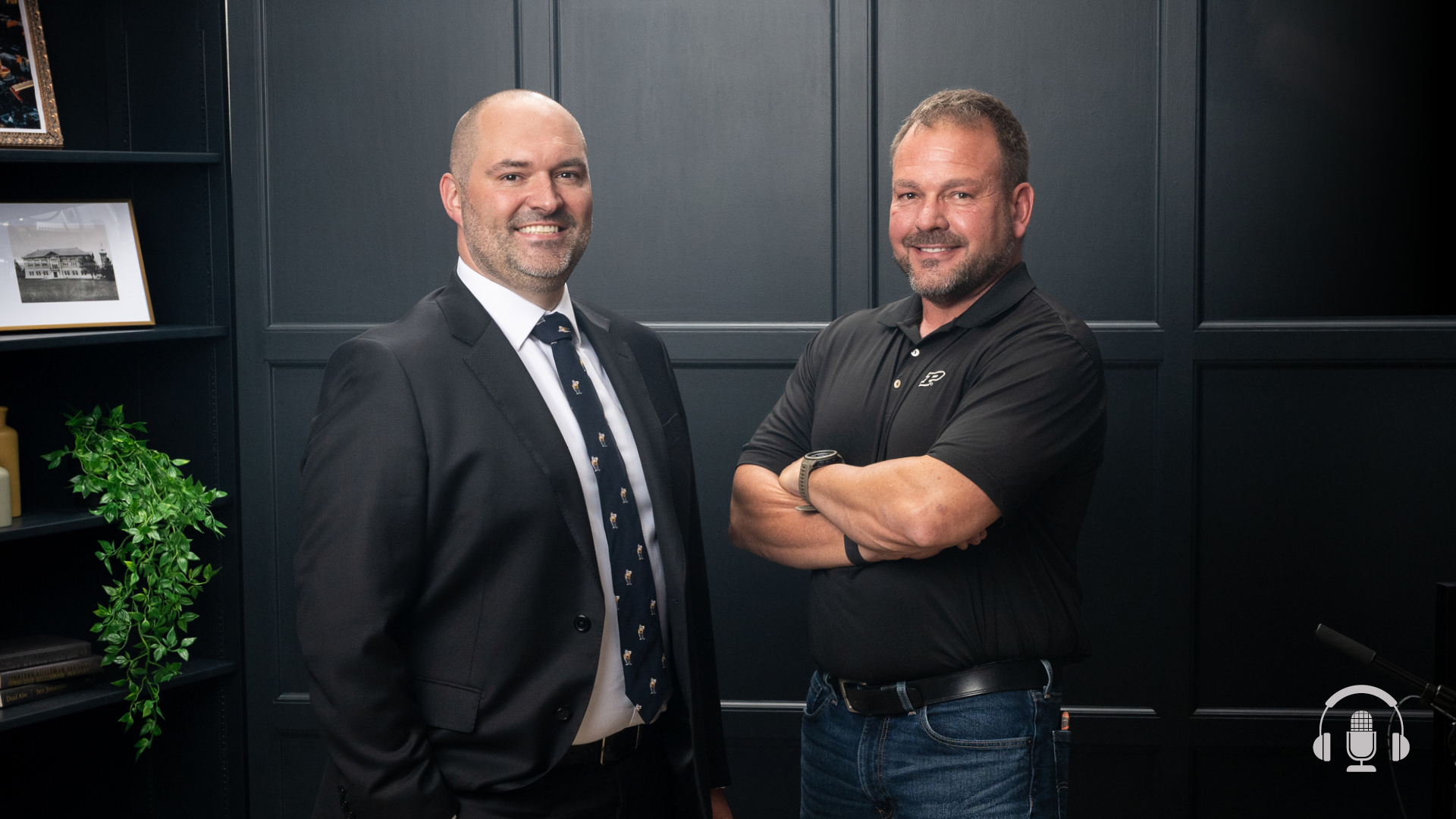
At Wabash Ignite in Louisville in October 2024, Yeagy spoke about empathy and vulnerability. The setting was a gathering of customers, suppliers and dealers. His argument was that frank conversations about needs could lead to solutions that a conventional transaction would miss. Participants had to expose some uncertainty before they could work on it together.
“It’s about trust,” he said. The phrase is modest; the demand behind it is substantial. A customer needs room to describe a problem that does not match an existing product. A supplier needs enough honesty to explain constraints. Both need to tolerate the possibility that the first attempt will require another attempt.
There is a recognizable connection between this argument and the nuclear training he describes. Each asks people to take their dependencies seriously. Precision deals with what is known. Trust helps an organization investigate what it still needs to learn. Neither is much use as a slogan on a wall if the daily decisions ignore it.
The trailer becomes a laboratory
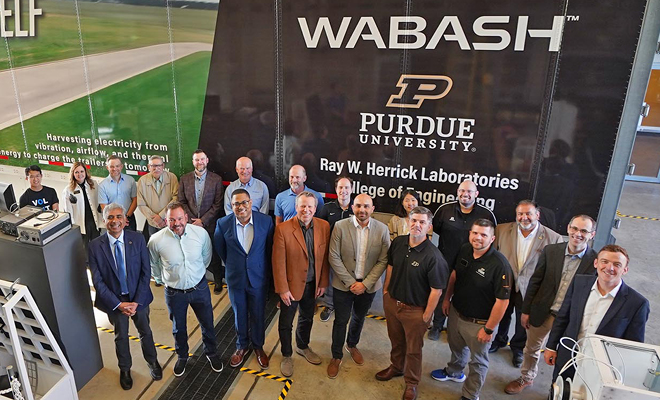
Purdue offers a physical example of that cooperative approach. Wabash and the university formalized a five-year research agreement in 2021. One subsequent project investigates whether a trailer can harvest energy from its own movement and surroundings. Vibrations, airflow and heat become possible inputs for electricity rather than merely conditions the vehicle encounters.
At Herrick Laboratories, the research involves faculty, graduate students and Wabash engineers. The work begins with measurements. Displacement sensors, accelerometers and other instruments help establish where energy is available. That groundwork is necessary before anyone can judge what might be recovered usefully. The research question remains a question; a working laboratory should be allowed to have those.
Mechanical engineering professor James Gibert and his colleagues are investigating mechanisms including suspension vibration and the movement of composite panels. Wabash supplied a trailer for the experiments. The approach turns a familiar industrial object into a mobile data system, with highway runs intended to expose it to the conditions it actually faces.
Can a trailer collect energy as it travels?
Back at Purdue, with advice
In an August 2025 conversation with higher education official Matt Butler, Yeagy defended the value of a degree. He emphasized the experience of learning, solving problems and developing resilience. His appreciation of Purdue included its practical culture and opportunities to encounter industry while studying. Education, in his telling, develops judgment through work as well as instruction.
His advice to students left space for ordinary uncertainty. Find a place at the university and activities that resonate, rather than treating every club choice as a career calculation. Coming from an executive whose own important promotion took him beyond his existing specialty, that advice has some weight. A young person does not need a fully scheduled future to begin doing useful work.
The next order has to be earned
By July 2026, the business offered a mixed report card. Second-quarter net sales were $417.2 million, down 9.1% from a year earlier. Wabash recorded a GAAP operating loss of about $25 million. Its backlog, however, reached $956 million, up 14% from the preceding quarter. More work ahead and losses today can occupy the same balance of facts.
Sales fell 9.1% year over year. Backlog rose 14% quarter over quarter. GAAP operating loss: approximately $25 million.
The company had also brought forward its order cycle for 2027 dry van production. Customers wanted earlier access to configurations, pricing and delivery windows. “The trailer buying cycle has moved,” Yeagy said. Responding meant adjusting the manufacturer’s calendar to the fleet’s planning needs. The next year’s work was already entering this year’s decisions.
That leaves Yeagy with a task more exacting than telling a satisfying career story. The organization has to convert commitments into equipment and equipment into useful service for customers. Years after accepting a role he had a day to consider, he is still working where engineering meets human judgment. The factory gives that meeting a daily deadline.