Before Tony Thene was responsible for a company that supplies alloys for aircraft engines, he was a senior product accountant at Alcoa’s Warrick Operations in Newburgh, Indiana. It is a pleasingly unglamorous place to begin a story about advanced manufacturing. The materials came first. The executive titles arrived much later.
That first Alcoa job is a useful clue to the career that followed. Thene learned the metals business through its accounts, then accumulated responsibilities that crossed finance, manufacturing and investor relations. By the time he joined Carpenter Technology in January 2013, he had spent 23 years at Alcoa. He came to Carpenter as chief financial officer. In July 2015, he became its president and chief executive.
Today he is Carpenter’s chairman, president and CEO, having returned to the executive role in July 2026. His working world stretches from Philadelphia to the places where specialty alloys are melted, processed and turned into components. Much of what his company makes disappears inside somebody else’s machine. A jet engine rarely pauses to thank its suppliers.
The accountant gets closer to the metal
Thene’s undergraduate subject was accounting. He graduated in 1983 from the Evansville institution now known as the University of Southern Indiana, then Indiana State University Evansville. He later earned an MBA at Case Western Reserve University in 2001 and became a certified public accountant. The educational itinerary points toward a financial career. His actual assignments became considerably broader.
At Alcoa, he worked as chief financial officer for both the Flat Rolled Products Group and Alcoa World Alumina and Chemicals. He also served as a manufacturing manager in the Alumina Chemicals business. That last title deserves a little space beside the accounting credentials: responsibility for manufacturing puts a different set of questions on a manager’s desk.
Investor relations added another audience. As Alcoa’s director of investor relations, Thene was the connection between the business and the analysts and investors assessing it. He later became vice president, controller and chief accounting officer, with responsibilities including financial controls and regulatory filings. By 2010, he was CFO of Alcoa’s Engineered Products and Solutions business group.
Seen together, those jobs offer a reasonable explanation for his later vocabulary. He talks about customer requirements, production and returns in the same conversation. That is an interpretation of his career, rather than a claim that a particular early assignment supplied a sudden revelation. The record shows a long accumulation of experience, spread across a business that actually had to make things.
A promotion with a practical assignment
Carpenter announced Thene’s first CEO appointment in June 2015, effective July 1. Gregory Pratt, whom he succeeded, remained on the board as interim executive chairman. The company had conducted an external search and chosen the finance chief already inside the building. Pratt credited Thene’s work in improving profitability and pointed to his experience in both operating and financial roles.
The arrangement also distributed the work. Pratt retained responsibilities for corporate strategy and capital markets, working with the new chief executive. Timothy Lain stepped in as acting CFO while Carpenter looked for a replacement. It was a practical reshuffling of responsibilities around someone who already knew the company’s numbers.
Carpenter itself had been founded in 1889. Thene was taking charge of an established manufacturer, with specialist knowledge, physical assets and customers whose requirements could be exceptionally demanding. The interesting question was how to make that existing capability more valuable to the people buying it.
Listening, with a production schedule attached
One phrase recurs in accounts of Thene’s approach: the “voice of the customer.” His strategy organized the company’s efforts around technology development, operational excellence, strategic marketing and talent engagement. These are familiar boardroom nouns. The substance lay in how they were connected: understand the customer’s problem, develop a material response, and make the organization capable of delivering it.
He reorganized the commercial side to bring Carpenter’s expertise and services into closer alignment with customer needs. He also introduced the Carpenter Operating Model, drawing on lean manufacturing principles. The combination suggests a chief executive concerned with the distance between a promising technical conversation and a finished product.
There is an appealing absence of magic in that formula. An alloy has to perform. A process has to repeat. A customer has to be able to use the result. Listening becomes commercially useful when somebody can translate it into development work, production decisions and a delivery that meets the agreed requirements.
“The full spectrum of our capabilities is what differentiates Carpenter Additive”
Tony Thene, on the business unit’s launch, 2019
Powder, parts and a ribbon in Alabama
In May 2019, Carpenter established Carpenter Additive. The new business brought together capabilities across the production chain: powders, design, prototyping, manufacturing, post-processing and inspection. For Thene, the proposition was that a customer could get help with the route to a usable component, along with the material itself.
Earlier acquisitions had helped assemble those capabilities. CalRAM brought part design and production expertise; LPW Technology added powder-related capabilities. The sequence matters because the business unit emerged from a series of investments. Announcing a service is easy. Acquiring the means to provide it takes rather more paperwork.
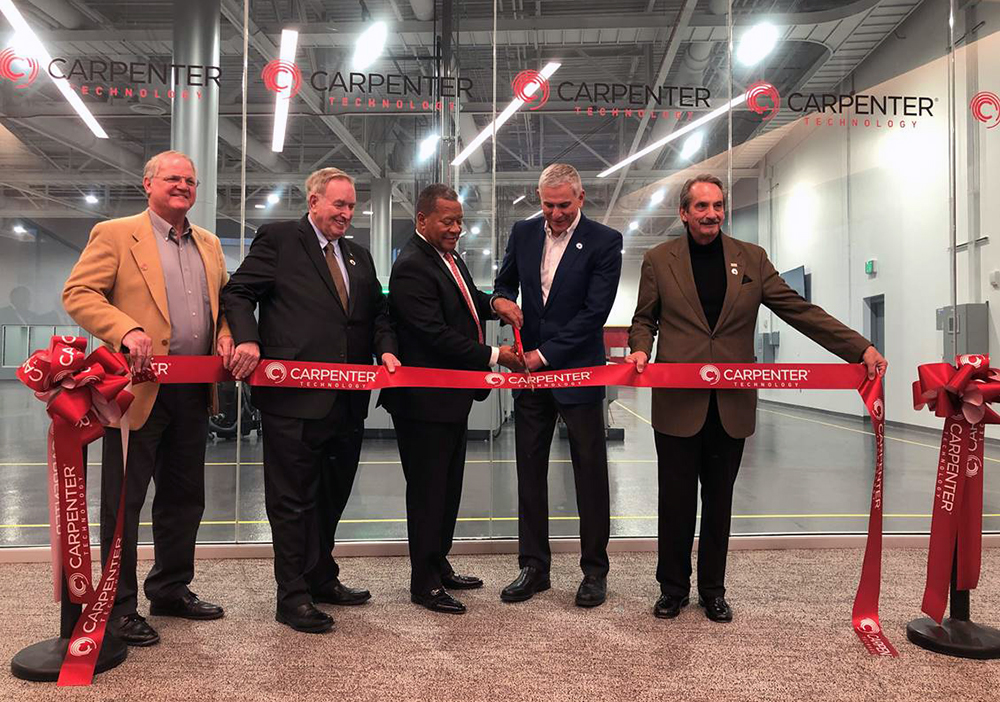
That December, Carpenter opened its Emerging Technology Center in Athens, Alabama. At the opening, the company reported roughly $40 million invested in the center and more than $600 million in its Alabama operations overall. The center occupied 500,000 square feet. Its purpose was to bring multiple stages of additive manufacturing together under one roof.
That included turning specialty alloys into powder, printing parts and applying downstream treatments. A digital thread was intended to preserve traceability through the manufacturing process. Thene explained the Alabama investment through three advantages: a technically skilled workforce, proximity to aerospace activity and cooperation with state and local officials. The location was part of the operating argument.
- 01Specialty alloy
- 02Metal powder
- 03Printed component
- 04Finish & qualify
A simplified view of the manufacturing chain brought together at the Emerging Technology Center.
The motor inside the growth story
Additive manufacturing was one avenue. Electrification was another. In a 2020 interview, Thene discussed Carpenter’s investment in soft magnetic materials and a $100 million strip mill project at its Reading, Pennsylvania, campus. These materials matter to the performance of motors, generators and related electrical equipment.
His explanation moved through technical requirements: electrical, magnetic, mechanical and thermal performance. Aircraft and land vehicles imposed different demands. More power in a given space, higher efficiency and suitable manufacturing processes all belonged in the discussion. The subject was less photogenic than a finished electric vehicle; it was also closer to Carpenter’s expertise.
That distinction helps explain his place in the wider industrial economy. Thene’s customers build products with their own names on them. Carpenter contributes materials and processing knowledge that influence what those products can do. Its commercial opportunity depends on meeting specific requirements that a general-purpose material cannot satisfy as well.
A new label for an old manufacturer
In September 2025, Carpenter announced a change in its industry classification to Aerospace & Defense, effective that month’s end. The change reflected the company’s position and concentration of revenue in those markets. For a business long associated with specialty metals, it was a compact expression of where its commercial identity had moved.
Thene said the designation could improve visibility among investors focused on that sector. Here his earlier investor-relations experience seems particularly relevant: classification shapes who notices a company and which peers they use to assess it. The furnaces did not change because a financial taxonomy did. The audience examining them could.
He added the chairmanship in October 2025, succeeding I. Martin Inglis. Brian Malloy became president and chief operating officer. A further succession announced in February 2026 put Malloy in the CEO role on July 1, with Thene as executive chairman. On July 26, the board appointed Thene to return as CEO; he also resumed the presidency.
The numbers, and the raised eyebrow
The 2026 earnings discussions offer a more conversational glimpse of Thene. On the fourth-quarter call, he fielded detailed questions about aerospace sub-markets, demand and pricing. At one point he admitted that a brief answer had been an attempt to escape another question. “I should have expected that from you,” he told analyst Gautam Khanna. Even a metals earnings call permits a little dry comedy.
The figures gave the conversation weight. For fiscal 2026, Carpenter reported $3.1242 billion in net sales and $702 million in operating income. Adjusted operating income also came to $702 million, compared with $525.4 million in fiscal 2025. The distinction between reported and adjusted measures matters when comparing the years.
Adjusted operating income
Full fiscal years. Adjusted figures exclude special items; these are company results, not personal earnings.
The latest results, released October 22, 2026, kept the operating story moving. First-quarter fiscal 2027 operating income reached $196.4 million, up 28 percent from a year earlier. Thene pointed to productivity, product mix and pricing, alongside stronger aerospace demand. These are the practical variables that recur throughout his public explanations of the business.
Carpenter maintained its fiscal 2027 operating-income outlook of $850 million to $880 million and its fiscal 2029 target of $1.2 billion to $1.3 billion. Those remain ambitions. Delivering them will require the customer demand, capacity and operating performance on which the company’s plans depend.
Thene’s career has put him on both sides of that relationship between a plan and a result. He has prepared the accounts, explained the business to investors and run manufacturing operations. Now he is back in charge of Carpenter’s execution. The early product accountant has acquired a much larger set of numbers. The metal still has to come out right.
Further into the materials
Interviews, company updates and places to keep reading or watching.