Aaron Jagdfeld really hates golf. This is a small inconvenience for anyone hoping to explain his career through the customary executive leisure activities. In a 2012 questionnaire, he preferred running or biking. His alternative career was more revealing: teaching U.S. history and coaching high school track. The future he once imagined involved a classroom, a stopwatch and young people learning how to improve.
Instead, he became the third chief executive of Generac, the Wisconsin manufacturer founded in 1959. He arrived in its finance department in 1994. By September 2008, he was running the company. The intervening years took him from accounting into responsibility for products, engineering, sales and customers. His education in manufacturing happened inside a business whose products become especially interesting at the moment everything else stops working.
A generator has an awkward relationship with its owner. Its finest performance is an interruption nobody wanted. Jagdfeld has spent much of his leadership trying to broaden that relationship: more customers, more countries, more ways of managing electricity before an outage ever arrives. By 2026, that effort had brought him from the American backyard to Amazon's data centers.
The accountant leaves his desk
Jagdfeld studied accounting at the University of Wisconsin-Whitewater and worked in Deloitte & Touche's Milwaukee audit practice before joining Generac. He became chief financial officer in 2002, president in 2007 and CEO the following year. The sequence matters. He had already spent years inside the business before he acquired authority over the whole of it.
The presidency widened his responsibilities to sales, marketing, engineering and product development. A balance sheet can tell you that something has gone wrong. Those departments offer a rather more immediate education in why. Jagdfeld's route to the top crossed both kinds of work. His title changed faster at the end; the apprenticeship had been long.
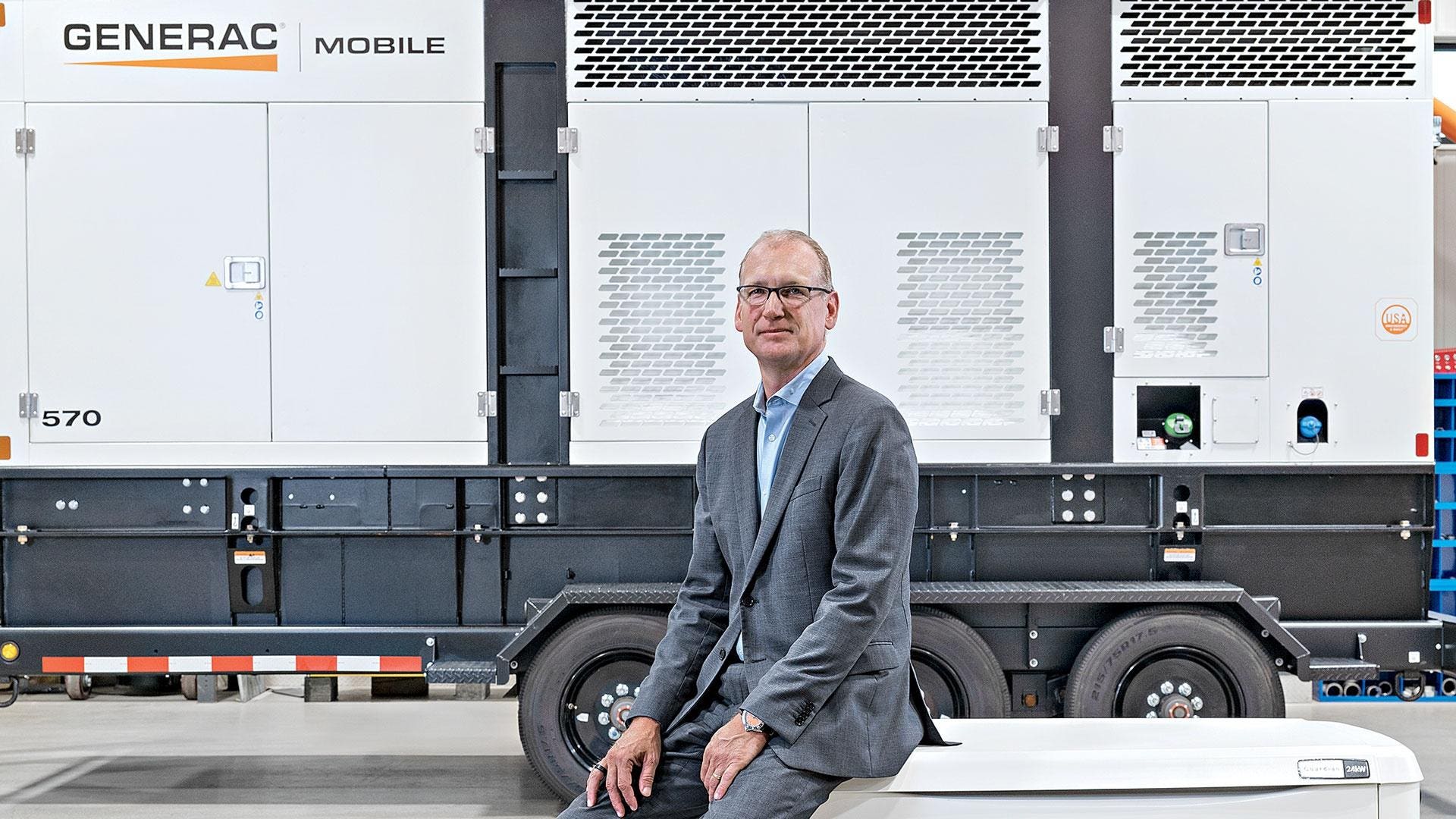
He also worked shifts on the assembly line at Generac's Whitewater plant. It is a useful detail in a career otherwise easy to reduce to job titles. The accountant had encountered the product as something to assemble, as well as something to count. In the 2022 factory photograph below, the machinery occupies considerably more space than the chief executive. The proportions seem appropriate.
A promotion with terrible timing
Becoming CEO in September 2008 provided an unusually brisk introduction to adverse conditions. Generac had been acquired by private equity firm CCMP Capital in 2006. The buyout left the company carrying substantial debt. Then the housing crash and recession struck a business already exposed to the erratic arrival of storms.
A generator manufacturer cannot schedule its most persuasive advertisement. Good weather can be bad for orders; economic weakness can discourage expensive purchases even when customers understand the need. Jagdfeld inherited both the financing problem and the problem of depending on circumstances he could neither arrange nor repair.
Generac went public in February 2010. Acquisitions followed, extending the company's reach beyond its existing products and markets. The response was expansive rather than purely defensive. Yet the underlying question was practical: how could the business make its future less dependent on the next weather report?
“I can't go out and try to fix housing.”
Aaron Jagdfeld, 2012 leadership interview
That blunt observation helps explain his appetite for diversification. In 2012, he described geographic expansion and adjacent product lines as ways to reduce exposure to a downturn. Magnum Products brought mobile equipment and customers in rental, road construction and oil and gas. GenTran added transfer switches and portable-generator accessories. Each purchase offered another route to a customer.
Electricity, even on an ordinary Tuesday
The next extension was into the home itself. Generac closed its acquisition of ecobee in December 2021, adding smart thermostats and home energy management to its portfolio. A thermostat is a modest object beside an industrial generator. It also has something a standby generator lacks: a job to do every day.
For Jagdfeld, the acquisition supported a broader home energy system. Producing electricity, storing it and deciding when to use it could become connected activities. The business would have a place in the household's ordinary energy decisions as well as its emergencies. That is a different commercial relationship from waiting in the garden for a tree to fall on a power line.
Ecobee cofounder Stuart Lombard described a shared ambition with Jagdfeld: combining ecobee's technology with Generac's generation, storage and energy management equipment. Their connection made the strategy tangible. One company brought devices already managing household consumption; the other brought equipment that could supply and store power.
In a January 2022 conversation about smart homes, Jagdfeld explored decentralized energy, storage and the information consumers could receive about their own usage. Electric vehicles were part of that discussion, too. Adding another large electrical load to a home changes the questions its owner needs to ask. How much power is available? When is it needed? What happens when the grid is unavailable?
His ambition extended to software coordinating gas generation, solar and batteries. “AI will help you export power,” he said in 2022. The remark placed artificial intelligence in an unglamorous but consequential role: helping decide what to do with electricity. It preceded the later rush to sell generators to the buildings that run AI.
The factory still needs people
A larger product portfolio creates a less photogenic assignment: building enough of it. In a second TechEd conversation in January 2022, Jagdfeld discussed manufacturing growth, automation and workforce development. Generac's work with GPS Education Partners connected the company to learning on the job. Certifications and employee training were part of the same discussion.
The topic had occupied him for years. In 2012, he argued that manufacturing's reputation was making recruitment harder. Parents and students were carrying an outdated picture of factory work, even as employers needed people with mathematics and technical skills. Buying more equipment would not, by itself, supply the people able to operate it.
The classroom in his abandoned career plan is an appealing echo here. There is no need to turn a youthful preference into a theory of everything. Still, the executive who once wanted to teach and coach has repeatedly returned to the question of how people learn a skilled job. A factory expansion begins with machinery and ends with somebody knowing what to do.
In March 2026, he joined the National Association of Manufacturers' board. The appointment gave his manufacturing advocacy another forum, alongside his company responsibilities. His public case for the industry had moved from explaining individual factory jobs to supporting policies affecting American manufacturers.
A Wisconsin address, with a soundtrack
Jagdfeld's outside connections also include hardware supplier Hillman and Milwaukee World Festival, the organization behind Summerfest. The latter places him in a recognizably local institution, even as Generac serves international markets. A global business can still have a nearby stage to help build.
Generac announced its Summerfest partnership in November 2020. The agreement included sponsorship of a major stage, improvements to its production capabilities and an admission promotion for military personnel and veterans. Jagdfeld presented the investment as a way to give back to Milwaukee and the region. The upgrades were scheduled for the 2021 festival.
Music supplies another small personal detail. His 2012 listening choice was the Beatles. His reading then included Hemingway's short stories, and his favorite film was Planes, Trains and Automobiles. These are snapshots rather than permanent settings. They do, however, make room for a person among the acquisitions and quarterly figures. Even a generator executive is allowed an interest in things that need no generator.
The cloud acquires a very large engine
By July 2026, Generac reported approximately $1.6 billion in backlog for products serving data centers, excluding committed volumes from its second hyperscale customer. The company was investing in additional production and packaging capacity for large generators. Jagdfeld's long-running effort to broaden the company had reached customers buying power infrastructure at a different scale.
September supplied a name and a timetable. Generac entered a long-term supply agreement with Amazon and said initial backup-generator deliveries were expected to total $2.4 billion in 2027 and 2028. Amazon also received warrants whose vesting, beyond an initial portion, depended on qualifying payments reaching specified levels, up to $8 billion.
Expected initial generator deliveries in 2027 and 2028.
For Jagdfeld, the significance lies partly in the customer and partly in the work that follows. Expected deliveries require manufacturing capacity, components, execution and service. The financial terms matter, but so does the older industrial task of getting equipment out of a factory and into useful operation. The former accountant and the assembly-line apprentice both have relevant experience.
His career has followed electricity into more corners of everyday life: the home during an outage, the thermostat during an ordinary day, the factory making the equipment, the data center behind a digital service. The machines have grown larger. The question remains plain enough for a classroom: what needs to keep running, and who will make sure it does?
Keep the conversation going
- GeneracCompany website
- Aaron Jagdfeld on LinkedInPersonal professional profile
- The factory, the IPO and the home energy planForbes · August 2022
- Leading Through Massive Growth in ManufacturingThe TechEd Podcast · January 2022
- The Future of Energy, Power and Smart HomesThe TechEd Podcast · January 2022
- Watch: Jagdfeld on a hyperscale supply agreementCNBC Television on YouTube · June 2026
- Amazon agreement: deliveries and warrant termsGenerac · September 2026 filing