A grocery store has a rather unforgiving definition of progress: the freezers must keep freezing. When Hurricane Harvey reached Texas in August 2017, Thomas McAndrew’s company had generators installed at H-E-B stores and a question to answer. Could its idea survive the weather that made people want to buy it?
Before the worst interruptions, Enchanted Rock disconnected operational sites from the utility grid and put them into island mode. Stores could generate their own electricity while the surrounding system struggled. McAndrew described one participating store serving as a National Guard base. Electricity, usually the least interesting item on a shopping list, had become the condition for everything else.
For McAndrew, this was a practical demonstration of a career’s accumulated lessons. He had operated nuclear propulsion plants, worked around commercial nuclear generation and moved into energy trading. In 2006, he founded the business now called ERock. Its proposition brought the engine room and the trading floor into the same conversation: dependable power at a customer’s premises, with an economic reason to keep the machinery there.
The engine room came first
His introduction to energy involved two very large moving objects: the USS Eisenhower and USS South Carolina. During six years in the US Navy, McAndrew worked in engineering and operations on nuclear-powered surface ships. He qualified as a Naval Nuclear Chief Engineer for a Nimitz-class aircraft carrier. Reliability was part of the assignment long before it became a word on a company presentation.
After the Navy, he became a maintenance support engineer at Southern Company’s Plant Farley nuclear power station. These jobs placed him close to systems whose continued operation depended on preparation, maintenance and people understanding what equipment would do. A generator’s presence on a site tells you surprisingly little about whether it will work when asked.
His education also crossed disciplines: mechanical engineering at Texas A&M and an MBA at Harvard Business School. His subsequent roles included director at Enron, vice president of West Power Trading at Statoil and vice president of trading and risk management at Calpine. At Calpine, his responsibilities also included commercial startups of natural gas combined-cycle plants.
The resulting career makes his later business easier to understand. Engineering addresses whether a system can perform. Trading addresses when its output has value. A customer asking for reliable electricity needs the first answer; a company trying to make reliability affordable benefits from both. McAndrew had worked on either side of that equation before putting his own name behind the venture.
Forty-five sites, one commercial question
By 2016, a joint venture called Texas Microgrid, formed with Balfour Beatty Infrastructure Partners, was planning 45 Houston-area microgrids. The commercial structure gave customers a smaller upfront payment while the venture owned and operated the equipment. Selling into Texas electricity markets would help recover the remaining costs. The generator could earn its keep between a customer’s emergencies.
McAndrew also favored repeatable equipment over elaborate customization. “CHP is always custom,” he said of combined heat and power systems in 2016. That preference shaped what the company chose to pursue. Standard components offered a route to reducing development time and costs. Every site has its own complications; the equipment did not need to acquire a fresh personality at each address.
This was a consequential choice for a founder. A bespoke engineering project can be satisfying and hard to repeat. A service business needs installations it can build, monitor and maintain again and again. McAndrew’s approach joined technical design to a financing model, then asked the machinery to serve more than one purpose. The customer could buy continuity without taking on the entire job of being a small power company.
Coordinated generation can earn grid-service revenue.
The microgrid separates and supplies its agreed local loads.
A supermarket cannot wait for a fuel truck
H-E-B’s difficulty was wonderfully specific. Its trailer-mounted diesel generators had to travel between stores. Earlier storms had made that movement difficult. McAndrew explained that logistics problem in an August 2017 interview: the grocer wanted generation permanently installed, ready at the place where it would be needed. A backup plan involving roads has an awkward relationship with a flood.
That customer request gave the technology a clear job. It had to support a working store, rather than merely demonstrate that an engine could start. Refrigeration, lighting and the activity of selling groceries made reliability visible. For a founder selling an unfamiliar arrangement, a store remaining useful through a storm offered a persuasive explanation of the product.
Harvey supplied the test. The company’s systems at participating stores operated independently of the central grid, using natural gas delivered through pipelines. McAndrew’s decision to island sites before interruptions emphasized operating judgment alongside hardware. Installation was one part of the promise. Knowing when to disconnect, and continuing to manage the equipment afterward, were part of the service customers had bought.
In February 2017, Energy Impact Partners had announced a $10 million investment. Its utility network mattered to McAndrew alongside the money. The business needed relationships with the electricity industry as well as customers wanting protection from interruptions. Its value depended on being useful to the larger system while remaining ready to separate from it.
The photograph has pumps behind it
In March 2023, McAndrew stood beside another application of that thinking at Fort Bend Levee Improvement District No. 2 in Sugar Land. The site had 12 megawatts of backup generation supporting a pumping station capable of moving a million gallons of water a minute. Between flood emergencies, the equipment could support the grid. The project illustrated how two uses could help pay for one installation.
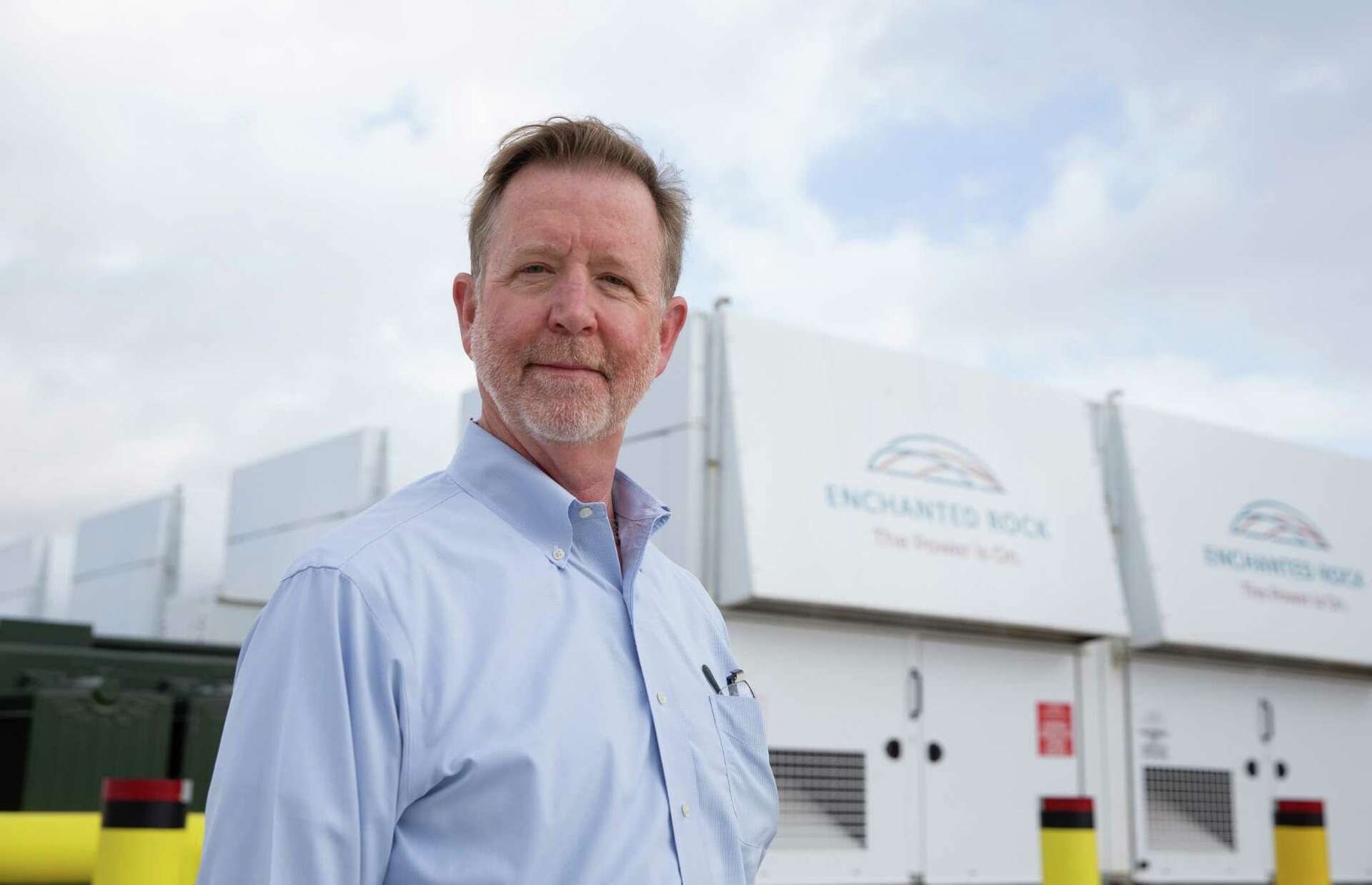
These are unglamorous customers for an entrepreneur to discuss: pumps, grocery stores, equipment behind buildings. They also make the argument tangible. There is a load to carry and a consequence if power fails. McAndrew’s business grew around that straightforward relationship, using the more complicated machinery of electricity markets to make the bill easier to bear.
A trophy, and a preference for the workshop
In June 2018, McAndrew received EY’s Entrepreneur Of The Year award in the Gulf Coast Area’s Technology category. His response shifted attention to the employees whose work had made the business possible. “I wouldn’t be here without them,” he said. An individual award had landed in a company dependent on people designing systems, completing installations and keeping them ready.
There is another glimpse of his interests in his 2023 Data Center Revolution conversation with Kirk Offel. The episode explored his childhood, enthusiasm for rebuilding cars, Navy service and the route to founding Enchanted Rock. Rebuilding a car is a nicely literal counterpoint to the abstract language of energy markets. Eventually, something mechanical must work.
The combination gives his public story its character. He can discuss electricity as a traded commodity, yet his career keeps returning to machinery and its behavior. The connection between those worlds is the useful part. A clever contract cannot compensate for an engine that fails; an excellent engine still needs a customer who can afford its services.
The data center joins the conversation
By 2022, Microsoft had contracted Enchanted Rock to develop backup power for its San Jose data center using renewable natural gas arrangements. The project brought McAndrew’s reliability proposition into a different purchasing conversation, involving carbon goals as well as continuity. The company proposed matching gas use with renewable natural gas injected upstream into the pipeline network.
That distinction matters. The arrangement concerns fuel supply and accounting across a network; the engines still generate electricity on site. It gave McAndrew another way to address customers who needed sustained backup while seeking to reduce emissions. His commercial task now included explaining how the fuel arrangement, generating equipment and grid support would fit together.
His later writing broadened the argument. In 2024 he published about data centers as grid assets, and in 2025 he argued for flexibility as a way to connect large electricity users more quickly. A facility with dispatchable generation could change when it draws on the utility. That made backup equipment relevant to the problem of adding new demand, alongside its established role during outages.
“I wouldn’t be here without them.”
Thomas McAndrew, on his employees, accepting the 2018 regional EY award
A founder changes seats
McAndrew stepped down as CEO in June 2025. The announced transition kept him involved in strategic advice, originating deals and board work while Corey Amthor took the chief executive role. After nearly two decades leading the company, he was changing the terms of his participation. The founder’s work could continue without requiring him to manage every part of the organization.
The 2026 public-company documents make a further distinction: his agreement provides for a non-voting board observer role at ERock, subject to an ownership threshold. That role permits attendance at board meetings without membership of the board or its committees. The business he founded had reached a stage with different governance arrangements and a different chief executive.
His June 2025 essay on manufacturing and AI nevertheless returns to a familiar concern: ambitious plans depend on access to electricity. He urged manufacturers to make energy strategy part of business planning, rather than treating power as an assumption. It is an argument that reaches from factory schedules to the everyday mechanics of remaining open.
The scale of the conversation has changed since the early microgrids. The question underneath it remains recognizably McAndrew’s: how do you make electricity dependable where it is used, and arrange the economics so someone will pay for that dependability? A data center can make the calculation enormous. The freezer supplies the shorter explanation.