A board member can vote for an acquisition and go home. A chief executive inherits Monday morning. For Vineet Nargolwala, the distance between those two jobs became unusually short in the summer of 2026. He had helped assess Brady’s proposed purchase of Honeywell’s Productivity Solutions and Services business. On June 8, he became Brady’s chief executive. On August 3, the $1.4 billion deal closed. The decision he had helped make was now his to deliver.
There was a further twist. Honeywell was already on his résumé, occupying nearly a decade of his earlier working life. He was taking charge of a company buying a business from a former employer. Corporate careers usually look tidy when reduced to a row of logos. This one had begun folding back on itself.
The products involved offer few opportunities for celebrity. Labels, barcode scanners, mobile computers and printers rarely get applause. They do, however, help people establish what something is, where it belongs and what should happen to it next. Nargolwala’s own career has travelled through a related set of questions: how to sense the physical world, how to make that information useful, and how to build a business around the answer.
Electrical engineering, with a widening field of view
His education began with electrical engineering at Maharaja Sayajirao University in Baroda, India, followed by a master’s in the same subject at the University of Texas at Arlington. He later added an MBA from Cornell. The combination gives his professional history two clear strands: understanding how technology works and accepting responsibility for whether customers will pay for it.
At Nortel Networks, he worked in engineering and product management. At Honeywell, his responsibilities expanded into business strategy and operating leadership, including serving as president and general manager of Phoenix Controls. These were jobs inside established organizations, where a new idea has to coexist with budgets, installed equipment and customers who would prefer everything to keep working.
He joined Sensata Technologies in February 2013 as vice president of Sensors Americas. His remit subsequently included North America, Japan and Korea. In 2019, he moved through leadership assignments in Global Safety & Mobility and Sensing Solutions; in March 2020, he became executive vice president of Sensing Solutions. The geographical reach widened alongside the technical responsibilities.
Sensors are an apt training ground for someone who will eventually run an industrial technology company. Their usefulness rests on turning a physical condition into information another system can act upon. Managing the business adds another translation: explaining why a technical capability deserves engineering time, factory capacity and a place in a customer’s next product.
A billion-dollar year, and the work behind it
In June 2022, Nargolwala became president and CEO of Allegro MicroSystems, succeeding Ravi Vig. Allegro made sensing and power semiconductors for automotive and industrial applications. It had already become a public company before his arrival. His assignment was to develop the next stage of its business, rather than collect credit for the previous one.
At the time, he identified electrification, industrial automation, data centers, autonomous vehicles and efficient motion control as opportunities. It was a technically coherent list. Each requires systems that can measure, control or convert something in the physical world. For an executive trained in electrical engineering, the commercial argument remained close to the machinery.
The headline result arrived in fiscal 2024: annual sales of $1.05 billion, up 8%. Automotive sales rose 17%, helped by 38% growth in e-mobility. These were company results achieved during his tenure, with the contributions of engineering, sales and operations teams behind them. A chief executive gets the microphone; the organization does the multiplying.
Acquisitions formed part of that effort. In October 2023, Allegro completed its $420 million cash purchase of Crocus Technology, adding tunnel magnetoresistance sensing technology. The name is a mouthful; the business purpose was more direct. Allegro was buying additional technical capability to strengthen its magnetic sensing portfolio and speed its development plans.
That is a useful distinction in Nargolwala’s record. Buying revenue makes a company larger on completion day. Buying engineering capability poses a longer question: what can the combined teams build that they could not deliver as readily apart? The Crocus transaction belonged to that second conversation, even though its success would still have to be measured commercially.
A ribbon in Hyderabad
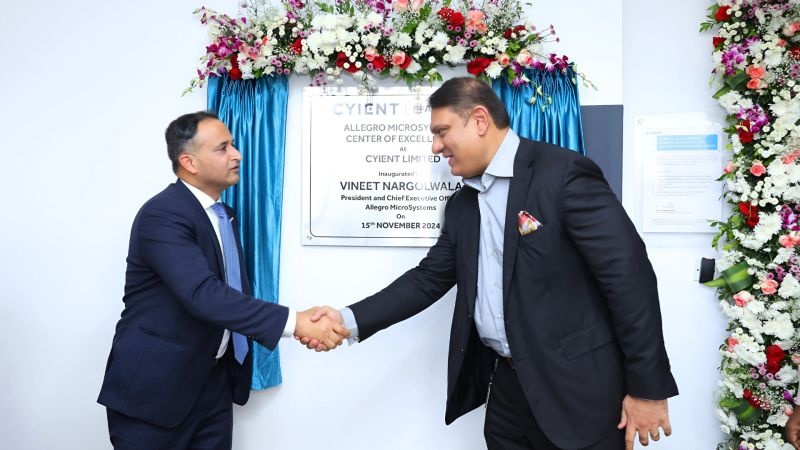
On November 15, 2024, Nargolwala inaugurated an Allegro-Cyient Center of Excellence at Cyient’s Manikonda campus in Hyderabad. The partnership called for more than 100 engineers working across areas including analog design, verification and embedded systems. His Allegro colleagues Max Glover and Suman Narayan joined the occasion, alongside Cyient leadership.
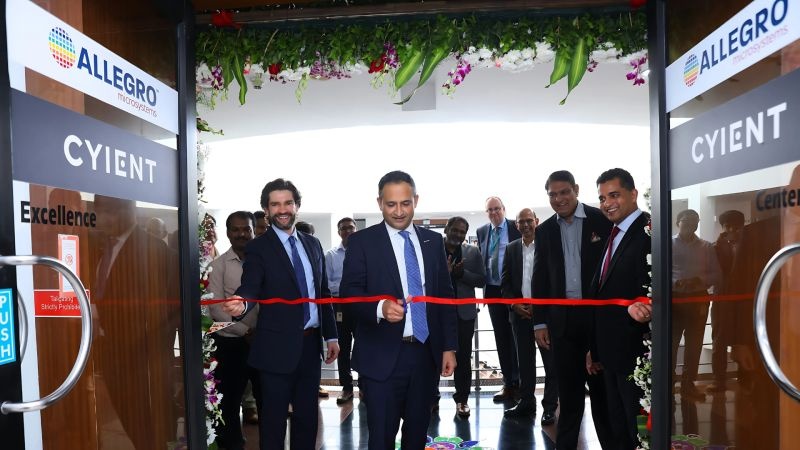
The ceremony supplied a visible moment in a business whose work is mostly concealed inside other people’s products. Behind the ribbon were tasks such as checking whether a chip behaves as intended after fabrication and verifying a design before it reaches that expensive stage. The plan connected an international semiconductor company with engineering talent in India.
For Nargolwala, whose undergraduate engineering education had been in India, the event placed a later chapter of his career back in the country where that education began. The professional connection is concrete: an engineer educated in Baroda was now opening a facility intended to help develop the next generation of automotive sensors and power devices.
There was also a change in Allegro’s ownership structure during his tenure. In fiscal 2025, the company repurchased 39 million shares from its largest shareholder, Sanken, reducing that investor’s stake from approximately 51% to 33%. The transaction changed the balance of ownership around a business that was already publicly traded. It helps explain why corporate independence featured in his later account of the period.
The difficult paragraph in the résumé
The Allegro years also included a sharp change in trading conditions. In January 2025, the company reported quarterly sales of $178 million. Nargolwala emphasized new product introductions and results above the midpoint of guidance. The figures nevertheless belonged to a very different period from the preceding billion-dollar annual milestone.
He left on February 23, 2025, when longtime Allegro executive Michael Doogue became CEO. The company subsequently described Nargolwala’s departure as involuntary and without cause. That wording matters. A polished career narrative should leave room for a job ending on terms other than the executive’s choosing.
Allegro’s full fiscal 2025 sales were $725 million, down 31%, primarily because customers were reducing inventory. The year ended after his departure. It would be misleading to assign every result to one individual, just as it would be misleading to tell the story using only the earlier record. Industrial technology has cycles; executive biographies have consequences.
His own farewell emphasized the team, new development centers, acquisitions and the operating systems put in place during his tenure. The tone was appreciative, including support for Doogue. It was a public goodbye that looked backward at collective work while leaving the next chapter to someone else.
The acquisition that became his assignment
Brady had elected Nargolwala to its board in 2022. By the time he succeeded Russell Shaller in June 2026, he had spent four years observing the company from that position. He also knew the proposed Honeywell transaction from the board’s assessment. His new job came with unusually direct knowledge of the reasoning behind its biggest immediate commitment.
His first week in the role included a global town hall. Describing it afterward, he highlighted meeting new colleagues and answering their questions. After several years on the board, he was now encountering the organization through a different set of conversations. Employees had a new chief executive to assess; he had a much closer view of the company they were helping him run.
When the purchase closed in August, the acquired business brought mobile computing, scanning, RFID and workflow software alongside Brady’s existing printers and consumables. Honeywell’s PSS business had generated approximately $1.1 billion in 2025 sales. Brady established two reporting segments: Identification Solutions and Intelligent Productivity Solutions. The names described the intended connection between identifying an item and helping manage the work around it.
The attraction is easy to follow at the level of a single object. A label gives it an identity. A scanner reads that identity. Software connects the reading to a workflow. Making those capabilities work together could deepen the company’s role in customers’ operations. The acquisition supplied more of the pieces; Nargolwala and his colleagues now had to assemble them.
At a September investor conference, he described spending time on the road visiting the acquired business’s facilities, alongside CFO Ann Thornton. His attention went first to the team and its capabilities. “To me, integrations always start with people,” he said. It is an ordinary-sounding sentence that carries a practical burden when a company has just spent $1.4 billion.
“To me, integrations always start with people.”
Vineet Nargolwala · September 2026
He also acknowledged that making the acquired offering more competitive required work. That admission gave the discussion a useful limit: the deal had closed, but the competitive result remained ahead. In his first months as CEO, the relevant questions concerned products, customers, talent and execution, all matters that continue after the announcement photographs have been filed away.
Nargolwala’s career has prepared him to recognize those questions from several angles: engineer, product manager, operating executive, director and CEO. At Brady, the roles have converged. He knows why the board said yes. He knows something of the seller’s world. Now comes the less ceremonial part of the story: helping the people inside the enlarged business make that decision useful, one working day at a time.