The future has a purchasing department. Somewhere between an ambitious design and a working machine, somebody has to order the right metal, coating, or chemical. It is a less photogenic part of invention than a rocket launch. It is also where Jugal Vijayvargiya has chosen to spend the second large chapter of his career.
Since March 2017, he has been president and chief executive of Materion, the advanced materials company based in Mayfield Heights, Ohio. Its customers make things whose names travel much farther than those of their suppliers. Vijayvargiya’s business sits inside that gap: close to the technology, several steps away from the applause.
His route there began in electrical engineering and passed through a long international career at Delphi. By the time he moved to Materion, he had already run a $3 billion automotive electronics business. He arrived with experience of the complicated middle ground where an engineer’s promising idea becomes something a factory can repeatedly deliver.
An electrical engineer takes the long way round
Vijayvargiya earned both his bachelor’s and master’s degrees in electrical engineering at The Ohio State University. The pairing is an unusually tidy opening to a career that later became geographically and professionally expansive. His work at Delphi took him through Europe and North America, and through functions that executives often encounter from opposite sides of a meeting table.
Product engineering. Manufacturing engineering. Sales. Product line management. Acquisition integration. General management. The sequence matters because each discipline puts a different question to the same product. Does it work? Can we make it? Will somebody buy it? Can the newly acquired operation do any of those things alongside the existing one?
In February 2012, he became president of Delphi Electronics & Safety. The business operated in 16 countries and covered automated driving, controls and security, infotainment, driver interfaces, and software and services. Its headquarters were in Germany. This was automotive work at a moment when the contents of a car were becoming an increasingly elaborate electronics assignment.
That background gives his later move a practical continuity. At Delphi, he worked on technologies that customers could encounter as features. At Materion, he would lead a company supplying the materials that let demanding technologies function. The point of view moved further into the product, toward ingredients most users never have a reason to name.
Buying a place deeper inside the machine
The handover at Materion was a planned succession. Richard Hipple, who had led the company since 2006, moved to executive chairman when Vijayvargiya joined on March 3, 2017. The new chief executive also joined the board. He was taking responsibility for an established manufacturer, with existing capabilities to develop rather than a blank sheet to decorate.
Two acquisitions make the direction of his tenure tangible. In June 2020, Materion announced an agreement to buy Optics Balzers, a thin film optical coatings business established in 1946. The announced transaction value was approximately $160 million. In a business of very thin coatings, this was a reasonably substantial cheque.
The attraction was partly geographical and partly technical. Optics Balzers brought a complementary mix of products and markets. Combining the operations widened what Materion could offer in optical coatings. When the purchase closed in July, Vijayvargiya welcomed the incoming team and pointed to collaboration in serving customers around the world.
The following year, Materion announced another purchase: H.C. Starck’s electronic materials portfolio. The September announcement put the price at $380 million and described a business expected to generate approximately $145 million in 2021 revenue. The target brought process technology and about 140 employees, adding depth to Materion’s semiconductor offering.
There is a small accounting distinction worth keeping straight. The announced price and the eventual cash purchase price were different figures: the annual filing recorded approximately $395.9 million when the transaction closed on November 1, 2021. A deal announcement describes an agreement; the completed accounts record what was paid.
Asked about the logic of putting these businesses together, Vijayvargiya emphasized growth from combining their capabilities. The useful question was what the enlarged operation could sell to customers. His answer tied the acquisition to Materion’s existing semiconductor, aerospace and defense, and industrial activities, rather than treating ownership itself as the achievement.
“We want our company to be a truly an advanced materials company, serving the most dynamic, high growth markets.”
Jugal Vijayvargiya · acquisition call, September 2021
A Mars rover offers a more memorable way to picture the work. In March 2021, Materion described its contribution to NASA’s Perseverance mission: optical filters in the Mastcam-Z camera system, filters in the rover’s weather instrumentation, composites, and products that seal sensitive electronics. The catalogue had become part of a machine operating on another planet.
Vijayvargiya expressed pride in supporting the mission. Materion’s space involvement reached back to the early 1960s, well before his arrival. That history gives his role a particular texture: he is responsible for developing a business whose expertise has accumulated across generations of engineers. The acquisitions sit alongside that inheritance, adding capabilities to an organisation that already knew how to meet exacting requirements. A new chief executive gets the office keys; the technical memory arrives with the company.
The unglamorous ingredient in a new energy plan
Acquisitions supplied one route into new markets. Partnerships supplied another. In 2020, Materion and Kairos Power began collaborating on salt coolant for advanced reactors. In July 2022, they jointly commissioned a Molten Salt Purification Plant at Materion’s Elmore, Ohio location. A future energy system had acquired a very present-tense industrial address.
The material was Flibe, a molten mixture of lithium fluoride and beryllium fluoride. Kairos needed a dependable way to obtain it at scale. Its account of the development describes testing, changes to the process, and the construction of the pilot plant. The work had the familiar texture of manufacturing: learning which steps were necessary and which could be simplified.
That plant produced material for Kairos Power’s first Engineering Test Unit, a non-nuclear test. The distinction is useful. Supplying a test programme is a concrete industrial milestone, while commercial reactor deployment remains a separate undertaking. Vijayvargiya’s company could contribute to the former without pretending the latter had already happened.
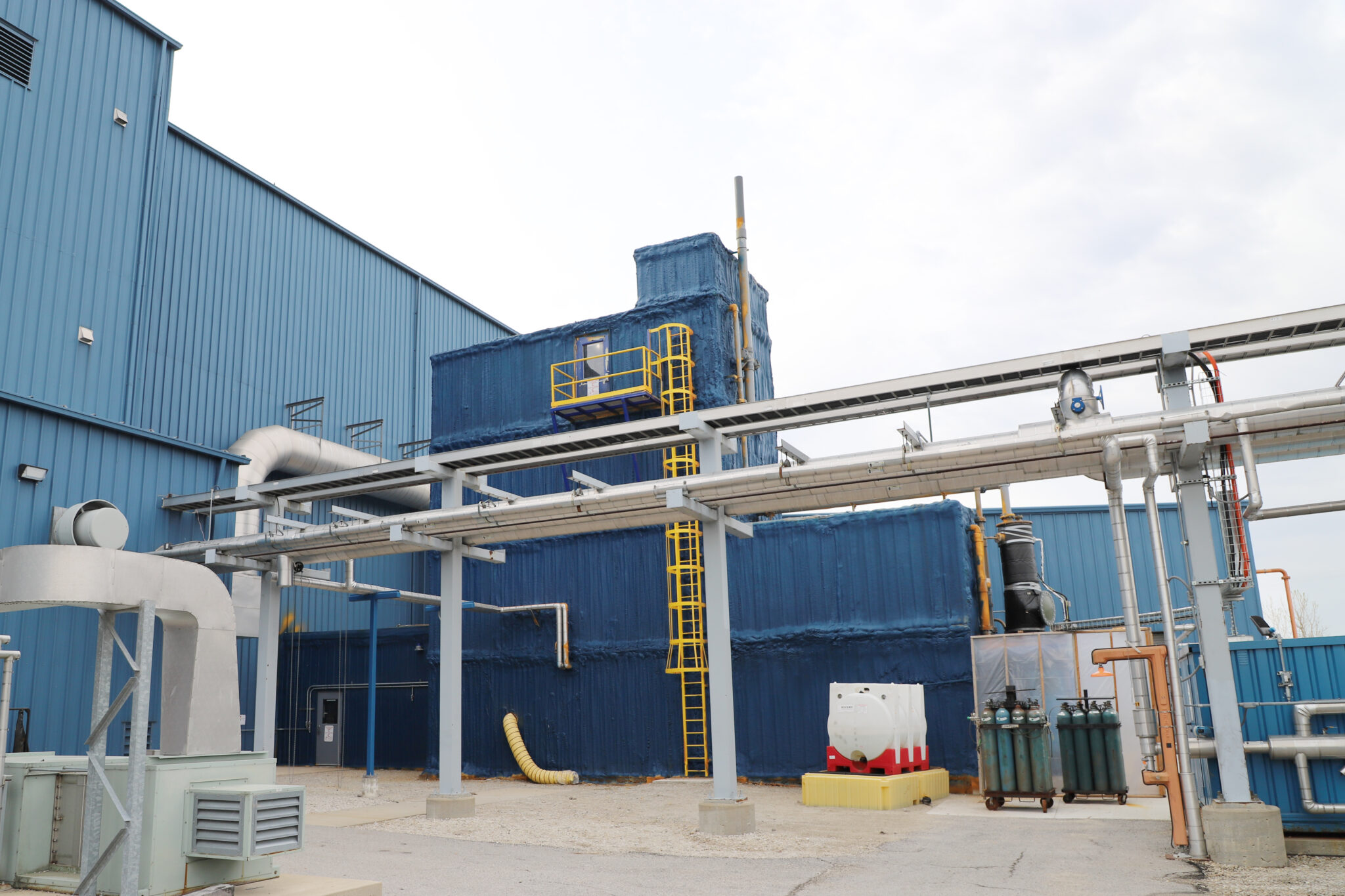
In October 2025, Materion announced a supply agreement with Commonwealth Fusion Systems. It would provide beryllium fluoride for the FLiBE molten salt intended for CFS’s ARC fusion power plants. Shipments from Elmore were scheduled to begin that year. The agreement connected Materion’s established materials expertise with another company’s developing energy technology.
Fission and fusion are different engineering projects. The link in Vijayvargiya’s portfolio is the supply work: producing a particular material in the quantities and condition a customer needs. The scale of the customer’s ambition makes the less visible supplier’s job more consequential. Even a sweeping energy plan eventually reaches a loading dock.
A good quarter still needs a denominator
His tenure has also included the ordinary irritations of running factories. In the third quarter of 2025, equipment downtime in Performance Materials affected output. At the same time, Electronic Materials and Precision Optics improved their performance. That combination is a useful corrective to any account in which a chief executive simply declares a new direction and every machine agrees.
By the second quarter of 2026, Materion reported $308.2 million in value-added sales, compared with $269.0 million a year earlier. Adjusted EBITDA reached $71.8 million, or 23.3% of value-added sales. The company said the result benefited from volume, pricing and mix, operational performance, and some favorable one-time items.
What Materion adds
The denominator deserves attention. Materion’s value-added sales deduct pass-through metal costs from net sales. That makes them different from the much larger headline revenue figure of $613.9 million for the quarter. For a materials business, separating the value of metal passing through from the work done to it helps readers understand what is actually being compared.
Those numbers describe a company’s output, produced by its teams and customer relationships. They belong in Vijayvargiya’s story because they test the programme he leads, while the one-time benefits make caution part of the reading. An attractive quarter is evidence of progress. It is still one quarter.
Ohio as a base, rather than a boundary
Vijayvargiya’s responsibilities extend beyond Materion. In June 2023, Sensata Technologies announced his appointment to its board. The industrial technology company makes sensors, electrical protection components, and related solutions. Its chairman, Andrew Teich, highlighted Vijayvargiya’s industrial technology experience and familiarity with automotive and transportation markets.
The connection returns his career to an earlier set of problems: how physical systems sense, control, and respond. A board role is different from operating a division, but the technical overlap is clear. He also serves on the Greater Cleveland Partnership board and on the Manufacturers Alliance board of trustees, linking his international experience with regional and manufacturing institutions.
His stated ambitions at Materion include responsibilities that receive less attention than acquisitions. In his sustainability letter, he sets out priorities around responsible mineral sourcing, supplier practices, ethical conduct, employee development, and community involvement. These are public commitments against which an industrial company’s behavior can be judged, alongside the financial figures.
The resulting career has a distinctive shape. Electrical engineering led to automotive electronics; automotive electronics led to a materials company; that company’s work now reaches into optical systems, semiconductor production, and developing energy programmes. Across those changes, the recurring task has been to bring technical capability into a business that can supply somebody else’s design.
For Vijayvargiya, the next chapter is tied to whether those designs become sustained demand. Reactor programmes must advance. Acquired capabilities must earn their place. Factories must keep delivering. The future can be discussed in wonderfully expansive language. His part of it comes with specifications, delivery dates, and a customer waiting for the shipment.