Taymur Ahmad has a sales demonstration that requires two paper towels. They look alike. They feel alike. One has been treated with nanoGUARD. Add water, and the resemblance ends: one absorbs it, while droplets roll off the other. For a business built on materials most customers will never see, this is a pleasantly unceremonious introduction. No elaborate apparatus. No instruction to imagine the future. Just a little water and a difference you can watch.
The demonstration suits the founder, chairman and CEO of actnano. He works in a corner of technology where the ambitious promises of electronics encounter the thoroughly ordinary habits of liquids. Cars get damp. Drinks spill. Condensation arrives without a calendar invitation. A processor can be exquisitely engineered and still have an awkward relationship with a drop of water.
Ahmad has spent much of his career thinking about what happens between a promising design and a product that keeps working. Before founding actnano in 2012, he spent nearly twenty years in manufacturing, including at Alcoa and Philips Electronics. That history gives his story its particular shape. The factory came first. The kitchen experiments came later.
The factory was his first classroom
At Alcoa, Ahmad worked on the automotive industry's move from steel toward aluminum car frames. It was an education in changing something physical, at industrial scale. A new material has to find its way into a system of equipment, suppliers, specifications and habits. The drawing may be elegant. The production line still has to run on Monday.
His formal education crossed that same divide between engineering and business. He earned an engineering degree at the University of Iowa and an MBA at Business School Lausanne in Switzerland. His professional life took him through Europe and Asia. These are useful coordinates for understanding a founder whose eventual product would need both laboratory work and a convincing answer to a purchasing department.
Working in consumer electronics, he encountered circuit boards with protective coatings that left parts uncovered. Connections posed a particular difficulty: a barrier meant to keep water out could also obstruct the electrical connection the device needed. Protection came with exceptions. Those exceptions were the problem Ahmad wanted to remove.
His later approach would put the coating directly onto parts that were difficult to protect, including connectors, antennas and components that generate heat. The challenge was to preserve what those parts did while shielding them from their surroundings. A waterproof object that can no longer connect is a rather expensive paperweight.
There is a clue to his working style in the record of that earlier career. At The Morey Corporation, manufacturing colleague Michael Brucki remembered Ahmad's insistence on lean methods and better processes. The description is of a demanding manager focused on quality, output and customer satisfaction. Years before the startup, the recurring subject was making an operation work better.
A second career, assembled in the kitchen
Around forty, Ahmad left his established industrial career and began working toward a different answer. He ordered coatings and tested them in his kitchen. The setting is memorable because the problem had followed him out of much larger workplaces. He brought years of familiarity with electronics manufacturing to a space better known for dealing with water in less technical ways.
Once he had a workable direction, he recruited a scientist with an MIT doctorate and raised money. The sequence matters: experience helped define the problem, experiments gave it a possible answer, and additional scientific expertise helped turn the effort into a company. The kitchen was a beginning. There was considerable work left after the dishes.
Ahmad's name also appears alongside Justin Kleingartner and Sruti Balasubramanian as an inventor on a US patent for coating compositions involving non-Newtonian fluids. Granted in October 2021, the patent is a concrete connection between the executive and the materials work. It also supplies a useful corrective to the lone-founder picture: several names belong on the technical record.
The commercial product became Advanced nanoGUARD. Its proposition was practical: protect more of the assembled circuit board and fit the process into existing manufacturing lines. For Ahmad, that last detail connects the new business to the old career. A material that requires a customer to reorganize a factory has another obstacle to overcome before it can earn its place.
“These days, electronics run the car. We make sure the electronics keep running even after the coffee spills.”
Taymur Ahmad · 2020
Six weeks to choose a country
By 2018, Ahmad faced a different kind of problem. Actnano needed more growth, and he gave himself six weeks to select a new country for expansion. The chemistry could not make that decision for him. He had to travel, meet prospective customers and work out where a small company could establish a useful presence.
Germany came first, with its concentration of automotive manufacturers. Japan followed. Ahmad brought chief operating officer Jim Sheridan, and the two worked through meetings with prospective partners and customers. Then came Korea, where the attraction of electronics and automotive companies sat alongside the difficulty of judging a potential local partner across a language barrier.
He recorded an audio diary during the journey. Across it came the less photogenic parts of expansion: a deadline approaching, news about a customer that unsettled the plan, and a last-minute trip to another country when unexpected help appeared. Those entries became the Waterworld episodes of Follow The Leader. They preserve a founder making decisions while the outcome was still unresolved.
It is a revealing episode in an otherwise technical story. A coating may travel easily in a container. A business needs introductions, local knowledge and people who can support a customer after the demonstration ends. Ahmad's overseas journey made those requirements visible. The map was becoming part of the product.
A six-week deadline. Customer meetings. Local partners. An audio diary recorded before the ending was known.
The customers who also wrote checks
Automotive investors became a recurring presence. In late 2021, actnano announced a $21.75 million Series B led by BMW i Ventures. Porsche Ventures joined a second close announced in January 2022. At that point, actnano said its coatings were protecting electronics in more than two million production vehicles. The company now reports its technology in more than fifteen million production vehicles.
The relationship between industrial investors and this kind of company is worth pausing over. Vehicle electronics live amid vibration, temperature changes and moisture. Reliability is part of the product's usefulness. An investor connected to that industry is looking at a material that addresses a problem within its own field, making the link between finance and application unusually easy to understand.
In April 2024, actnano announced a $40 million investment from Anthelion Capital. The stated uses included a larger technical sales and service presence, more production and better efficiency. In October, Ericsson Ventures added $3 million at another Series C close. The investor list now reached into telecommunications as well as mobility.
Ahmad's company also appeared in the Financial Times and Statista's 2024 ranking of growing businesses in the Americas, which measured revenue growth between 2019 and 2022. He credited the team for the recognition. The acknowledgment fits his short public self-description: “Fortunate member of an impressive team.”
production vehicles with actnano protection
A team, and an occasional football match
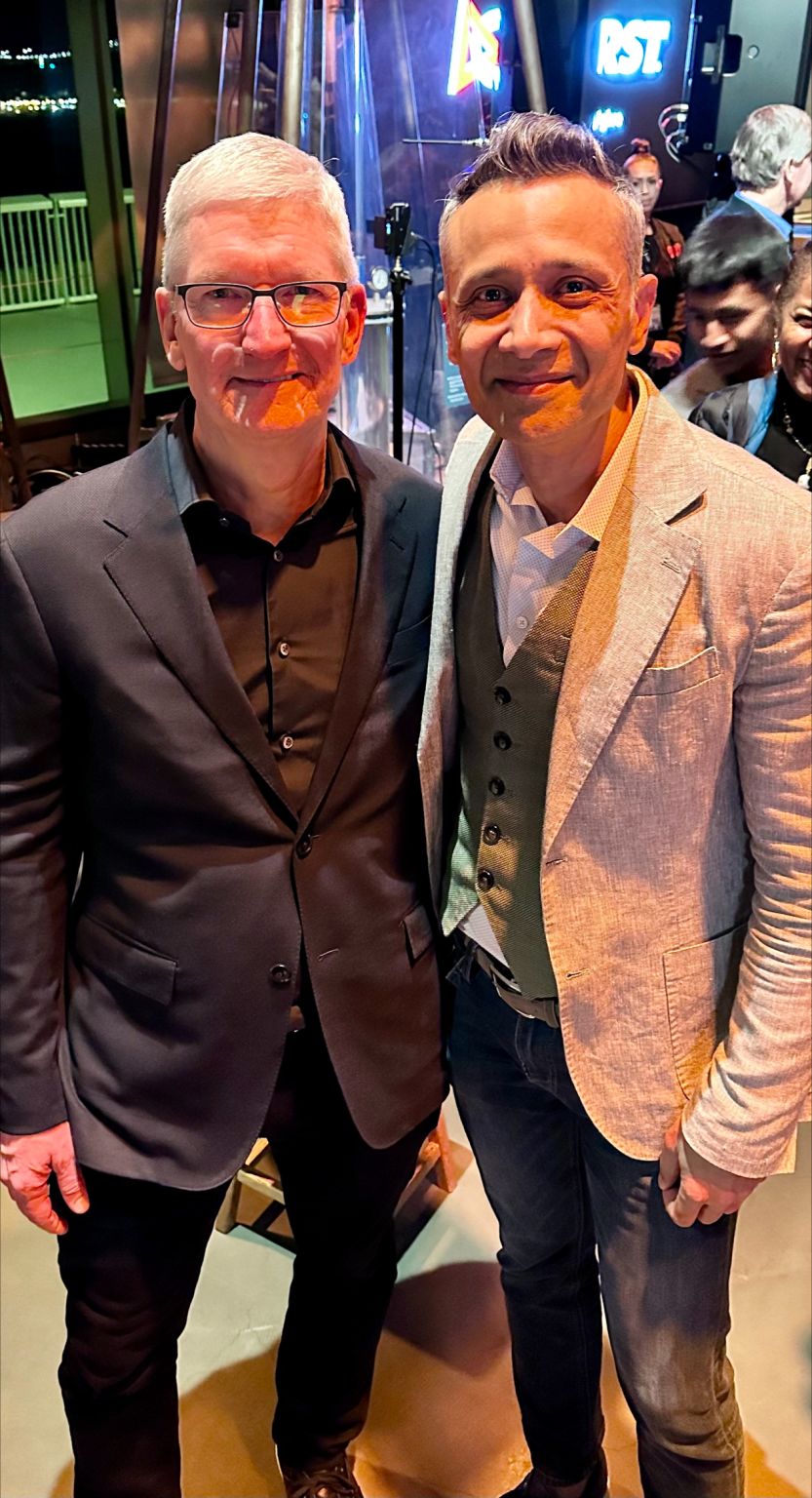
There is room for a less industrial Ahmad in his public posts. One photograph places him beside Tim Cook, accompanied by an uncomplicated expression of enjoyment. Another post names Stuttgart Surge as his favorite football team. A founder whose work crosses borders can apparently make room for a team in Germany and a game-day cheer.
His longer commitments include volunteering with Youth Advocate Program International. His professional affiliations include the Dell Founders 50 and Philips Alumni Club. In 2010, before actnano, Surface Mount Technology magazine awarded him its Visionary of the Year recognition. The founder arrived with an existing working life, colleagues and interests; the company did not supply his entire biography.
His emphasis on other people has specific names attached. In a post describing the team's 2025 performance and a gathering in Bangkok, he recognized Jiawen Sun, Ling Luo, Tooba Shoaib, Clara Vijay and Richer Zhang for leadership, innovation and collaboration. The geography had expanded to teams across Asia, the United States and Europe. The six-week search for a new market belonged to an earlier stage.
The server has the same old problem
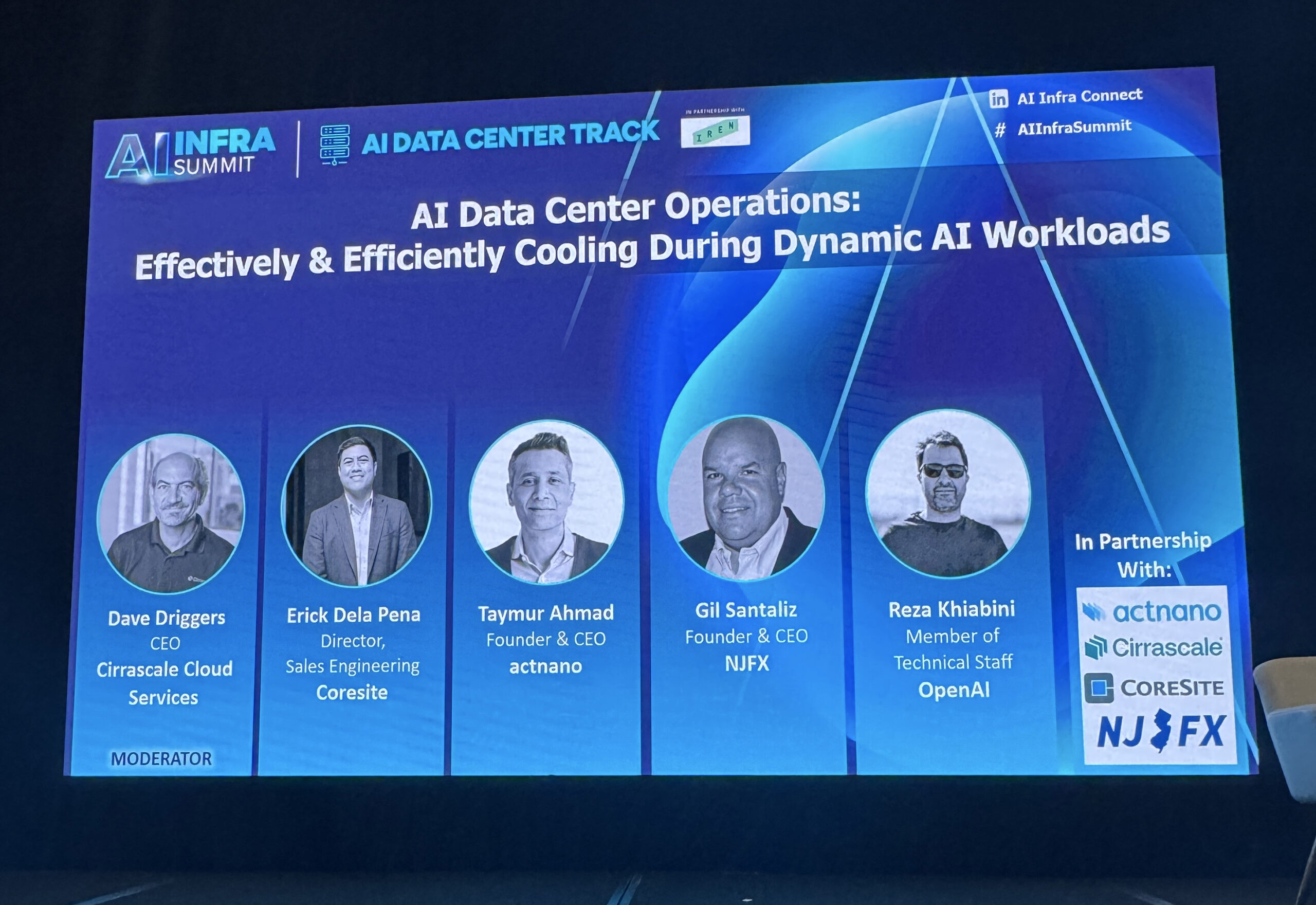
By 2026, Ahmad was bringing his automotive experience into conversations about AI infrastructure. On September 16, the AI Infra Summit scheduled him for a discussion of reliability, risk and performance in data centers. His current argument follows a familiar material concern into a different room: powerful electronics increasingly depend on liquid cooling, and liquid near electronics deserves careful preparation.
In his August 2026 essay about data-center micro-climates, he focused on small, localized changes that room-level environmental controls can miss. Cooling lines and hot components can create conditions for condensation. His proposed response is protection at the circuit board itself. The emphasis is characteristic of his business: go to the vulnerable component, rather than assume the surrounding system will always keep trouble away.
He had already described ambitions beyond automotive electronics, including solar inverters and coatings for glass. Those were areas he wanted to explore, rather than proof that every proposed application had reached the market. His longer-standing ambition was broad enough on its own: put nanoGUARD into vehicles around the world. The newer infrastructure work gives that underlying concern another setting.
The paper towels remain a useful way into the story. One small test makes an invisible material legible. Beyond it sit years of manufacturing experience, a kitchen, scientific collaborators, trips abroad and the work of supplying customers. Ahmad's career has grown around the space between an electronic device doing something clever and continuing to do it after the water arrives. The drop has kept its appointment. He intends the circuitry to keep working.