A soldier disappears into a landscape. The colours are right, the outline is broken, the position is carefully chosen. Then somebody looks through a thermal camera. The landscape has acquired a conspicuous human shape. The camouflage has answered one question beautifully, while another observer has asked something else entirely.
- Ametrine makes materials that reduce signatures across multiple sensor bands.
- Its products range from wearable concealment to hides and a platform coating called Flint.
- The design challenge is keeping people concealed while allowing them to move and work.
That mismatch is the starting point for Ametrine Inc. The defense manufacturer belongs to a market with an unusually unforgiving definition of product failure: being detected. Its interesting proposition is that better concealment requires attention to both the observer and the person carrying the equipment. A material that looks convincing in a photograph still has to earn its place in a soldier’s load.
The observer changed first
In Ametrine’s account of its origins, an adversary using thermal sensors compromised its chief technology officer’s special operations team, with lethal consequences. That experience prompted the founding of the business. The company’s story begins with a failure of concealment against a particular technology, rather than an ambition to devise a prettier camouflage pattern.
The broader explanation offered by Ametrine is the spread of affordable commercial sensors, imaging equipment and adaptable drone warfare. Equipment once constrained by cost and complexity became more widely available. The consequence, as the company sees it, is that sound fieldcraft needs additional technical support. A soldier cannot choose which kind of camera an adversary brings.
“If you can be seen, you can be hit”
Retired LTG Ken Tovo, recalling his military training in Ametrine’s leadership message
Ametrine calls its specialty Multi-Spectral Signature Management, or MSSM. The terminology sounds forbidding; the practical question is straightforward. How conspicuous is a person or object to the systems looking for it? A pattern visible to the human eye is one part of the answer. Infrared observations introduce other material properties and other ways to stand out.
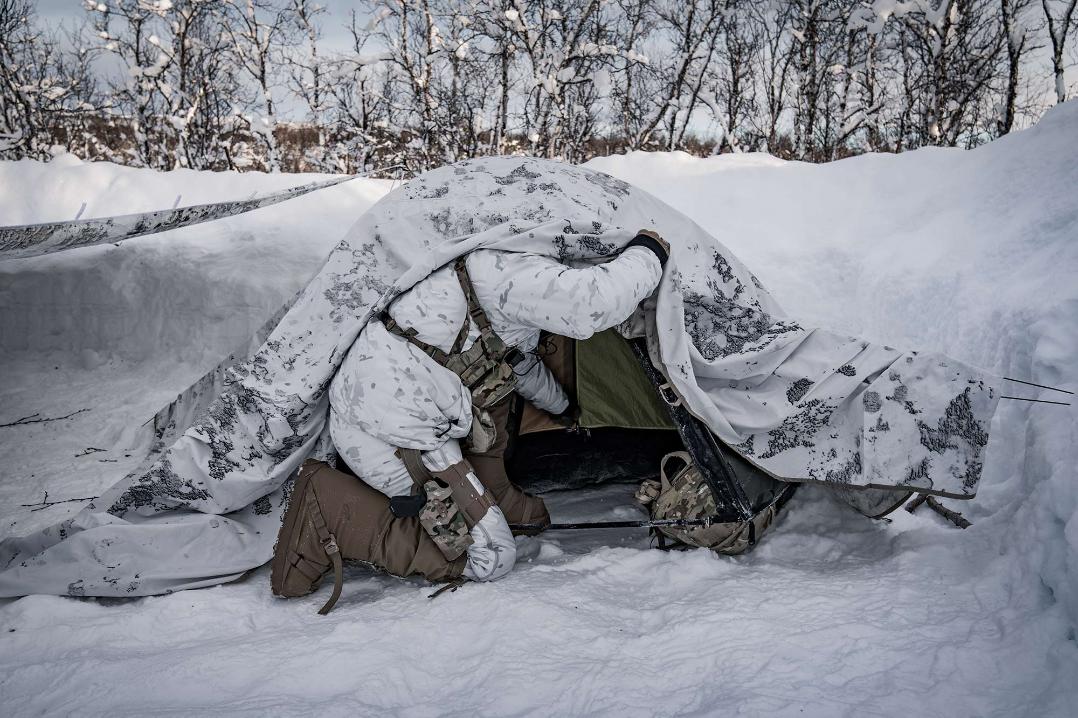
A cloak with chores to do
The public product range falls into three useful physical forms: systems worn by personnel, covers and hides, and mobile-platform solutions. The Advanced Camouflage Combat Uniform System is part of the personnel offering. Ametrine emphasizes breathable, comfortable and durable materials, making usability part of its concealment pitch.
Its covers have reversible visual patterns and can be reconfigured for different environments. The larger point is adaptability. A concealment system must accommodate the place where it is used, the equipment beneath it and the work its occupants must perform. An elegant material becomes less attractive if deploying it creates a fresh operational problem.
Brigantes, a specialist equipment partner, supplies revealing particulars. Its Ametrine Arctic Poncho listing gives a weight of 620 grams, reversible construction and grips for use while moving. The jacket and overpants are listed at 580 grams, with fresh-snow and “snirt snow” patterns. Even snow, apparently, refuses to be a single colour.
A measurable carrying burden. Not a score for concealment effectiveness.
The same partner lists a nine-kilogram modular arctic hide, a waterproof floor and shape-breaking packs. Its developmental collaboration with Ametrine includes a next-generation ghillie suit. These details place the company within military equipment procurement: fabrics become usable systems, and specialist partners help connect those systems with operational requirements.
Then the vehicle starts moving
Ametrine’s website identifies a particular weakness in textile-based platform camouflage. Fabric can occupy cargo space and, while underway, billow or deform. Its Flint technology takes a different physical approach: a multilayer composite coating applied to a platform’s skin, intended to reduce signatures while the platform moves.
The revealing change is in the design brief. Concealing a stationary asset and concealing one underway impose different demands. For a buyer, the useful comparison is therefore about fit, movement, installation and the relevant signatures. A flattering still image cannot settle all of those questions.
Ametrine operates alongside established suppliers. Saab’s Barracuda Mobile Camouflage System also addresses multispectral concealment for moving vehicles, using customized material systems. Ametrine’s distinctive emphasis is its combination of personnel fabrics, reconfigurable covers and Flint’s coating format. Comparing those approaches means examining the specific application; the existence of an alternative is useful discipline for any product pitch.
Invisible equipment, visible commitments
Manufacturing leaves a more conventional paper trail. In January 2021, Round Rock approved an economic development agreement requiring Ametrine to invest $3 million in property improvements and $5.68 million in equipment and other business property. It also required 147 primary jobs over ten years. Scheduled incentives totaled $345,000, subject to performance and clawbacks.
Those are commitments, rather than a receipt for completed spending or a current employee count. They nevertheless describe the business behind the concealment: production capacity, physical equipment and a long lease. The business model is specialized defense manufacturing and development, with government customers and professional equipment partners.
A June 2026 U.S. Air Force notice stated an intent to buy Ametrine’s Hobey Elite wearable multispectral system through a sole-source, firm-fixed-price order. In August, Ametrine announced a development partnership with Rekord for Polish requirements. The first is procurement intent; the second is a collaboration announcement. Neither should be enlarged into a claim about universal military adoption.
Let the real observer judge
The transferable lesson is an engineering habit: evaluate the product against the conditions that determine success. For concealment, that means the relevant sensor, background and movement, alongside the wearer’s practical burden. Ametrine also describes training and integration, acknowledging that equipment is used by people rather than displayed by mannequins.
This approach has limits built into the question. Change the environment or observer and the evaluation changes with it. “Be Invisible” is a memorable company motto; signature reduction is the more useful purchasing language. The cloak still needs to let its wearer do the job. And the camera still gets to look.