A rearview mirror is a peculiar place to build a career. Drivers consult it for a second, perhaps less, and move on. If it does its work properly, nobody gives a thought to the people who made it. Fred Bauer spent decades finding things to improve inside that brief glance. The interesting part is how readily he let an earlier answer become obsolete.
In 1982, Gentex introduced an automatic-dimming mirror with a small motor that moved it between clear and dim positions. Five years later, the company introduced an electrochromic version. Electricity changed the darkness of the glass; the motor had lost its starring role. A successful product had acquired a successor from inside its own house. Some businesses would consider that an awkward family gathering.
Bauer’s career offers a useful way to think about invention: follow a problem closely enough and the boundaries between industries begin to look negotiable. Furnace controls, smoke detectors and automotive mirrors seem an unlikely collection. Look at the sensing and electronics underneath them, and his route becomes easier to follow.
The furnace came first
Bauer grew up in Fenton, Michigan, and studied electrical engineering at Michigan State University. His early business, Simicon, made electronic furnace controls. There was a practical connection to the work: his father operated a furnace business, where Bauer had noticed a need for better controls. His first market was close enough to inspect without commissioning a report.
That detail gives his beginnings a pleasing lack of ceremony. A furnace must respond to conditions, operate dependably and justify its place in a working system. An elegant circuit that cannot do those things is an expensive ornament. Bauer’s work began among products whose customers expected them to function, then largely disappear from attention.
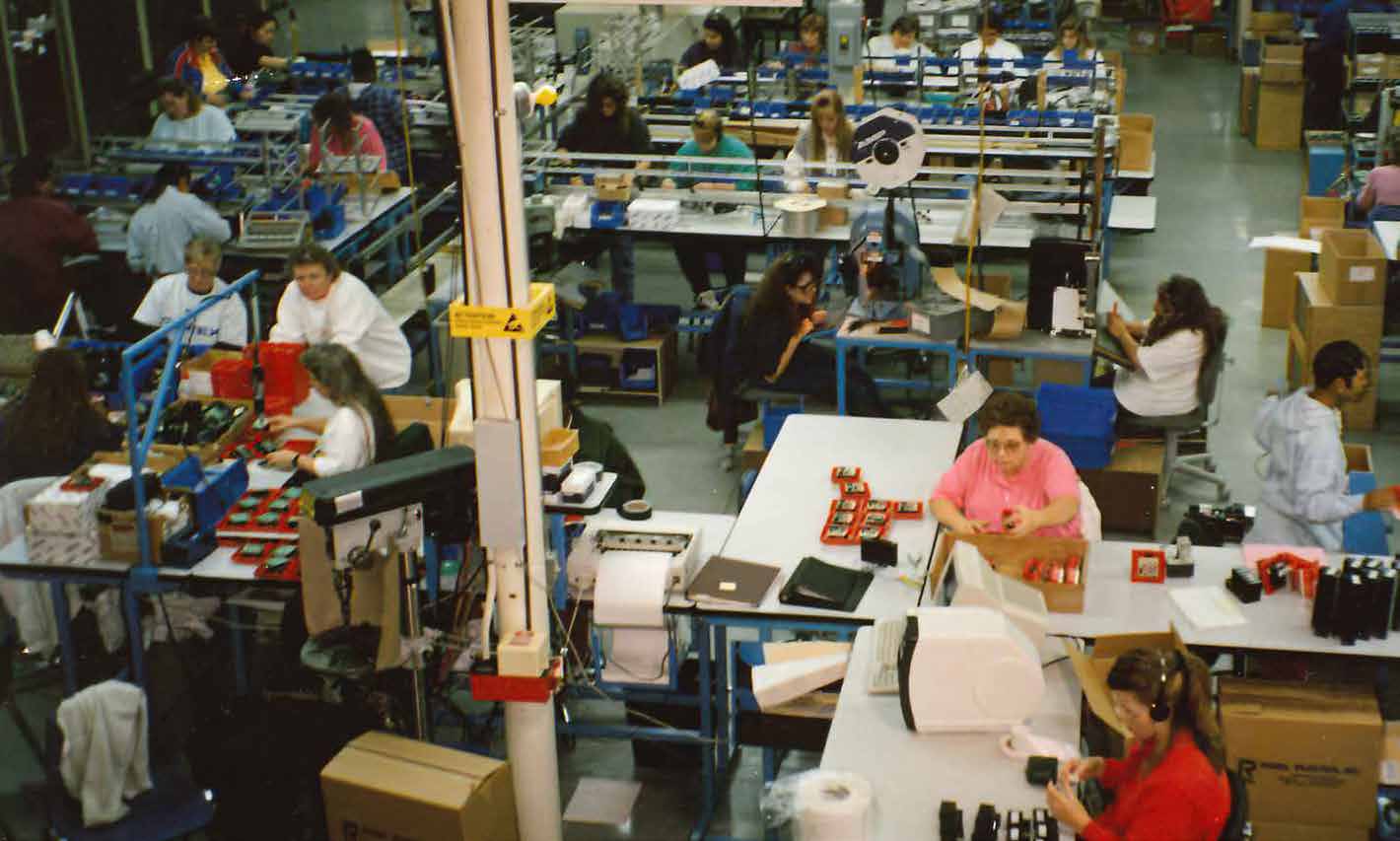
Robertshaw Controls bought Simicon in the early 1970s. The sale preceded a second business, Gentex, founded in Zeeland in 1974 to make fire protection equipment. Bauer was moving into a different product category while continuing to work with electronics and photoelectric sensing. The connection was in the means of solving a problem.
A smoke detector takes the automotive exit
Gentex’s early detectors used light to detect smoke particles. Bauer recognized that sensing light could also help a driver confronted by bright headlights in a rearview mirror. The object on the ceiling and the object above the dashboard had something in common that their buyers had little reason to notice.
He became more active in Gentex during the early 1980s and pushed the mirror project toward production. The company went public in 1981, raising money in part to support its move into automatic-dimming mirrors. It was a consequential commitment for a business that had begun with fire protection products.
The first automotive answer was mechanical. The 1982 mirror used a motor to change its position when dimming was needed. It brought automation to a familiar adjustment, giving Gentex a product to sell while leaving room for a different technical approach. The first answer had done useful work. It did not have to be the last.
The trick was to stop moving
The electrochromic mirror introduced in 1987 changed darkness through an electrical response in its materials. Sensors detected glare; the mirror adjusted. Instead of moving the reflective surface between positions, Gentex could vary how much reflected light reached the driver. A component that looked familiar from the driver’s seat now depended on a different collection of capabilities.
That distinction matters when considering Bauer’s achievement. An automatic mirror had already been made. Gentex then had to improve the way it performed the task, even though doing so superseded its own earlier design. The incentive to defend yesterday’s work can be quite strong when yesterday’s work has finally begun to sell.
The chronology suggests a founder prepared to keep revising the product. It also makes a better story than a solitary flash of inspiration. There were successive versions, production decisions and years between introductions. The mirror’s apparent simplicity was the customer’s privilege. People making it had to concern themselves with all the complications hidden behind the glass.
A small motor shifts the mirror between clear and dim positions.
An electrical response changes the mirror’s tint.
The mirror acquires more jobs
Over time, Gentex added functions around the mirror. Bauer’s 2007 shareholder letter discussed SmartBeam, its high-beam assistance system, and a rear camera display that appeared through the reflective surface when the vehicle was in reverse. The mirror was becoming a convenient home for electronics that did more than reflect.
The letter also described a commercial aim: develop products inexpensive enough for automakers to sell in millions, rather than confine them to the costliest slice of the market. That ambition connects the inventor’s work to the manufacturer’s. A useful feature has a different reach when its price allows it to travel beyond a small group of expensive cars.
By 2015, Gentex’s Full Display Mirror had become a finalist for a 2016 Automotive News PACE Award. A camera supplied a rearward view to an LCD integrated into the mirror. A switch let the driver choose between the reflective mirror and the display. The familiar rectangle had acquired another occupation.
“Our Full Display Mirror system is the culmination of years of research into cameras, displays and image processing.”
Fred Bauer, October 2015
“Years” is doing useful work in that sentence. From the driver’s position, a switch produces an immediate result. Behind it sit separate engineering disciplines that have to cooperate. Bauer’s public explanation gave that long preparation its due. Even an object designed for looking backward required a considerable amount of forward planning.
Unpretentious, on purpose
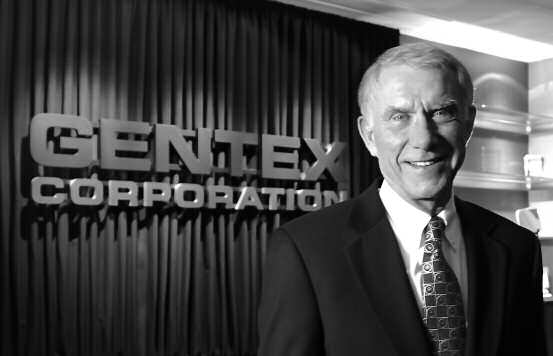
Bauer’s management vocabulary included “ownership mentality” and “unpretentious management.” They are unusually plain terms for a corporate philosophy. They put responsibility and conduct in the foreground, with little room left for ceremonial grandeur. His emphasis on quality and innovation accompanied an interest in how people worked together.
Bruce Los, who worked with him at Gentex, later wrote that Bauer taught and lived unpretentious management. Another former colleague, John Roberts, described continuing to draw on lessons learned during his years there. Those recollections give the management language a personal dimension: people remembered behavior as well as the company’s products.
There was recognition outside Zeeland too. In 1998, Bauer received the national Ernst & Young Entrepreneur of the Year award in the Master Entrepreneur category. The category emphasized sustained management and innovation over time. It suited a career already defined by moving from an initial invention to the less photogenic business of making the next version work.
Gentex’s later account of its culture traces the Gentex Foundations, introduced in 2002, to concepts Bauer espoused. That is a different kind of durability from a patent or a product launch. A founder’s working habits can become organizational language, giving colleagues a way to discuss expectations after the founder leaves the executive chair.
A successor, and a longer view
Bauer retired as chairman and chief executive at the end of December 2017; Gentex announced the change on January 5, 2018. Steve Downing became CEO, and James Wallace took the chairman’s role. Downing had spent 15 years at the company. The handover placed the executive job with someone who had learned the business from inside.
Two numbers marked the distance Gentex had traveled. Its market capitalization had been approximately $17 million at the 1981 public offering. At the retirement announcement, it was approximately $6 billion. Those are company valuations at two moments in time. Between them lay decades of product development and the work of many people.
Gentex’s valuation at the time of its public offering and retirement announcement.
The retirement arrangements gave Bauer the titles Chairman Emeritus, Founder and Advisor. His consulting employment agreement ran from January 2018 through December 2022. It provided a defined bridge between running the company and being available to people who did. The executive transition had a date; access to experience had a longer timetable.
A place beside the people who built the cars
In July 2023, Bauer entered the Automotive Hall of Fame. His induction class included Mary Barra, Juan Manuel Fangio, Takeo Fujisawa, Larry Wood and McKinley Thompson Jr. A supplier of components joined a group spanning company leadership, racing and design. Automotive history had room for the part a driver barely thinks about.
His daughter Sheila attended the induction and later thanked those involved in the tribute, including Bruce Los, Bruce Johnson and Robert Shillman. Her account emphasized the people who had worked under her father’s leadership. The evening brought together the public achievement and the personal relationships accumulated around it.
The recognition arrived years after his executive retirement. By then, the argument for his place could be made through ordinary objects: a mirror adjusting to headlights, a display showing the view behind a vehicle. There is something satisfying about an inventor whose work asks for so little attention from the person using it.
Bauer had followed a practical thread from furnace controls to smoke detection to the rearview mirror. Along the way, he helped build a company willing to replace one answer with another. For drivers, the transaction remained agreeably modest. Glance up, see what is behind you, carry on.