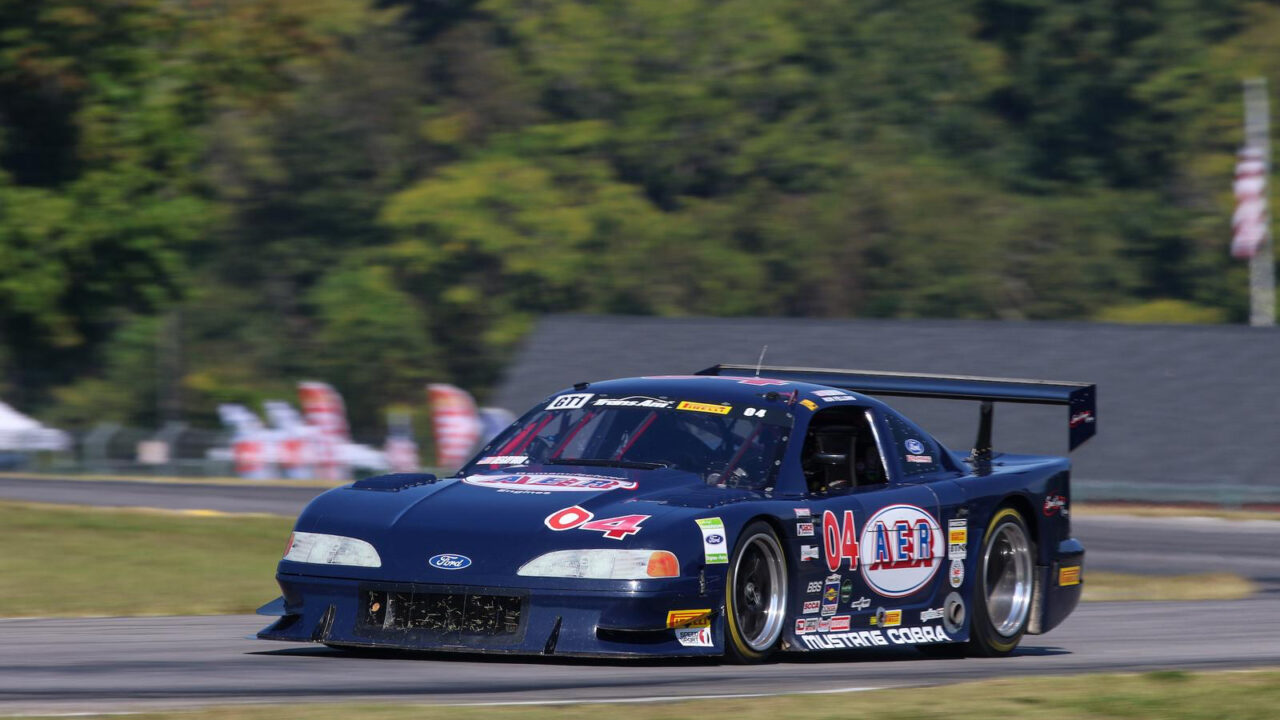
Jon DeGaynor’s Ford Mustang has a number on its flank: 04. In 2025, it carried him to four class victories from five starts in the Trans Am Series’ new GT1 Challenge. The car had previously been raced by Ron Fellows. Its current driver spends his working life dealing with another kind of machinery: the people, plants and products of Methode Electronics.
Put those two pursuits beside each other and a question presents itself. What does a chief executive learn when he becomes the person strapped into the product? For DeGaynor, the connection predates the championship. He has described racing as an exercise in preparation, collective effort and anticipating what comes next. The stopwatch is a wonderfully terse colleague. It rarely accepts a longer presentation as an answer.
His business career has taken him through precision machining, automotive components, industrial glass and electronic systems. He became Methode’s president and chief executive on July 15, 2024, with a seat on its board. The assignment was explicit: restore profitability and strengthen the company’s foundations. The racing trophy would arrive while that work was still underway.
A family business before a global one
DeGaynor traces his interest in leadership to his parents. They gave him responsibility in the family business at an early age and invested in his education. He has credited that trust with helping him develop a taste for running a business. It is a modest origin for a career subsequently measured in international operations, acquisitions and public company earnings calls.
He earned a mechanical engineering degree at the University of Michigan, graduating in 1988, and an MBA at Wharton. Those qualifications sit comfortably together in his subsequent work. One concerns how things function; the other concerns whether an organization can make a business out of them. His career has repeatedly required attention to both questions, often across several countries at once.
At Delphi, where he worked from 1993 to 2005, his responsibilities included diesel systems and operations. From 2005 to 2008 he was Autocam’s chief operating officer for international operations. He then joined SRG Global, a Guardian company making plated parts for automotive and other markets, as vice president of business development and managing director of Asia. A role in strategic planning and innovation at Guardian followed.
His international experience was residential as well as managerial. He has described spending eight years living in Europe and four years running a business in China, alongside work involving Brazil and India. In his account, geographic variety belongs in a young professional’s education. His advice is to seek different jobs, places and difficult assignments early, building experience that can be drawn upon later.
- 1988Michigan
Mechanical engineering - 1993-2015Delphi · Autocam
SRG Global · Guardian - 2015-2023Stoneridge
President & CEO - 2024Methode
President & CEO
The mirror that became a system
DeGaynor took charge of Stoneridge in 2015 and remained its president and CEO until 2023. The company designed and manufactured electrical and electronic products for passenger cars, commercial vehicles and other equipment. During his tenure, its strategy moved toward providing systems, particularly in vehicle intelligence and advanced driver visibility. MirrorEye made that otherwise abstract change easy to picture.
A truck’s exterior mirrors are familiar enough to seem inevitable. MirrorEye offered cameras and interior displays in their place. That required more than a persuasive demonstration. Truck operators needed equipment they could rely on, drivers needed useful views, and the product needed a route through rules written for conventional mirrors. An engineering idea had to survive contact with ordinary working life.
In late December 2018, the Federal Motor Carrier Safety Administration approved Stoneridge’s exemption application. Announced in January 2019, it allowed MirrorEye-equipped commercial vehicles to operate in the United States without the conventional rear-vision mirrors otherwise required. Stoneridge said fleets had already driven more than two million miles with the system during evaluation, with feedback from companies including J.B. Hunt, Maverick Transportation and Schneider National.
The practical details explain the attraction. Camera views could follow the end of a trailer and improve visibility in low light. Slimmer exterior camera arms also offered an aerodynamic benefit. In September 2019, Stoneridge announced a second commercial vehicle manufacturer award for MirrorEye, with production then scheduled for 2021. Innovation, in this instance, involved a long sequence of tests, permissions and purchasing decisions.
By 2020, a pre-wire option through Daimler Trucks North America was another step toward commercialization. This was the unglamorous middle of bringing something new to market: making installation easier, supporting fleets and converting evaluations into orders. DeGaynor appeared with fleet products executive Brad Corrodi on a 2021 podcast to discuss the system and drivers’ experience of using it.
A turnaround with the bonnet open
When Methode appointed DeGaynor in June 2024, it described a 35-year career in engineered products. He succeeded interim CEO Kevin Nystrom the following month. Methode’s business covered user interfaces, lighting and power distribution, bringing him into familiar industrial territory. Familiarity did not make the assignment small. His opening priorities placed operating performance ahead of any grand unveiling.
The company makes components and assemblies that usually disappear inside someone else’s finished product. Its markets include transportation, construction equipment and data center infrastructure. A customer may see a vehicle, a machine or a computing facility. Methode has to understand the electrical connections, controls and manufacturing work behind it. Its chief executive’s job includes making that collection of capabilities function coherently.
The leadership roster changed around him. Laura Kowalchik joined as finance chief in October 2024; Lars Ullrich arrived to lead the global automotive business that December. Karen Keegans became chief human resources officer in February 2025, and Brad Corrodi was named chief strategy officer with a March start. Corrodi’s earlier work at Stoneridge supplied one connection between DeGaynor’s old assignment and his new one.
By March 2026, he was describing different speeds of improvement across Methode’s facilities. Egypt was further along; Mexico was contending with weaker volumes and delayed customer programs as well as operational changes. He also reported completion of the headquarters move from Chicago. These are consequential details in a turnaround. A common plan still has to contend with the particular circumstances of each location.
“progress won't always be linear”
Jon DeGaynor · September 2026
The September 2026 results supplied a useful check on the narrative. First-quarter fiscal 2027 sales reached $265.4 million, compared with $240.5 million a year earlier. The net loss also widened, from $10.3 million to $11.4 million. Higher industrial volumes, led by data centers, helped revenue. Costs and investment meant the improvement did not travel neatly to the bottom line.
Quarter ended August 1, 2026. Sales growth and a wider loss can coexist.
That distinction matters to any reading of his tenure. More orders and better execution can be encouraging without establishing a completed recovery. In September, DeGaynor described rebuilding leadership and connecting Methode’s businesses more closely. The company scheduled its first Investor Day for December 17, 2026, at the New York Stock Exchange, with presentations on operations, growth and capital allocation. As of October, that examination still lay ahead.
The driver has a coach
There is a more compact record of progress in his racing. SVRA named him its Most Improved Driver for 2023. He had won its Group 6 GT championship in a Devin and added a Mustang to his program. In 2024, he made his Trans Am debut at Sebring, finishing sixth in class. The move put an experienced business executive in the agreeable position of being a newcomer.
The next year brought the inaugural GT1 Challenge championship and SVRA’s Driver of the Year honor. His winning venues included Sebring, Mid-Ohio, VIRginia International Raceway and Circuit of The Americas. After the title, his thanks went to the Watt Shop, coach Johnny O’Connell and the people supporting the car. Even a CEO, it appears, benefits from having somebody qualified to tell him where he could improve.
There is a limit to the racing analogy. A class championship has a finishing point, and a company continues operating after the quarterly results have been read aloud. Still, the comparison is useful when kept to preparation and dependence on others. The driver gets the visible seat. The result carries the work of people standing elsewhere.
Back to the engineering students
DeGaynor also returns to the institutions that educated him. He became an industry senior fellow at Wharton’s Mack Institute in January 2024, contributing to its vehicle and mobility innovation program through student teams and practitioner discussions. At Michigan, he is listed on the engineering Leadership Advisory Board. In 2025, he and Methode colleagues met engineering students to discuss their careers and answer questions.
That is a useful setting for his story because it allows the intermediate jobs to remain visible. Before the CEO appointments came diesel systems, precision machining and regional operating responsibilities. Before the racing title came a newcomer’s result and an improvement award. A career can look inevitable when reduced to its last line. His contains plenty of work between the lines.
DeGaynor’s current ambition at Methode is measurable: sustained profitable growth from a more connected organization. The next results will test that ambition, as customers and factories supply their own verdicts. Meanwhile, the Mustang offers another appointment with a clear set of rules, a team behind it and very little room for verbal interpretation. For someone who enjoys both machines and competition, that seems a reasonable way to spend a weekend.