Before Frank Pennisi became chief executive of EFI, he had already encountered the company in a role that can be considerably less forgiving: customer. At Orora Packaging Solutions, the business he ran used EFI’s Nozomi industrial inkjet technology. He knew the product from the buying side. In January 2023, he moved across the table.
It is a pleasing reversal in an industry devoted to making impressions. A supplier can spend years explaining what customers need. Pennisi arrived having been responsible for a business that actually needed the equipment. His introduction to EFI came with the practical context of packaging production, rather than a fresh set of presentation slides.
When his appointment was announced, he began one statement with five useful words: “As a former customer”. Those words gave the usual corporate welcome a different weight. They also supplied the central question of his tenure: what happens when someone familiar with buying industrial technology takes responsibility for the company making it?
The customer changes sides
At Orora, Pennisi’s exposure extended beyond a single printing platform. Packaging connected him to Nozomi; collaboration with Orora Visual connected him to display graphics and textile printing through EFI’s VUTEk and Reggiani equipment. He encountered several parts of the future employer’s business through their applications.
That experience matters because a corrugated package, a fabric display and a large printed sign make rather different demands. They share a need for equipment that fits a production process. The customer has to make something, sell something and keep the work moving. A demonstration is an introduction; production is the longer acquaintance.
Pennisi’s arrival coincided with a corporate change that made his assignment more specific. EFI’s Fiery business became an independent company, initially remaining under Siris ownership. EFI concentrated on industrial inkjet for packaging, display graphics, textiles and related industrial applications. Jeff Jacobson, the previous CEO, stayed on as executive chairman at the time of the separation.
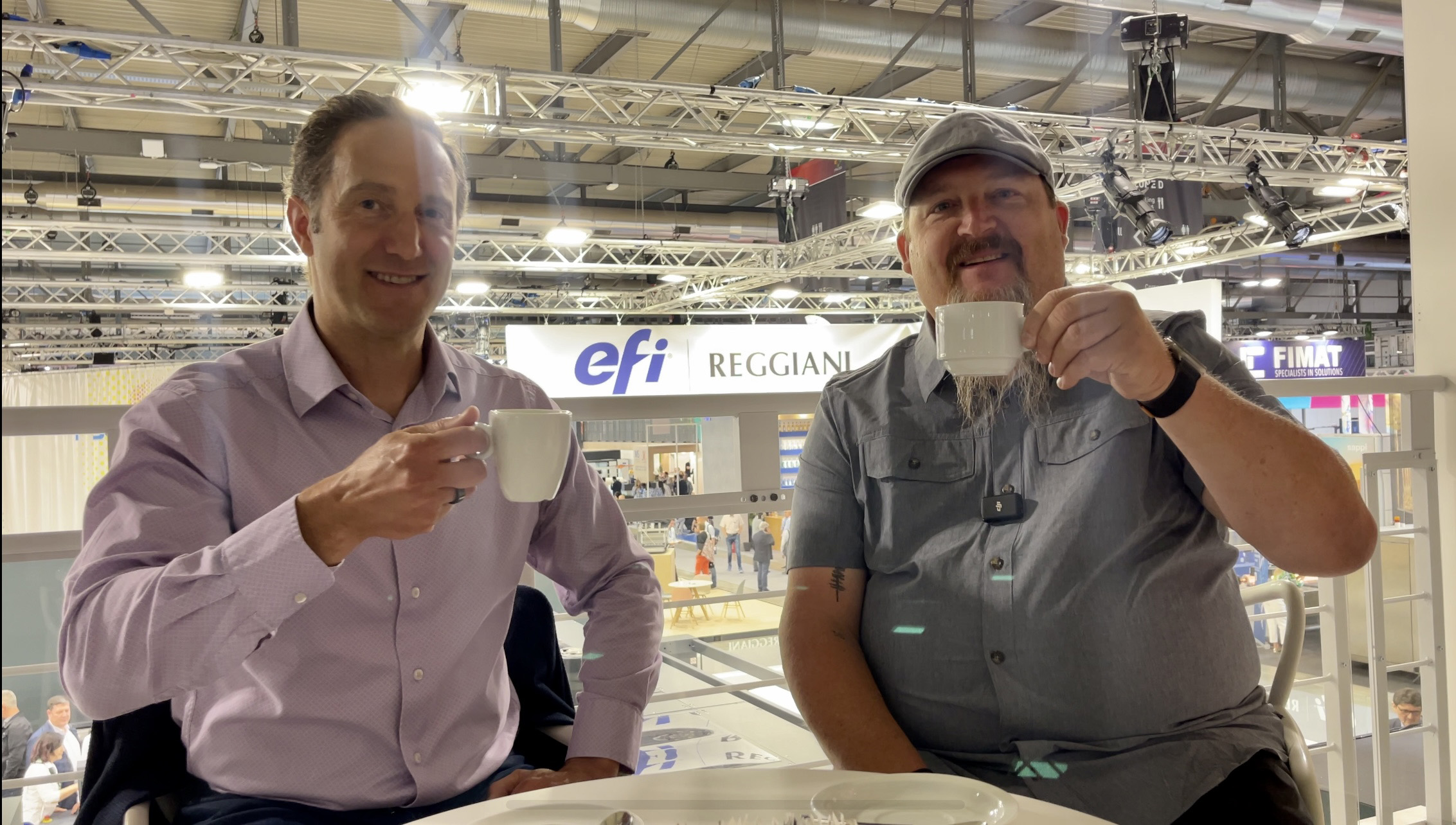
The new chief executive was therefore joining a company with a newly defined perimeter. His background as an equipment customer fitted the moment. By June 2023, an interview with Eric Vessels described the EFI appointment as his dream job. In the accompanying photograph, the two raise coffee cups. Industrial transformation, apparently, can begin with a refill.
An engineer before the corner office
Pennisi studied mechanical engineering and materials engineering at the University of California, Berkeley, then earned a master’s degree in mechanical engineering at MIT. His education joins the behaviour of materials to the behaviour of machines. It is an appropriate foundation for a career in which software repeatedly meets something stubbornly physical.
His early professional experience was at GE, covering engineering, logistics and operations. Later came senior leadership positions at Honeywell and FLIR Systems. The employers changed; industrial technology remained a constant. His path into printing ran through businesses that had to turn technical capability into products and operating results.
At FLIR, he became president of the Industrial business during the company’s 2017 reorganization. Orora later described the business he led as a $1.1 billion operation. That figure belongs to his former responsibility at FLIR, rather than to his personal wealth or to EFI’s current revenue. Scale is useful only when attached to the right thing.
A January 2018 FLIR article under his name concerned thermal imaging for self-driving vehicles. It discussed a development kit that allowed automotive engineers to add a thermal camera to their work. Long before his EFI appointment, he was publicly explaining how a specialized imaging technology could fit into a larger system.
- Berkeley + MITEngineering
- GE + HoneywellIndustrial leadership
- 2017 · FLIRIndustrial business
- 2020 · OroraPackaging
- 2023 · EFIIndustrial print
Orora announced his appointment in November 2020, succeeding Bernie Salvatore as president of its North American packaging and distribution business. Its introduction emphasized his experience across manufacturing, engineering, logistics and technology. The stated context was Orora Packaging Solutions’ own digital transition. His next employer would supply some of the machinery involved.
Orora’s 2021 annual report placed his earlier FLIR work in the context of automating tools and services. It also described digital and commercial programs at Honeywell. These are different businesses, yet the recurring assignment is recognizable: introduce new capabilities into an operation that already has people, customers and established ways of working. Changing the equipment is one part of that job. Making the change useful is the part that lasts.
A management style with witnesses
The progression of job titles tells one story. Former colleagues supply a more personal view. Former FLIR colleague Paul Clayton recalls a manager who communicated directly, used data and encouraged collaboration with other FLIR divisions. His account includes a specific management habit: framing the market through questions, then giving the team room to work.
Ryan Schultz’s recommendation looks back to Honeywell, where he describes Pennisi’s work on the company’s response to Nest and the development of its connected homes and buildings business. Schultz also emphasizes coaching and team building. These are recollections from people who worked with him, with the particularity that an executive biography tends to iron away.
Taken together, those accounts describe a leader interested in both the commercial problem and the people solving it. They offer a useful way to read the career without pretending to know his private thoughts. Asking a team to look beyond its own division is a small managerial act with potentially large consequences in a company selling interconnected technologies.
“As a former customer”
Frank Pennisi, on joining EFI · January 2023
The six-second cardboard box
At drupa in May 2024, EFI gave the customer argument a particularly tangible form. The Packsize EFI X5 Nozomi system combined printing with cutting, creasing, gluing and erecting customized boxes. Its stated maximum pace was one box every six seconds. The finished object was familiar enough to be overlooked; the sequence behind it was the point.
A box that fits its contents brings several operations into one conversation. Graphics, dimensions and production have to agree. For a packaging executive turned equipment executive, the example neatly joins the two sides of the résumé. It makes digital printing’s promise legible without asking anyone to become sentimental about a printhead.
Print → Cut → Crease → Glue → Erect
Packsize EFI X5 Nozomi stated maximum rate, presented at drupa 2024. Actual production depends on application and conditions.The same exhibition included an aqueous Nozomi platform for corrugated packaging and a Nozomi platform for direct printing on metal packaging. The subjects were different materials and different production requirements. In a drupa interview with Cary Sherburne, Pennisi discussed the equipment portfolio across packaging, textiles and sign and display graphics. His remit had become the supplier’s full range.
Choosing what EFI should own
Another part of Pennisi’s EFI chapter concerns how a company broadens its offering. In January 2024, EFI and Agfa agreed to a technology partnership. Agfa would incorporate EFI’s roll-to-roll system into its range; EFI would incorporate Agfa’s high-end hybrid inkjet printers. Each could add capabilities through the other’s platform.
For customers, the arrangement offered a wider selection while preserving existing partner relationships. For the companies, it joined specialist strengths. The mechanics of the agreement are more revealing than a general promise of innovation: one side brought roll-to-roll technology, the other a hybrid platform. A partnership has substance when you can identify what crosses the boundary.
In November 2025, EFI announced an agreement for Fiery to acquire Inèdit Software, whose products serve digital textile printing. EFI Reggiani would continue its relationship with Inèdit as an OEM partner. Pennisi described the deal as allowing EFI to concentrate on systems, production software and ink, while keeping important software available to textile customers.
The distinction is practical. A company can use a capability without owning its supplier. A printer still needs the software around it; the corporate ownership chart need not reproduce every connection in the production process. In Pennisi’s public decisions, partnerships appear alongside product development as a way to assemble what customers need.
The work after the launch
By May 2026, EFI’s FESPA presentation in Barcelona included a new hybrid printer and an eight-colour dye-sublimation printer. Pennisi’s accompanying remarks emphasized flexibility, efficiency and profitable work for print providers. The vocabulary remained close to the concerns of an equipment buyer: what can it produce, and how does it fit the business?
September’s PRINTING United exhibition in Las Vegas continued that theme through automation. EFI showed its InSpec AI inspection system for scanning output during production and identifying defects. It also presented EFInsight for select multi-pass platforms, bringing printer and production information together. The agenda reached beyond putting an image onto a surface to understanding the work as it happened.
Those details give his current dual title, Chief Executive Officer and Chief Product Officer, a concrete setting. Inspection, production visibility and additional applications occupy the space between an attractive sample and a repeatable operation. For a customer, that space contains a great deal of the buying decision.
A larger company, still a pending deal
On September 28, 2026, EFI and Agfa announced an agreement to combine EFI with Agfa’s Digital Printing Solutions business. The proposed ownership is 60 percent for a Siris affiliate and 40 percent for Agfa, with governance under which the two would act as equal partners. The announcement followed their 2024 technology partnership.
Pennisi called the combination “a natural next step”. Completion was expected by the end of 2026, subject to employee processes, regulatory approvals and closing conditions. As of this profile’s October publication, the agreement belongs in the future tense. The proposed business would bring together additional platforms, expertise and customer relationships; delivering the promised benefits is work still ahead.
His story now returns to the relationship that made his arrival distinctive. Before he led EFI, Pennisi had responsibility for a business using its equipment. The corporate perimeter may grow again. The person deciding whether a machine earns its place on the production floor will still have questions. He has occupied that chair.