A cupboard is an unpromising place to look for a business biography. The soup has a brand. So does the pet food. The company that made the container usually receives rather less attention. D. Greg Horrigan spent much of his working life on that quieter side of the shelf. With R. Philip Silver, he founded Silgan in 1987 and helped turn the manufacture of everyday packaging into a business whose reach extended across continents.
There is something pleasingly practical about his starting point. A food company needs a container before it can sell a packaged meal. It needs the right container, delivered reliably, at a price that leaves room for the food. Horrigan's career belongs to the people who built businesses around those requirements. The glamorous part, if there is one, tends to happen several steps before the shopping trolley.
His story also has an unusually long ending. He stopped being co-chief executive in 2006, remained a non-executive co-chairman until 2019 and stayed on the board until May 2023. The founder's departure took place in stages, over seventeen years. That sequence is as revealing as the acquisitions that came before it: building an institution includes deciding how other people will run it.
Before the cupboard, Continental Can
Horrigan arrived at entrepreneurship with operating experience already behind him. From 1984 to 1987, he was executive vice president and operating officer of Continental Can Company. Silver was also a former Continental Can executive. Their new venture therefore began with two people who knew the packaging business from inside an established manufacturer. They were entering familiar industrial territory with a new company.
The opening transactions were concrete. In 1987, Silgan acquired Nestlé Food Company's metal container manufacturing division and Monsanto Company's plastic container business. The metal operation had roots in Carnation's can division. These were functioning manufacturing businesses making things customers already used. For Horrigan and Silver, the work ahead involved taking ownership, running operations and expanding from that base.
The following year brought Fort Madison Can Company and Nestlé's Seaboard Carton Division. More plastic packaging purchases followed in 1989. Even at the beginning, the company crossed material boundaries. Metal and plastic were both part of the founding business, an important detail in a story that is easily reduced to cans. Horrigan's enterprise was taking shape around packaging requirements rather than one single object.
A factory acquisition gives a corporate history a convenient date. Its consequences last much longer. Equipment must keep working, products must meet specifications and customers must keep ordering. The chronology of Silgan's early purchases is useful because it shows how quickly the founders accumulated those responsibilities. Each additional operation enlarged the company and added another set of promises to fulfil.
Buy the factory. Keep the relationship.
In 1993, Silgan acquired Del Monte's U.S. can manufacturing operations. In 1995 came American National Can's Food Metal and Specialty business. The company went public in February 1997. A year later it acquired Campbell Soup Company's can manufacturing operations. Together, these transactions put the young company in a position to serve familiar food brands through an expanding manufacturing network.
The Campbell transaction helps explain the machinery behind that growth. Campbell was reducing its involvement in making its own packaging. The arrangement paired the sale of canmaking operations with an exclusive, long-term supply agreement. Silgan acquired production capacity and a continuing customer relationship; Campbell retained a supply of cans. The factory and the order book belonged in the same conversation.
That logic had already become a substantial part of Silgan's business. In 1996, 80 percent of its metal can sales were covered by long-term supply agreements. The customer relationships included Nestlé and Del Monte, whose captive canmaking operations had entered the Silgan network. Buying production assets could also establish a durable role in the seller's supply chain. The relationship continued after the purchase paperwork was finished.
This is the part of Horrigan's career that gives the acquisitions their human meaning. In 2023, chairman Tony Allott credited him with embedding close attention to individual customers throughout the organization. The tribute emphasized understanding what those customers needed. In a company assembled through repeated purchases, a shared habit of listening could help connect businesses with different histories and different products.
Approximate U.S. metal food container market share. Two historical snapshots; bars share a 50% maximum.
The discipline behind the deals
By 2005, Silgan had acquired and integrated twenty businesses. Its share of the U.S. metal food container market had grown from roughly a tenth at its founding to approximately half. The scale mattered, but the operating questions remained recognizable: what could the company make well, what did customers require and where could it sustain an advantage?
The founders' principles included an instruction that deserves more attention than the usual corporate invitation to grow. Where an advantage existed or could be developed, Silgan would pursue growth. Where it did not, the company would change course, reorganize or leave. Expansion came with an exit clause. A business could be available to buy without being a sensible business to own.
Other principles put employee performance and ethical conduct alongside customer needs. Read together, they describe a fairly demanding arrangement. The organization should reward good work, compete effectively and care about how results are achieved. These principles remain part of Silgan's public description of itself. They are one way the founders' decisions continue to appear in the company after their executive tenures.
The products themselves offered room for improvement. Easy-opening food cans, custom plastic designs and specialized closures gave Silgan ways to respond to particular requirements. The contents of a cupboard can look timeless until someone tries to open them. A better opening mechanism is a modest invention to admire from a distance and a rather welcome one at dinner.
The photograph before the handover
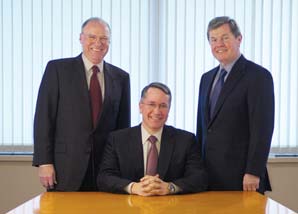
In the photograph accompanying the 2005 shareholder letter, Silver and Horrigan stand beside a seated Tony Allott. It is a conventional corporate picture, but the arrangement becomes interesting when placed beside the next change in management. On March 1, 2006, Allott became chief executive. Both founders continued as co-chairmen in a non-executive capacity.
Horrigan had served as co-chief executive from March 1994 to March 2006. Before becoming executive co-chairman in August 2004, he had been president. These titles trace a shift from running the business to overseeing it. The distinction matters: a founder can remain involved without retaining the same daily authority. Silgan's transition gave the succeeding chief executive a defined role while keeping the founders at the board table.
The broader company continued developing. By 2012, its acquisition count had reached twenty-nine. Its businesses included metal containers in North America and Europe, vacuum closures and plastic containers. The venture that began in 1987 had grown beyond its original footprint. Horrigan remained connected to an organization increasingly shaped by the work of subsequent managers as well as its founders.
“his guidance, wisdom, integrity and friendship”
Tony Allott on Greg Horrigan, April 2023
A departure measured in stages
The next handover came in April 2019. Allott became chairman while continuing as chief executive, and Adam Greenlee became president while retaining his chief operating officer responsibilities. Silver and Horrigan stepped down as non-executive co-chairmen and continued as directors. By then, Silgan operated one hundred manufacturing facilities across North and South America, Europe and Asia.
Silver retired from the board in November 2022. In April 2023, Horrigan told the company he would not seek reelection, and his board service ended on May 30. He had been a director since the company's inception. Thirty-six years is long enough for the organization around a founder to change repeatedly, even while its central products remain familiar.
Allott's farewell to Horrigan emphasized customer attention, alignment with shareholders and the influence of his leadership on company culture. Greenlee also thanked both founders that spring on behalf of nearly sixteen thousand employees. The scale of that acknowledgment places the early purchases in perspective: factories and supply contracts had become a working organization employing people around the world.
- 2006Co-CEO tenure ends; non-executive co-chairmanship begins.
- 2019Co-chairmanship ends; board service continues.
- 2023Retires from the board after 36 years.
Still connected to what he built
Board retirement did not erase Horrigan's financial connection to Silgan. A filing signed in May 2025 reported beneficial ownership of 7,043,303 shares as of March 31, 2025, representing approximately 6.6 percent of the relevant outstanding shares. That total included holdings through trusts, a family partnership and a foundation, alongside directly owned shares. It describes a disclosed ownership position at a particular date.
There are several ways to measure a founder's career here: years in office, acquisitions completed, factories operating or ownership retained. Another sits closer to Horrigan's particular contribution. A food manufacturer sells a product under its own name while relying on somebody else to make the package work. The supplier earns its place by understanding that dependence and continuing to meet it.
Horrigan helped build a company in that space, then moved through successive stages of responsibility as other executives took charge. His story stays close to tangible things: cans, containers, closures, factories and customers. The next time a cupboard opens, the brand names will still take the credit. Somewhere behind them is the less conspicuous business he spent decades helping to build.