Consider the rotary joint. One side stays still. The other turns. Steam must pass between them without escaping. It is an unshowy assignment, until the seal wears and a production line has a problem. Kadant supplies these joints, along with an assortment of industrial equipment whose importance becomes easier to appreciate when something stops working.
That is a useful starting point for understanding a company with roughly a billion dollars in annual sales. Kadant lives inside the processes behind ordinary things: the box arriving at your door, the tissue in your bathroom, the wood panel in a building. Its customers buy help with the awkward business of making materials behave.
- Keep it running. Equipment, engineering and replacement parts for process industries.
- Keep the relationship. Parts and consumables supplied 71% of 2025 revenue.
- Keep decisions close. Acquired businesses operate through a decentralized model.
A seal with an expensive job
A rotary joint illustrates the proposition. Kadant’s ELSX model handles steam and thermal oil in demanding operating conditions. The company says its convex seal design offers up to 15% more seal-ring wear life in steam applications than an equivalent earlier ELS joint. The qualification matters: a specific improvement, against a specific predecessor, under specific conditions.
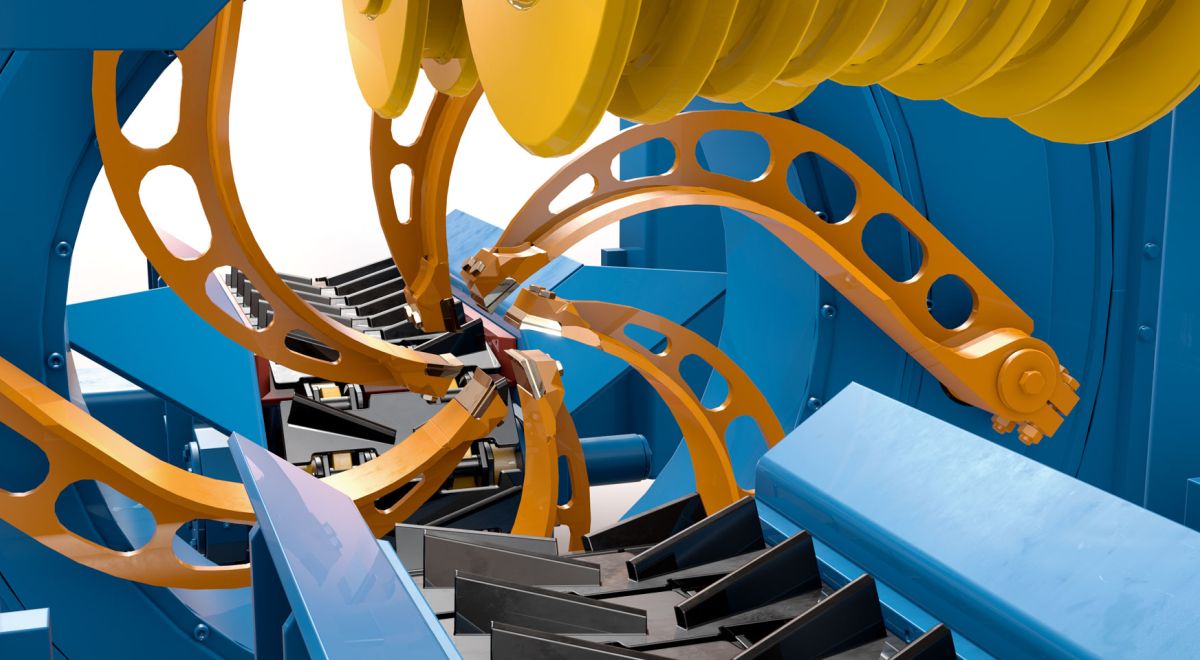
Elsewhere in the factory, doctor blades scrape rolls clean. Filtration systems recover water and fiber. Stock-preparation machinery turns virgin or recovered fiber into usable papermaking material. Debarkers and chippers process wood. Conveyors, feeders and balers move or compress material. Kadant organizes this collection into Flow Control, Industrial Processing and Material Handling.
Its customers include manufacturers in paper, packaging, tissue, wood products, mining, metals, food and recycling. Each has a different process; each must weigh purchase price against output, maintenance and operating expense. This is where a specialist earns its place. Knowing how a component behaves inside a particular machine is part of what the customer purchases.
The sale after the sale
In 2025, parts and consumables accounted for 71% of Kadant’s revenue. The initial equipment sale therefore tells only part of the story. A machine enters service, components wear, operators need replacements, and the supplier has another reason to hear from the customer. These are repeat purchases rather than subscription contracts.
The machine sale begins a relationship that can outlast the purchasing cycle.
The distinction becomes useful when customers postpone large projects. Kadant’s 2025 stockholder letter described delayed capital investment amid trade uncertainty and fluctuating tariffs, alongside record aftermarket revenue. Annual revenue was about $1.05 billion. Free cash flow reached $154.3 million, a company record measured using its non-GAAP definition.
The cushion has limits. An installed machine creates maintenance demand while it operates; an idle machine creates less. A purchaser can also compare alternatives. ANDRITZ supplies competing fiber-preparation systems, while Deublin offers steam rotary unions. Kadant’s case depends on application expertise, product performance and support. The existence of an installed base alone does not settle the next purchasing decision.
Buy the knowledge. Keep it local.
The corporate name is younger than much of the expertise. Established in 1991 as Thermo Fibertek, the company took the Kadant name in 2001. Black Clawson, a fiber-processing business in its portfolio, traces its history to 1873. Acquisitions allow Kadant to add accumulated engineering knowledge alongside products and customer relationships.
The published buying criteria are unusually revealing. Kadant expresses strong interest in businesses with more than 40% of revenue from parts and consumables. Another category names “critical components with a high cost of failure.” Read together, those preferences describe equipment that matters to the customer and needs attention after installation.
“critical components with a high cost of failure”
From Kadant’s acquisition criteria
The purchases require real capital. The 2025 acquisitions of Babbini and GPS Engineering cost approximately $16.5 million combined, net of acquired cash; Clyde Industries cost $173.7 million on the same basis. Those businesses added dewatering, power-transmission and boiler-cleaning capabilities. Borrowing under the revolving credit facility primarily financed the deals.
In April 2026, Kadant completed its purchase of the business renamed Kadant Profil, an Austrian maker of specialized rolled profiles and industrial knives. Powell described it as a supplier Kadant had trusted for more than 30 years. That is a different starting point for due diligence from meeting a prospective acquisition for the first time.
Kadant’s operating promise is local autonomy with access to group resources. Its culture statement emphasizes responsiveness, collaboration and employee development. The structure also develops managers: Michael Colwell led Carmanah before its 2013 acquisition. He is scheduled to succeed Jeffrey Powell as CEO in January 2027. Acquiring businesses can enlarge the leadership bench, too.
The detour into decking
The portfolio has included an unsuccessful experiment. Kadant Composites made decking and roofing products using recycled materials. In October 2005, it sold substantially all its business assets for approximately $11.1 million in cash plus assumed liabilities. The subsidiary retained warranty obligations for products manufactured before the sale.
By September 2007, that subsidiary said it lacked funds to honor warranty claims and ceased doing business. This history puts a useful brake on a tidy growth narrative. Selling a business can leave obligations behind. A product’s service life matters to the maker as well as to the buyer.
Start with the loss you can measure
For a plant manager, the practical first step is diagnosis. Kadant’s steam-system audit approach examines drying rates, temperatures, humidity and drainage flows. Those measurements help establish whether the constraint lies in heat transfer, condensate removal or another part of the system. Equipment selection follows the operating problem.
A recent example is Södra’s Mörrum pulp mill. Kadant Black Clawson and Kadant Noss evaluated its requirements before supplying a green-liquor clarifier and dregs filter. The clarifier is designed for 100 liters per second. The project joins engineering, chemical recovery and maintenance support in one specific operating environment.
The lesson a reader can copy is straightforward: count the losses before choosing the fix. Compare installed cost, stoppage time, resource use and replacement needs. A more durable seal has value when its operating conditions fit the application. If they do not, the promised improvement is beside the point. Kadant’s business begins with that kind of detail.
Follow the machinery
Explore the equipment, the engineering and the people behind it.