A door can be surprisingly bad at being a door. It swings. It closes. It offers the reassuring little click of a latch. And then, through the gap underneath, the outside air comes in anyway. For an engineer, this is an invitation. For most people, it is a reason to fetch a towel.
Tony Salgado put his name on a more deliberate answer. In April 2012, a United States patent was granted for his door draft excluder. The device combined an angled bracket, a clip, a flexible covering, and a weight. It addressed a modest domestic nuisance with a specific mechanical arrangement. A door should be able to open without requiring someone to rearrange its defenses afterward.
The invention is an unexpected entry in the career of a Cleveland-based executive whose professional world includes industrial trucks, factories, and international distribution. It is also a useful place to begin. Before considering the territories and titles, consider the gap under the door: a small physical problem, a moving part, and an answer that has to work on the floor.
Salgado is now Chief Operating Officer of Hyster-Yale, Inc., appointed effective August 1, 2026. Immediately before that, he was President and Chief Executive Officer of Hyster-Yale Materials Handling, its principal operating subsidiary. The distinction matters. The latest appointment sits at the parent company, following a career spent inside the business of moving materials.
An engineer, before the corner office
His preparation began in aerospace engineering at the United States Naval Academy. His public profile lists the years 1988 to 1992. An aerospace degree might suggest an eventual career pointed toward the sky. Salgado’s subsequent work took him aboard a ship, into manufacturing, and eventually into the particularly earthbound world of lift trucks.
He served as a lieutenant in the United States Navy, including a tour as a Surface Warfare Officer aboard USS Fort McHenry. He also served as Executive Officer of the Navy Ceremonial Guard in Washington, DC. Those assignments placed him in two different organizational settings: shipboard service and a unit with a highly visible ceremonial responsibility.
There is an easy temptation to turn military service into a ready-made explanation for everything a business executive later does. Salgado’s record is more interesting when allowed to remain particular. A ship, a ceremonial unit, and an engineering education are separate experiences. Together they describe the actual starting points of his career, without requiring an invented speech about what he learned on deck.
His civilian work included Six Sigma and quality leadership positions at GE Appliances and GE Capital. Quality is a revealing area to encounter early in an industrial career. It asks whether a process produces the intended result repeatedly. A design can be elegant on paper; repetition is where manufacturing gets its vote. In Salgado’s case, those roles preceded a much longer commitment to materials handling.
Fifteen years close to the machinery
Before joining Hyster-Yale, Salgado spent 15 years at Nissan Forklift and UniCarriers. His responsibilities there included quality, manufacturing, and aftermarket operations. He became Vice President of manufacturing operations, then held the positions of Vice President and Corporate Officer of UniCarriers Corporation and President of its Americas Division.
The sequence puts several parts of an equipment business in view. Manufacturing concerns the machine leaving the factory. Aftermarket operations concern what happens once it is already earning its keep. Regional leadership adds another set of questions about customers and distribution. His career crossed those areas rather than staying inside a single function.
During that period, he also served on the Industrial Truck Association’s board and executive committee. By 2016, when he joined Hyster-Yale Group, he brought experience both within a manufacturer and in the industry’s trade organization. His first Hyster-Yale assignment covered Japan, Asia-Pacific, India, and China. The title was Senior Vice President; the geography was considerably longer.
A career that kept adding geography
At Hyster-Yale’s 2018 investor day, Salgado appeared as Senior Vice President for that regional grouping, known as JAPIC. The following year brought a broader operating brief. In July 2019, he became Chief Operating Officer of Hyster-Yale Group, responsible for the performance of its global lift-truck operations and interests across the Americas, EMEA, and the Asian regions.
His name appears again in the 2023 investor-day leadership lineup as COO of Hyster-Yale Group, alongside executives responsible for the parent company, attachments, fuel cells, technology solutions, and finance. It is a useful snapshot of the business around him. A forklift manufacturer contains more than the forklift. Product development, distribution, power systems, and financial decisions all arrive at the same table.
There was a less formal gathering in Pune in December 2023. The India team celebrated its location’s eighteenth anniversary with an event called ELEVATE. Salgado participated alongside Rajiv Prasad, Stephen Karas, and Rajesh Wazarkar. Employees performed dances, songs, and music; colleagues with at least 15 years of service were honored. The occasion gave the operating chart a human scale: people marking the years they had spent building something together.
In January 2025, he became President and Chief Executive Officer of Hyster-Yale Materials Handling. That position put the global lift-truck business and its growth strategy within his remit. The August 2026 parent-company COO appointment followed. The dates describe a gradual widening of responsibility, with regional leadership preceding a global operating role and then subsidiary leadership.
- 2016Regional leadership
Japan, Asia-Pacific, India & China - 2019COO
Hyster-Yale Group - 2025President & CEO
Materials Handling subsidiary - 2026COO
Hyster-Yale, Inc.
The sale is only part of the journey
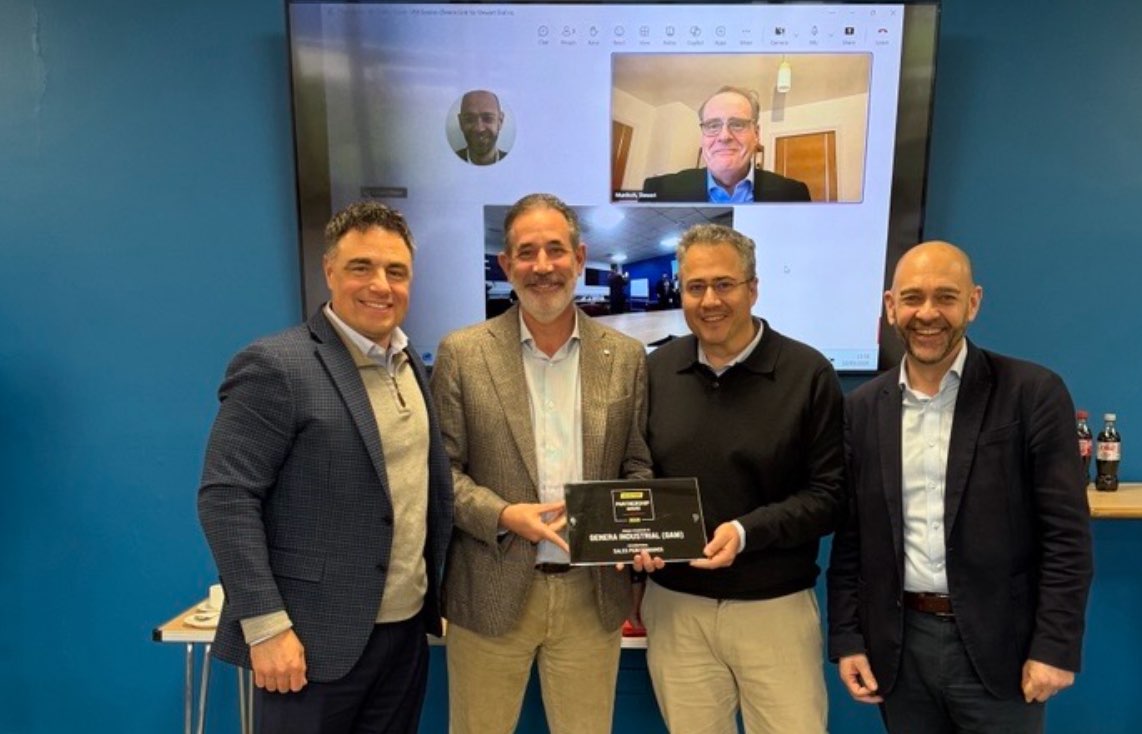
A March 2026 dealer-award photograph finds Salgado at the left of a group with GAM executives Diego García Pastor and Raúl Rodelas Castillo, and Hyster-Yale’s Vince Cook. GAM had received recognition for its 2025 Hyster sales performance at the EMEA All Dealers Meeting. The photograph records a commercial relationship that extends across Spain, Portugal, and Morocco.
It is a fitting scene for someone whose earlier responsibilities included aftermarket operations. Equipment travels through a network of people who sell it, deliver it, maintain it, and help customers use it. An award presentation can look like a pause from the operating business. In this case, the people in the picture are part of how that business reaches its customers.
The company’s 2024 figures illustrate the changing structure of that network. Dual-brand dealers represented 59 percent of its Americas dealer base, compared with 38 percent in 2019. Those percentages describe dealers representing both Hyster and Yale. They measure the company’s distribution mix, rather than an individual executive’s performance, but they help explain the commercial system in which Salgado has worked.
That system has to accommodate local service and international customers at once. A truck is sold for a particular job, in a particular place. A global manufacturer must make decisions across many such places. The challenge is easy to describe and harder to draw neatly on an organizational chart: how to preserve attention to the individual application while running an operation that spans regions.
Americas dealers representing both Hyster and Yale
An American factory question
In December 2024, Salgado spoke about Hyster-Yale’s plans to meet Build America, Buy America requirements for selected forklift and container-handling equipment. The announcement concerned manufacturing choices, domestic suppliers, and electric options for high-capacity equipment intended for infrastructure applications. It was a practical intersection of product planning and the conditions under which customers could buy.
“Our leadership is fully invested in meeting the needs of businesses that require BABA-compliant material handling solutions,” he said. The company described plans to assess production location and expand sourcing arrangements. These were announced plans, with work still to do. A statement about future production belongs in that tense.
The distinction is especially relevant in industrial equipment. An announcement can name an objective in a few lines. Delivering equipment requires decisions about components, production, and customer requirements to agree with one another. The subject suits a career that has passed through quality, manufacturing, regional management, and global operations. Each function has its own portion of the answer.
“Our leadership is fully invested in meeting the needs of businesses that require BABA-compliant material handling solutions.”Tony Salgado · December 2024
Back to the threshold
The door draft blocker remains the unexpected companion to all of this. Salgado’s public professional profile includes it among his patents and links to the Ez Glide Draft Blocker business. The connection is unusually concrete. Here is an executive associated with industrial machinery who also pursued a device small enough to sit at the bottom of an ordinary door.
The patent drawing reduces the problem to parts. There is a bracket. There is a covering. There is weight where weight is needed. The ambition of the arrangement is limited and understandable: reduce a draft while allowing the door to remain useful. Nobody needs a strategy retreat to appreciate the appeal of a door that opens properly.
This is an editorial lens on Salgado’s career, rather than a claim about his private motivations. The parallel lies in the work itself. At one scale, materials handling involves moving goods through commercial operations. At another, an invention deals with the passage of air and the movement of a door. Both bring an abstract intention into contact with a physical object.
His story runs through naval service, quality roles, a long stretch in forklifts, regional responsibility, and a parent-company operating appointment. Yet the small invention gives the sequence an agreeable twist. Alongside the meetings and manufacturing footprint sits a problem anyone can recognize from home. The executive résumé gets him into the room. The draft blocker makes you look down at the threshold.