Joe Bartolacci had a small piece of advice for the interns: leave some space in your calendar. Problems would find them. There was no need to make an appointment.
It was the summer of 2025, and a group of Matthews International interns had joined their chief executive for lunch. Corporate Communications intern Rianna Morris later described a conversation about family, taking risks early, staying curious and making a useful contribution. Among those respectable subjects sat the wonderfully practical matter of an unfinished diary. A blank square, in this account of executive life, had a job to do.
By then Bartolacci had been running Matthews since 2006. His company made products for remembrance and equipment for industrial production, a combination unlikely to fit comfortably on a business card. His advice had the ring of experience: when the business includes both caskets and machinery for battery manufacturing, the unexpected has several entrances.
His own career had required room for changes of direction. Accounting led to law. Law led to an industrial company. A legal post led to operating businesses in Europe. Nearly three decades after he joined Matthews, another change arrived: in August 2026, the company announced his retirement and named Michael J. Whitehead as his successor.
The accountant who went back to school
Bartolacci graduated from Saint Vincent College in 1982 with an accounting degree. He worked in public accounting at Touche Ross, gained his CPA qualification and then returned to study law at the University of Pittsburgh. He received his Juris Doctor in 1987. There is a certain economy to learning both how a transaction is counted and how it is written.
In a 2014 interview, he described the early sequence himself: a couple of years in public accounting, about five years with a law firm, then about five years as general counsel of a Pittsburgh-area retail pharmacy business. He joined Matthews as general counsel in 1997. The route to manufacturing leadership began with professions usually called in to examine somebody else’s decisions.
That background gives his later career an interesting shape. He had learned to read the numbers and the agreements before taking responsibility for the operations behind them. It would be tempting to turn that into a tidy formula for success. His subsequent years offer a more demanding lesson: understanding a business on paper is only the beginning of running one.
His connection to Saint Vincent continued beyond his undergraduate years. The college named him an Alumnus of Distinction in 2007 and lists him on its board of directors. For a career with a substantial European chapter, the institutions of western Pennsylvania remain conspicuous landmarks.
Saint Vincent College
University of Pittsburgh
Six years on the other side of the Atlantic
Matthews’ own account of Bartolacci’s career records six years working in Italy, helping guide its European expansion. He became president of Caggiati, the company’s Italian subsidiary, and later president of Matthews Europe. Those are operating assignments, with customers and production to answer for, rather than a legal brief carried overseas.
The dates trace his return toward the corporate centre. He became president of Matthews Europe in April 2002, executive vice president of Matthews in January 2004 and president of its casket division that February. He returned to the United States in 2004. In September 2005, he became president and chief operating officer; that November, he joined the board.
The progression matters because it complicates the shorthand description of a lawyer becoming CEO. Before the chief executive appointment in 2006, he had already moved across subsidiaries, regions and a substantial product division. His education inside Matthews came through different businesses under the same corporate name.
The company’s later tribute described him as available to teams around the world, day or night. That is an employer’s assessment, but the international assignments behind it are concrete. An executive who spends six years abroad has had a rather thorough introduction to the inconvenience of a single headquarters time zone.
- 1997Joins Matthews
General counsel - 2002European operations
President, Matthews Europe - 2004Returns to the U.S.
Leads the casket division - 2005President & COO
Joins the board - 2006Chief executive
The next operating assignment
A company that kept finding another use for a mark
Matthews began in Pittsburgh in 1850, when John Dixon Matthews opened an engraving and stamping business. By the time Bartolacci arrived, it had accumulated a history much longer than his own. He would spend his tenure extending an existing enterprise, a different assignment from inventing one and giving it your surname.
The business now places memorial products beside industrial technologies. Bronze and granite memorials, caskets and cremation equipment occupy one side. Product identification, precision machinery and production processes occupy the other. The connection is easier to follow through the work itself: making things, putting marks on them and improving how that work gets done.
One of Bartolacci’s examples was especially unglamorous and therefore useful. Industrial inkjet printers need maintenance. A new entrant can struggle to afford a service network before it has customers, while customers hesitate without dependable service. Matthews worked on a disposable printhead as a way around that difficulty. The commercial idea began with a repair problem.
In February 2026, Matthews reported that commercialization of its MPERIA Axian inkjet systems was progressing. That update belongs beside the earlier ambition. Product development takes time; the distance between an appealing engineering answer and a repeatable commercial business is where much of an industrial chief executive’s work lives.
The title arrived after the assignments.
A CAREER BUILT ACROSS THE BUSINESS
The size of a business, and the argument over its value
Acquisitions were a recurring instrument. In March 2014, Matthews announced an agreement to buy Schawk in a transaction with an enterprise value of approximately $577 million. Schawk brought brand development and packaging capabilities, with 2013 sales of $443 million and roughly 3,600 employees across more than 20 countries. This was a consequential expansion of what Matthews could offer.
Expansion also made the company harder to judge. A portfolio can look coherent to the people operating it while presenting investors with several different markets, investment cycles and expectations at once. Bartolacci’s career became a public argument over the benefits and costs of keeping those businesses together.
In December 2024, activist investor Barington Capital called for his replacement, criticizing capital allocation, execution and share-price performance. Matthews defended its strategy and pointed to growth from about $700 million in fiscal 2006 revenue to roughly $1.8 billion at the time of its response. Those positions measured different things. Revenue describes the amount of business being done; shareholders also have to consider the return on the money committed to it.
The disagreement reached a proxy contest. At the February 2025 annual meeting, shareholders elected the full slate nominated by Matthews’ board. The vote settled those board seats, while the questions about portfolio structure and financial performance remained part of the company’s work.
In May 2025, Matthews contributed SGK to Propelis, receiving $250 million in cash proceeds before the adjustment for divested cash, a $50 million preferred equity investment and 40 percent of the common equity. An operation acquired to broaden the company had become part of a different ownership arrangement. Building the portfolio had been one task; deciding what to retain, combine or release was another.
Different measures, different transactions. These figures show the change in ownership structure, not an investment-return calculation.
The people around the deal
There is another way to read Bartolacci’s working life: through the people expected to carry on after a decision has been made. His role on the Federated Hermes board began in October 2016. Its governance disclosures record his work on audit and compliance committees. The accountant and lawyer had acquired a second vantage point, evaluating a different public business from the boardroom.
Closer to home, the intern lunch supplied a less formal expression of his priorities. Morris described him as approachable and family oriented, and reported that he connected his motivation to his family. Her account included advice about choosing a supportive life partner and adding value through work. These were observations from a particular conversation, rather than a personality assembled from a title.
Bartolacci replied publicly to her post. He thanked her, emphasized the people involved in anyone’s success and offered his own compact description of leadership: “Becoming a successful leader, for me, is about creating leaders around yourself.”
That statement is modest enough to be tested. It asks what happens to the people nearby: whether they gain judgement, take responsibility and become able to act without waiting for the person at the top. For an executive whose job involved multiple businesses and countries, that is a practical concern as much as a generous sentiment.
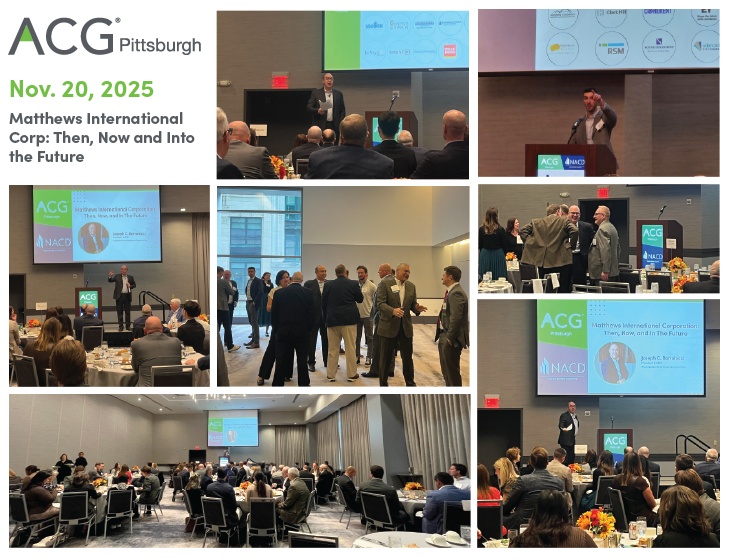
In November 2025, he appeared before ACG Pittsburgh and the NACD Three Rivers Chapter to discuss Matthews’ past and future. The photographs show the familiar equipment of business explanation: a microphone, projected slides, tables and an audience. After years of transactions and engineering investment, he still had to stand in a room and explain how the pieces belonged together.
Making room for the next name on the door
On August 4, 2026, Matthews announced Bartolacci’s decision to retire. He had joined in 1997 and spent nearly 20 years as CEO. The company credited his tenure with more than 60 acquisitions and an expanded international footprint. Chairman Michael Nauman praised his passion and integrity; Bartolacci placed the emphasis on the team.
“It has been a privilege to serve Matthews for nearly three decades,” he said. The retirement announcement also provided for his support of the leadership transition at least through January 1, 2027. A departure from the chief executive’s office could still involve work to make the handoff function.
Whitehead’s appointment was announced on August 11 and took effect on August 31, 2026. He came from Lincoln Electric with a background spanning engineering, law and industrial leadership. In October, Matthews confirmed the succession while outlining further changes to the size of its board. The company Bartolacci had helped reshape was continuing to change hands and shape.
His public ambitions had often been expressed in terms of leaving an old Pittsburgh enterprise with opportunities for another generation. That intention now has a literal successor. The judgement on individual investments will continue through operating results, customer orders and the returns earned on capital. A long tenure does not close those accounts.
But the advice to the interns remains appealingly usable. Learn another discipline. Take an assignment somewhere unfamiliar. Help other people acquire the ability to lead. And leave room in the diary. After all that preparation, the next problem will still insist on arriving without an invitation.