The boiler pump had a bearing problem. At a wood-products manufacturer, AssetWatch’s system picked up elevated vibration. An engineer asked the plant to grease the bearings and check their models. Further analysis isolated defects in both outer raceways. The bearings were replaced during scheduled maintenance. Vibration settled down. The customer estimated $74,000 in avoided downtime and maintenance costs.
- Wireless sensors watch industrial equipment; engineers interpret the findings.
- One subscription bundles hardware, software, installation and analysis.
- The customer still has to make the repair. That is where value becomes real.
No spectacular rescue followed. Nobody needed one. That is the appeal of predictive maintenance: a machine gets attention while the problem still fits into the calendar. AssetWatch sells manufacturers a way to make that ordinary outcome happen more often.
The bearing that got an appointment
Consider the distance between a warning and a decision. A vibration trace can show that something has changed without telling a busy maintenance manager which bearing to order or how urgently to act. In the wood-products case, the useful work included a conversation, additional equipment information and a recommendation specific enough to schedule.
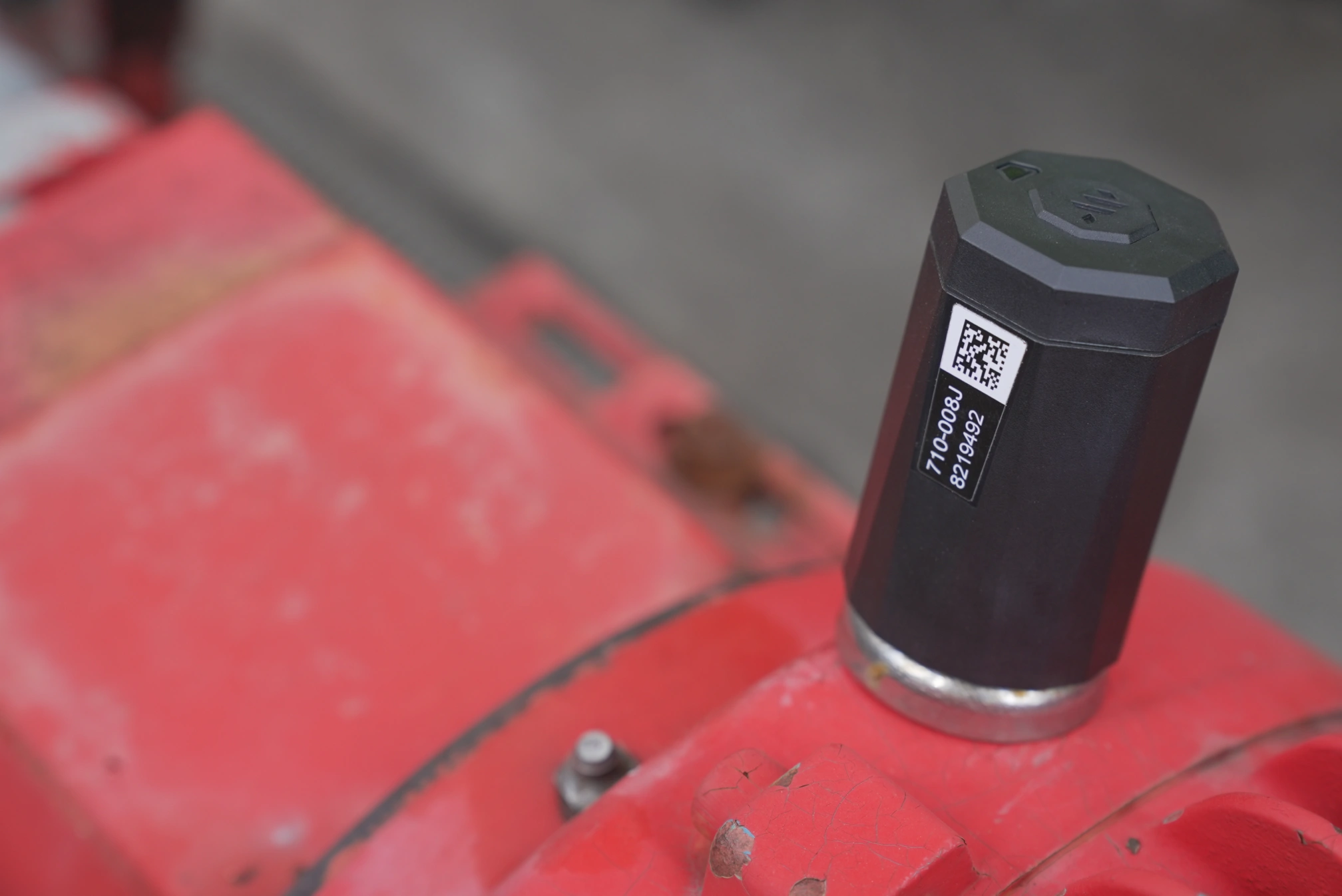
AssetWatch occupies that distance. Its wireless sensing hardware feeds cloud software, where AI helps identify developing faults. A dedicated Condition Monitoring Engineer reviews findings and recommends corrective action. The service is aimed at plant managers, maintenance teams and reliability engineers responsible for motors, pumps, gearboxes, fans and compressors.
First, it wanted to power your phone
The company’s first ambition lived somewhere much smaller than a factory. Nikola Labs, founded in 2014, worked on wireless power using Ohio State technology. A 2015 university account describes a phone case designed to harvest radio-frequency energy. Will Zell and engineers including Robert Lee and Chi-Chih Chen were involved in the early business.
In 2017, the team encountered condition monitoring for manufacturing equipment. Low-power electronics had another job available: watching machines. Its first condition-monitoring product launched in 2019. In January 2023, Nikola Labs took the name of its monitoring platform, AssetWatch.
The company’s account of that pivot describes an attractive industrial application pulling the team away from wireless power. It does not establish that the original technology failed. The change was a narrowing of purpose: use the electronics expertise to solve a particular maintenance problem, then build software and expert support around it.
The subscription buys the handoff
Vero provides continuous vibration and temperature monitoring. Collect offers a different arrangement for less critical equipment: workers carry a wireless sensor kit along guided routes, following placement photographs in a mobile app. Oil analysis adds evidence about lubricant condition and internal wear. These are different ways of listening, chosen according to the machine and its importance.
The last step belongs to the plant.
The commercial package includes hardware, installation, ongoing system maintenance, software and expert analysis. One published customer account describes pricing by sensor count. The advertised 30-day trial costs $199, with installation of up to 200 sensors. That introductory price is separate from the quoted ongoing subscription.
This puts AssetWatch in the market for managed machine health. Augury also combines sensors, AI and expert validation. AssetWatch’s pitch rests on how its complete service fits a plant’s workload and budget. Buying sensors alone, retaining a monitoring contractor or building an internal analysis team are other ways to address the problem.
The handoff can extend into maintenance software. Its MaintainX integration can create work orders carrying expert recommendations. It requires MaintainX Enterprise, an AssetWatch subscription and configuration. A finding has somewhere concrete to go.
Seventeen plants, one shared habit
At Boise Cascade, the obstacle was partly organizational. Plants had different maintenance practices and experience levels. Early pilots gave teams evidence to compare. Expansion required training and clearer responsibilities. Across a 13-month rollout ending in December 2024, the program reached 17 manufacturing sites.
The published case study reports 130 documented saves and $4 million in estimated cost avoidance, with a stated fivefold return. Those figures describe a particular customer’s experience. Avoided production losses involve assumptions about what would have happened without intervention; they are not equivalent to money deposited in an account.
Boise Cascade’s reported reach after a 13-month rollout. Training travelled with the sensors.
The lesson is transferable: let operating results make the case for expansion. A useful finding gives colleagues something to inspect, discuss and repeat. Shared evidence can travel between plants more persuasively than a corporate instruction to become predictive.
A motor has more than one way to complain
On October 13, 2026, AssetWatch added electrical monitoring. It measures current across three AC motor phases from a wireless sensor in the electrical panel. Overload and current imbalance can emerge without an obvious early vibration signature. Adding another measurement addresses a specific gap in what the system can see.
An August 2026 partnership with Oden Technologies brings production context into the picture. Asset condition and production performance answer related questions: what is happening inside the machine, and how is the line behaving?
“AssetWatch protects the machine, Oden optimizes each run.”Carlos Barberena, VP of Partnerships · August 2026
Expansion has capital behind it. AssetWatch announced a $75 million Series C led by Viking Global Investors in April 2025. Its MKI partnership, announced in 2024, opened a channel for serving manufacturers in Japan.
Copy the sequence, earn the result
For a prospective buyer, the sensible experiment is specific. Pick equipment whose failure matters. Agree who receives findings, who schedules repairs and how avoided costs will be estimated. Compare the readings after the intervention. Expand when the plant has a result it can explain.
There are limits to the bargain. Periodic routes leave gaps between readings. Different fault types call for different measurements. An early warning cannot fix a bearing when nobody has time, parts or authority to act. AssetWatch can help a factory hear trouble coming. The factory needs to make room for the appointment.